
Northeastern Thailand
More actions
| Northeastern Thailand | |
|---|---|
| Isaan, Isarn, Issarn, Issan, Esan, or Esarn | |
| ActiveCannabis last recorded here in 2025 | |

| |
| Looking towards the Phu Phan mountains over the rice fields, Sakon Nakhon Province, Thailand, December 2025 | |
| Location | |
| Coordinates | 16.000000, 103.000000 |
| Gene Pool | Lao-Isan Gene Pool |
| Regional Complex | Mekong Basin |
| Country | Thailand |
| Provinces/States | Nakhon Phanom,Sakon Nakhon,Nong Khai,Mukdahan,Loei,Udon Thani,Nakhon Ratchasima,Buriram,Surin,Yasothon,Roi Et,Khon Kaen,Kalasin,Maha Sarakham,Chaiyaphum,Amnat Charoen,Ubon Ratchathani,Si Sa Ket,Nong Bua Lamphu,Bueng Kan |
| Elevation | 62–1,794 m |
| Area | 167,718 km² |
| Climate | Tropical savanna (Köppen: Aw), semi-arid zones |
| Primary Rivers | Mekong,Mun,Chi |
| Primary Mountains | Phu Phan Mountains,Phetchabun Mountains,Dong Phaya Yen Mountains,Sankamphaeng Range |
| Growing history | |
| Dated accessions | 1958–2025 |
| Conservation | |
| Populations | none documented yet |
Northeastern Thailand, commonly called Isan, is a growing region on the Khorat Plateau in the north-east of Thailand, bounded on the north and east by the Mekong and the border with Laos.[1]: 8 From the late 1960s into the 1980s it held Thailand's main cannabis fields. Its seedless flower became known abroad as the Thai stick,[2][3][4]: para. 12 and police and intelligence reports placed most of the growing in Nakhon Phanom, Sakon Nakhon and Nong Khai.[5] Large-scale eradication began in 1984, but illicit growing continued in the valleys of the Phu Phan range into 2020.[6]: 20[7][8]
After Thailand allowed the medical use of cannabis in 2019, two of the five cannabis cultivars registered with its Department of Agriculture by January 2022, Hang Kra Rog Phu Phan ST1 and Hang Suea Sakon Nakhon TT1, were selected from seed matched with folk doctors' descriptions of the region's named types.[9]: 2, 12[10]
Geography
Cannabis growing in the region is documented mainly around the Phu Phan range and in the provinces between it and the Mekong. The range runs north-west to south-east through the middle of the Khorat Plateau and divides it into two basins, the Sakon Nakhon basin to the north and the Khorat basin to the south.[11]: 2, 4[12]: 6 The Mekong bounds the plateau on the north and east and forms the border with Laos.[1]: 8 Mid-20th-century herbarium collections come from Phu Kradueng and Phu Luang in Loei, and from Wang Nam Khiao in Nakhon Ratchasima.[13][14][15]
The region as a whole covers about 170,000 square kilometres, nearly a third of Thailand's land area.[16]: 2[12]: 6 Most of the plateau lies between 130 and 200 metres above sea level.[12]: 6 The plateau is set off from central Thailand by the Phetchabun range and the smaller Dong Phaya Yen and San Kamphaeng ranges,[16]: 1 and the mountains of the north-east, sandstone, shale and granite that weather to infertile soils, cover about 15 per cent of the region.[17]: 95–96 The Mun and Chi rivers drain most of the plateau into the Mekong near Ubon.[1]: 8 Sandy soils of low fertility and low water-holding capacity predominate, and farming is mainly rain-fed.[18]: 191
Climate
The climate is tropical savanna in the Köppen classification, with a rainy season from May to September and a long dry season for the rest of the year.[17]: 96 The ranges dividing the north-east from the rest of Thailand block much of the south-west monsoon, so that the areas in their rain shadow are the driest of all.[16]: 2 Mean annual rainfall falls from more than 2,000 mm in the north-eastern corner of the region to less than 1,000 mm in the south-west, and almost no rain falls in December and January.[18]: 194 Of the region's mountain ranges the Phu Phan is the wettest, with a mean of 1,724 mm a year, varying between 1,301 mm in 2003 and 2,142 mm in 2008.[17]: 96
Accounts of the cannabis season during the export trade differ. A broker from the north-east quoted by Peter Maguire and Mike Ritter said that growers "plant at nearly the end of the rainy season".[19]: 63 The Royal Canadian Mounted Police estimate for 1982 put planting "at the onset of the rainy season in May" and harvesting from December, with "harvesting and drying stages" continuing into March.[20]: 62 The State Department in 1990 wrote that the main north-eastern crop was "planted in the late fall and harvested in December, January, and February", with a second crop harvested in April and May.[21]
Demography
The Sakon Nakhon basin has an unusual ethnic diversity for the north-east. Besides the Lao majority it is home to the Kalaeng, Nyaw, Phu Thai and Yoy, Tai-speaking peoples believed to have settled there in the early 19th century after the Siamese army moved them by force from their homes in Laos, and to a Vietnamese community.[22]: 3
Across the region, Charles Keyes estimated in 1967 that at least 95 per cent of the Tai-speaking population shared linguistic and cultural traits that set them apart from the Central Thai and relate them more closely to the Lao across the Mekong; the bilingual Thai-Khmer of the southern provinces were the only large non-Tai minority.[16]: 2 Isan is the name used for the region and its people throughout Thailand. North-easterners sometimes called themselves khon phuen mueang ("natives") or Lao, and by the 1960s a growing number had taken up khon isan, "Isan people".[16]: 3 In 1960 the north-east held nearly 9 million of Thailand's 26.3 million people.[16]: 2 In 2008 it was still the poorest region of Thailand, with more people working outside agriculture and remittances from emigrants working elsewhere.[23]: 289
Culture
Cannabis has the Thai name kancha (กัญชา).[24]: 64 The Forest Herbarium's collectors wrote the local name kan cha on a sheet from Loei in 1958 and po kan cha on one from Phu Kradueng in 1948.[25][13] The physician Joel Fort wrote in the Bulletin on Narcotics in 1965 that cannabis was "widely used in the country, particularly in the north-east by smoking in pipes or cigarettes or adding it to food".[26] In Thailand ground cannabis flowers were added to the curry kaeng phet.[24]: 73 Among 45 long-term cannabis users in Kalasin followed for a year in a study published in 2019, all of them men and just over a third of them farmers, the bamboo pipe was the main way of using it.[27]
Hang kra rog (หางกระรอก), "squirrel's tail", refers to inflorescences that resemble the tail of a squirrel,[28] and the name is joined to the Phu Phan range in Hang Kra Rog Phu Phan. Hang suea (หางเสือ) is the name of a second Thai type.[9]: 12 When the Department of Medical Sciences and Rajamangala University of Technology Isan applied in 2021 to register a line of Hang Kra Rog Phu Phan, they matched its seed with the descriptions given by village sages and folk doctors in Sakon Nakhon.[9]: 2 Researchers at the Sakon Nakhon campus of Kasetsart University write that hang krarok is commonly grown in the province and that its leaves have been used in folk medicine for epilepsy, paralysis, stomach ache, nausea and lack of appetite and as a sleeping aid.[29]: 4
Cultivation history
Before the export trade
By 1991 most of the prehistoric textile finds of Thailand had come from sites in the north-east, among them Ban Chiang and other sites in Udon Thani and Ban Don Tan in Nakhon Phanom, though most of the fabrics survived on illegally excavated objects without a dated context. The fibres identified from prehistoric Thai sites are mostly hemp and cotton; the fragments from Ban Chiang were identified as cotton.[30]: 16–17
The Cannabis Act of B.E. 2477, published in the Royal Gazette on 5 May 1935, forbade planting cannabis or keeping its seed, and gave those already growing it a year to harvest and sell the crop.[31]: 339–342 Sheets in the Forest Herbarium of the Royal Forest Department document the plant in Loei from 1948. A sheet from Phu Kradueng dated 21 April 1948 (Nakkan 213 (1948)) describes a shrub "common in primary forest";[13] one from the Si Than forest dated 18 March 1958 (Suvarnakoses 1437 (1958)) a "Cultivated herb, uncommon on lowland";[25] and one from Phu Luang dated 5 September 1966 (Bunchuai 30 (1966)) a herb "common in plantation".[14] Two sheets from Wang Nam Khiao in Nakhon Ratchasima, collected in June and July 1968 (Phengnaren 483 (1968), Praphat 729 (1968)), describe a shrub one metre tall and a "Cultivated herb, Common and scattered on hillside".[32][15]
The export crop

Charas Suwanwela and Vichai Poshyachinda of Chulalongkorn University judged in 1986 that the increased demand during the war and the profits of trafficking "were probably the main factors that stimulated its widespread cultivation in South-East Asia, especially in the north-eastern part of Thailand".[2] The geographer Pierre-Arnaud Chouvy writes that seedless cannabis had long been produced in north-east Thailand, whose Thai sticks became famous in the late 1960s after the war introduced American soldiers to Thai cannabis.[4]: para. 12
In Fielding's account of Udon in 1971, quoted by Peter Maguire and Mike Ritter, "mothers and children sat in groups in the dirt, making up Buddha sticks", while older villagers assembled the bricks.[19]: 63 Maguire and Ritter write that growers "were independently contracted by traders who put up the capital", and that kamnan, regional leaders "who controlled multiple villages and large swaths of the northeast", hired villagers to grow cannabis and carry it over the Phu Phan range at night to avoid police checkpoints.[19]: 71
In June 1977 suspects arrested with a ton of marijuana in Bangkok's Bang Khen district said they had been hired to carry it from Nakhon Phanom, and police told the newspaper Nation Review that Nakhon Phanom was "the largest marihuana growing province in the northeast", a crop "second only to rice there".[33]: 31[34]: 26 The secretary-general of Thailand's Narcotics Control Board, Chavalit Yodmani, wrote in 1983 that "the main cannabis plantation fields are in the northeastern part of the country".[3] American intelligence estimates found cannabis "an important cash crop in 11 of the 17 provinces" of the north-east in 1983 and reported it grown in 12 of the 17 in 1984.[35]: 12[6]: 20 A 1985 article by drug-intelligence staff of the Royal Canadian Mounted Police, citing intelligence reports from Thailand, put the centre of cultivation in Nakhon Phanom, Sakon Nakhon and Nong Khai.[5] The State Department reported in 1986 that most commercial production centred "around Nakhon Phanom, where the highest quality marijuana is grown", and that the average $17 a kilogram paid to farmers earned them five times the income of tomatoes, the next most profitable crop.[36]
Suppression
The Thai government began a large-scale eradication campaign in 1984, which American intelligence credited with destroying 3,000 tonnes of cannabis that year.[6]: 20 The government reported eradicating 2,400 hectares in 1985 and more than 3,000 in 1986.[37]: 20 An assessment in the Central Intelligence Agency's Narcotics Review of August 1986 reported cultivation spreading to north-central provinces, where a syndicate "headed by a former member of parliament from northeastern Thailand" sponsored about 50 hectares in Sukhothai and Lampang, and Thai traffickers "increasingly" turning to Laos.[38] Yodmani wrote in 1992 that illicit cannabis was "grown mainly in remote areas of northeastern Thailand" but had spread to provinces in the centre and south.[39] By 2010, according to Thai authorities cited by the United Nations Office on Drugs and Crime, cultivation in Thailand "had been drastically reduced over a period of 20 years".[40]
In September 2019 the narcotics control office found 30 illicit plots in three districts of Sakon Nakhon, Mukdahan and Kalasin, 26 of them, located by helicopter survey, in the valleys and stream gullies of Kut Bak district in Sakon Nakhon and two each in Dong Luang district of Mukdahan and Kham Muang district of Kalasin; Matichon reported that the Kut Bak area was the largest growing area in Thailand.[7] A study of cannabis users published the same year chose Kalasin as its site because it was "a major area of cannabis production".[27]
Since 2019
Thailand amended its narcotics law in February 2019 to allow the medical use of cannabis,[41] and removed cannabis and hemp plants from its list of narcotics with effect from 9 June 2022.[42] By January 2022 the Department of Agriculture listed five registered cannabis cultivars, among them Hang Kra Rog Phu Phan ST1 and Hang Suea Sakon Nakhon TT1.[10] Growers in a Sakon Nakhon community enterprise told The Nation in 2024 that after decriminalisation their leaf had sold for 10,500 baht a kilogram and their flowers had gone to the Department of Thai Traditional and Alternative Medicine and a hospital in Sakon Nakhon. By 2024 their stock lay unsold and buyers offered 1,200 baht a kilogram, while investors were importing foreign strains to sell at higher prices than "the Thai strain" they grew.[43] The Ministry of Public Health had listed cannabis as a controlled herb in June 2022 and confined the listing to the flower that November.[44] A replacement notification of June 2025 kept the flower controlled and limited its sale by licence holders to other licence holders and to patients with a prescription.[45][46]
Genetics
The registered line Hang Kra Rog Phu Phan ST1 was selected by the Department of Medical Sciences, Mahidol University and the Sakon Nakhon campus of Rajamangala University of Technology Isan over three generations from seed received under the 2019 amnesty, after its seed was matched with the descriptions of Hang Kra Rog Sakon Nakhon cannabis given by village sages and folk doctors in Sakon Nakhon. The applicants place the type around the Phu Phan range in Sakon Nakhon and Kalasin provinces.[9]: 2 Hang Suea Sakon Nakhon TT1 was selected in the same way, from seed of the same amnesty declaration matched with folk doctors' descriptions from Sakon Nakhon and the Phu Phan range, and grown over three generations.[9]: 12
A whole-genome study of Hang Kra Rog Phu Phan published in 2025 found it unexpectedly close to the CBD-dominant cultivar "CBD Shark", and its authors describe a distinct lineage among high-THC cultivars.[47]
In an ISSR study of plants collected across Thailand in 2020, the samples from Sakon Nakhon and Mukdahan fell in two sub-groups of one cluster, one made up of north-eastern samples alone and one shared with samples from the north, south and centre.[48] A second ISSR study, of 50 samples, grouped accessions from Sakon Nakhon and Nakhon Phanom with breeding lines of United States origin bred at Maejo University, and found 91.1 per cent similarity between "Sakon Nakhon Hang Krarok Phu Phan" and "Hang Krarok Kiew"; its authors read the similarity as a sign of selection by farmers in the north-east.[49]: 63, 69–70 A breeding study published in 2026 treated hang kra rok accessions from Sakon Nakhon and Bangkok as "different regional adaptations of the same landrace".[50]: 2
Growing Areas
| Growing Area |
|---|
| Ban Phaeng |
| Phu Phan |
| Si Songkhram |
| That Phanom |
Accessions
| Accession ID | Name | Collected | Locality |
|---|---|---|---|
| ACE-CHN-YUN-0120130001 | China Yunnan Reproduction 2013 | ||
| ACE-ETH-UNK-0120160001 | Ethiopia Reproduction 2016 | ||
| ACE-HND-UNK-0120150001 | Honduras Reproduction 2015 | ||
| ACE-JPN-HOK-0120190001 | Hokkaido Japan Reproduction 2019 | ||
| ACE-LBN-UNK-0120180001 | Lebanese Reproduction 2018 | ||
| ACE-MAR-HOC-0120200001 | Morocco Beldia Kif Reproduction 2020 | ||
| ACE-MWI-UNK-0120120001 | Malawi Reproduction 2012 | ||
| ACE-NPL-GAN-0120200001 | Nepal Annapurna Reproduction 2020 | ||
| ACE-PAK-KHY-0120120001 | Pakistan Chitral Kush General Population 2012 | ||
| ACE-THA-CHM-0120230001 | Thai Reproduction 2023 | ||
| AFP-MWI-CEN-0120040001 | Malawi Gold 2004 | ||
| AFP-MWI-CEN-0120040001-R1 | 2004 AFP Malawi Mini IBL | ||
| AFP-NGA-UNK-0120090001 | Nigerian 2009 | ||
| AFP-SWZ-UNK-0120090001 | Swazi Red 2009 | ||
| AFP-ZAF-UNK-0120090001 | Durban Poison 2009 | ||
| ATA-AFG-BAL-0120060001 | 2006 ATA Mazar-i-Sharif IBL | ||
| ATA-AFG-HEL-0120240001 | 2024 ATA Lashkar Gah Reproduction | ||
| ATA-MDG-UNK-0120230001 | 2023 ATA Madagascar Zamala Reproduction | ||
| ATA-SWZ-UNK-0120090001 | 2009 ATA Swazi Red IBL | ||
| Abdel Rahim Abdel Zahir s.n. (1934) | Abdel Rahim Abdel Zahir herbarium specimens, grown at Giza from Calcutta seed (1934) | ||
| Adamson 2872 (1940) | Adamson 2872 herbarium gathering, Keurboom Park, Rondebosch (1940) | Keurboom Park | |
| Adrianov 239 (1926) | Adrianov 239 herbarium specimen, stream bank in Khabarovsk, Russia (1926) | Stream bank, a weedy place, within the city of Khabarovsk | |
| Alexandrov s.n., Kokuy (1911) | Alexandrov herbarium specimen, hemp patches near Kokuy, Irkutsk Oblast, Russia (1911) | Hemp patches near the hamlet of Kokuy, Verkholensk uezd, Irkutsk governorate | |
| Alleizette s.n., Hà Nội (1908) | d'Alleizette herbarium specimen, Hà Nội (1908) | Hanoï, village du Papier | |
| Almeida s.n., Malanje (1903) | Almeida herbarium specimen, Malanje (1903) | Malange | |
| Anders 11036 (1973) | Anders 11036 herbarium specimen, Chalas (1973) | Chalas | |
| Anders 4869 (1970) | Anders 4869 herbarium specimen, Dab (1970) | Dab | |
| Anderson s.n., Mussoorie (1914) | Anderson herbarium gathering, Mussoorie (1914) | Mussoorie | |
| Anon. 1813 (s.d.) | Herbarium specimen 1813, Heng County, Guangxi (s.d.) | 廣西橫縣 (Heng County) | |
| Anon. 2808 (1931) | Herbarium specimens 2808, Hai-tchen (1931) | Hai-tchen | |
| Anon. 29 (1946) | Herbarium specimen 29, Peitaiho, Hopeh (1946) | 北戴河 (Beidaihe) | |
| Anon. 3189 (1885) | Herbarium specimen no. 3189, near Nanae, Hokkaido, Japan (1885) | Near Nanaye, Hakodate | |
| Anon. 6033 (1920) | Herbarium specimen 6033, Shantung (1920) | ||
| Anon. 6255 (1921) | Herbarium specimen 6255, Shantung (1921) | ||
| Anon. 6874 (1922) | Herbarium specimen 6874, Shansi (1922) | ||
| Anon. 69 (1930) | Herbarium specimen 69, Chiu-shan-tou (1930) | Chiu-shan-tou | |
| Anon. 7363 (1924) | Herbarium specimen 7363, Chahar-gobi (1924) | Chahar-gobi | |
| Anon. 7543 (1924) | Herbarium specimen 7543, China (1924) | ||
| Anon. 9133 (1929) | Herbarium specimen 9133, China (1929) | ||
| Anon. 92561 (1939) | Herbarium specimens 92561, Kwangsi (1939) | ||
| Anon. s.n. (1907) | Yokohama Nursery Company herbarium specimen, Japan (1907) | ||
| Anon. s.n. (1911) | Herbarium specimen, Japan (1911) | ||
| Anon. s.n. (by 1859) | Japanese herbarium specimen from Heinrich Zollinger's herbarium (before 1859) | ||
| Anon. s.n. (s.d.) | Herbarium specimen from the herbarium of H. L. Jones, Japan (undated) | ||
| Anon. s.n., Akyrtobe (1934) | Anonymous herbarium specimen, Akyrtobe, Moyynkum desert, Jambyl Region, Kazakhstan (1934) | Broad hollow between sand ridges, Akyr-Tyube (Akyrtobe), Moyynkum desert | |
| Anon. s.n., Atyrau (1895) | Herbarium specimen of the head of the Guryev navigation classes, environs of Atyrau, Kazakhstan (1895) | Environs of Atyrau | |
| Anon. s.n., Calcutta Botanic Garden (s.d.) | Herbarium specimen cultivated in the Calcutta botanic garden (undated) | Acharya Jagadish Chandra Bose Indian Botanic Garden | |
| Anon. s.n., Goalpara (1884) | Calcutta botanic garden herbarium specimen, Goalpara, Assam (1884) | Goalpara | |
| Anon. s.n., Guémar (1858) | Herbarium specimen from the oasis of Guémar (1858) | Guémar | |
| Anon. s.n., Harbin (1924) | Herbarium specimen of seedlings, environs of Harbin (1924) | Окрестности Харбинскаго опытнаго поля К.В.ж.д. (environs of the Harbin experimental field of the Chinese Eastern Railway) | |
| Anon. s.n., Imaichi (1901) | Makino Herbarium specimen 120388, Imaichi, Tochigi, Japan (1901) | Imaichi | |
| Anon. s.n., India (by 1896) | Herbarium specimen labelled India, Gower Collection (by 1896) | ||
| Anon. s.n., India (undated) | Herbarium specimen labelled Bangue, Edinburgh University Herbarium (undated) | ||
| Anon. s.n., Kwai (1897) | Berlin herbarium specimen, Kwai, Usambara (1897) | Usambara, Kwai | |
| Anon. s.n., Kyoto (1905) | Herbarium specimen from the Shimadzu specimen department, Kyoto, Japan (1905) | Kyoto | |
| Anon. s.n., Lào Cai (s.d.) | Hemp fibre sample, Lao Kay, Tonkin (undated) | Lào Cai (Lao Kay) | |
| Anon. s.n., Miura (1891) | Herbarium specimen of cultivated hemp, Miura, Japan (1891) | Miura | |
| Anon. s.n., Samulcottah (1822) | Herbarium specimen from Samalkot (1822) | Samalkot | |
| Anon. s.n., Tbilisi (1883) | Anonymous herbarium specimen, environs of Tbilisi, Georgia (1883) | Environs of Tbilisi | |
| Anon. s.n., Tokyo (1906) | Herbarium specimen, Tokyo, Japan (1906) | Tokyo | |
| Anon. s.n., Tokyo (1908) | Yokohama Nursery Company herbarium specimen of cultivated hemp, Tokyo, Japan (1908) | Tokyo, cultivated | |
| Anon. s.n., Tokyo (1910) | Herbarium specimen, Tokyo, Japan (1910) | Tokyo | |
| Anon. s.n., Tokyo (1921) | Herbarium specimen, Tokyo, Japan (1921) | Tokyo | |
| Anon. s.n., Tokyo (1930) | Herbarium specimen of cultivated hemp from the Shimadzu specimen department, Tokyo, Japan (1930) | Tokyo, cultivated | |
| Anon. s.n., Tokyo (s.d.), 02032350 | Herbarium specimen of cultivated hemp from the Sanseidō specimen department, Tokyo, Japan (undated) | Tokyo, cultivated | |
| Anon. s.n., Tokyo (s.d.), 2151C0001C02032370 | Herbarium specimen, Tokyo, Japan (undated) | Tokyo | |
| Anon. s.n., Wynberg Hill (1959) | Herbarium gathering from a garden on Wynberg Hill, collector unrecorded (1959) | Wynberg Hill | |
| Armacost 66 (1930) | Armacost 66 herbarium specimen, Hopei (1930) | ||
| Arroyave 2 (s.d.) | Arroyave 2 herbarium specimen, Villamaría (undated) | Vivero La Florida, Villamaría | |
| Asai 8509 (1958) | Asai herbarium specimen, Nishihama, Katase, Fujisawa, Kanagawa Prefecture, Japan (1958) | Nishihama, Katase | |
| Ascherson 2230 (1874) | Ascherson 2230 herbarium specimen, Al-Qasr, Dakhla Oasis (1874) | Kasr Dachl | |
| Astapova 140 (1931) | Astapova 140 herbarium specimen, Muyunkum near Akyrtobe, Jambyl, Kazakhstan (1931) | Steppe hollow between sand ridges, Muyunkum, near Akyrtobe | |
| Avetisyan s.n., Verin Dvin (1961) | Avetisyan herbarium specimen, dry stony slope near Verin Dvin, Ararat Province, Armenia (1961) | Dry stony slope, environs of the village of V. Dvin (Verin Dvin), Artashat raion | |
| Balfour 75 (1910) | Balfour 75 herbarium specimen, Eastern China (1910) | Eastern China | |
| Banerjee 263 (1964) | Banerjee 263 herbarium specimen, Motihari (1964) | Motihari | |
| Barat s.n., Sig (1850) | Herbarium specimen from the Herbier Barat, Sig (1850) | Sig | |
| Barragán 13 (s.d.) | Barragán 13 herbarium specimen, Rionegro, Antioquia (undated) | La Bodega, Rionegro | |
| Barthe 1 (s.d.) | Barthe 1 herbarium specimen, Philippines (s.d.) | ||
| Beach 48 (1948) | Beach 48 herbarium specimen, Hsin Chi, Hopei (1948) | Hsin Chi (Xinji), Sulu Hsien | |
| Bel'chikova s.n., Kosaya Gora (1931) | Bel'chikova herbarium specimen, near Kosaya Gora, Ural Oblast, Russia (1931) | Weedy fallow near the village of Kosaya Gora, Ural Oblast | |
| Bester 11097 (2012) | Bester 11097 herbarium gathering, Othandweni, Nongoma (2012) | Othandweni | |
| Biswas 4783 (1940) | Biswas 4783 herbarium specimen, Darjeeling hills (1940) | ||
| Bjørnland 356 (1978) | Bjørnland 356 herbarium specimen, Ban Pong Noi (1978) | Ban Pong Noi | |
| Bock 668 (1891) | Bock and Rosthorn 668 herbarium specimen, Nanch'uan (1891) | Nanch'uan | |
| Bock 909 (1891) | Bock and Rosthorn 909 herbarium specimen, Nanch'uan (1891) | Meit'an-ts'ao, Nanch'uan | |
| Bodinier s.n., Beijing (1889) | Bodinier s.n. herbarium specimen, plain of Peking (1889) | Plain of Peking | |
| Boivin 1107 (1848) | Boivin 1107 herbarium specimen, Île Bourbon (Réunion) (1848) | Ile Bourbon, La source | |
| Bon 2113 (1883) | Bon 2113 herbarium specimen, Lan Mát, Tonkin (1883) | Lan Mát | |
| Bon s.n., Lan Mát (1884) | Bon herbarium specimen, Lan Mát, Tonkin (1884) | Lan Mát | |
| Botbaeva s.n., Ketmen-Tyube (1960) | Botbaeva herbarium specimen, foothills of the Ketmen-Tyube basin, Jalal-Abad Region, Kyrgyzstan (1960) | Foothills, valley part of the raion, Ketmen-Tyube basin | |
| Boulanger 1262 (1977) | Boulanger 1262 herbarium specimen, Mae Sa (1977) | Mae Hat, Mae Sa Watershed | |
| Boulanger 1520 (1977) | Boulanger 1520 herbarium specimen, Mae Sa (1977) | Pan Lung, Mae Sa Watershed | |
| Brichi s.n., Alger (1909) | Brichi herbarium specimen, Algiers (1909) | Algiers | |
| Brink 680 (1979) | Brink 680 herbarium gathering, Grahamstown (1979) | Grahamstown | |
| Buchanan-Hamilton 2182 (1815) | Buchanan-Hamilton 2182 herbarium specimen, Calcutta botanic garden (1815) | Acharya Jagadish Chandra Bose Indian Botanic Garden | |
| Buchtien s.n., Valparaíso (1895) | Buchtien herbarium specimen, Valparaíso (1895) | Valparaíso | |
| Bunchuai 1208 (1962) | Bunchuai 1208 herbarium specimen, Doi Chiang Dao (1962) | Doi Chiang Dao | |
| Bunchuai 30 (1966) | Bunchuai 30 herbarium gathering, Phu Luang (1966) | Phu Luang | |
| Burgoyne 10063 (2004) | Burgoyne 10063 herbarium gathering, Uniondale District (2004) | Uniondale District | |
| Burtt 3743 (1932) | Burtt 3743 herbarium specimen, Shinyanga (1932) | Shinyanga | |
| ... further results | |||
<ul><li>The part "Has growing region" of the query was not understood.Results might not be as expected.</li> <!--br--><li>The part "::" of the query was not understood.Results might not be as expected.</li> <!--br--><li>The part "Northeastern Thailand" of the query was not understood.Results might not be as expected.</li></ul>
Botanical characteristics
Regional traits
The registration of Hang Kra Rog Phu Phan ST1 describes a large inflorescence in clusters like a squirrel's tail, with an aroma like ripe mango and without a pungent smell; that of Hang Suea Sakon Nakhon TT1 describes long inflorescences in long clusters, with a scent like orange peel and slightly pungent.[9]: 2, 12 A broker from the north-east whom Maguire and Ritter quote said that a plant grown through the full cycle of about six months reached about two and a half metres,[19]: 63, 66 and the plants in the illicit plots found in Kut Bak in 2019 stood 2.5 to 3 metres tall.[7] The herbarium sheets from Loei and Nakhon Ratchasima describe shrubs or herbs with white or yellowish flowers, one of them a shrub one metre tall.[13][32]
Geographic variation
The applicants who registered Hang Kra Rog Phu Phan ST1 place hang kra rog around the Phu Phan range in Sakon Nakhon and Kalasin,[9]: 2 while they write that hang suea is found widely in Thailand, especially in the north and north-east, and found in Sakon Nakhon alongside hang kra rog. For the hang suea line they also gathered information in the north and in the west around Tak.[9]: 12 Seed lots collected in Sakon Nakhon and Nakhon Phanom in 2024 and 2025 carry both names: there are "Squirrel Tail" and "Tiger Tail" selections from the same farms (for example ZOM-THA-PHU-0120250001 and ZOM-THA-PHU-0120250002 from Kut Bak).
Cultivation practices
Traditional methods
Maguire and Ritter's account of growing in the north-east begins with the removal of male plants: "Male plants were immediately ripped from the ground" because pollinated females set seed.[19]: 65 Chouvy cites the passage as evidence that seedless cannabis was produced in north-east Thailand before sinsemilla growing began in North America.[4]: para. 12–13 A grower quoted in the same book kept only about a hundred plants so as to tend them well.[19]: 66 The harvested plants were hung upside down in the shade, and "Traditionally banana leaves were wrapped around the buds; when they turned brown, it meant the pot was perfectly dried".[19]: 65 Intelligence reports of the mid-1980s found the crop "on hilly terrain and on flat lowlands", often "interspersed among legitimate crops to deter detection".[5] The illicit plots found in Kut Bak in 2019 measured up to about 100 square wa (about 400 square metres) and were planted in holes of three or four plants each.[7]
Modern methods
The registered line Hang Kra Rog Phu Phan ST1 was selected over three successive crops; mean THC rose from 3.92 per cent by weight in the first to 7.76 per cent in the third, and mean CBD from 4.78 to 7.32 per cent.[9]: 2, 7 The Department of Medical Sciences grew its four collected Thai cultivars in greenhouses for research and development,[51] and plants identified as Hang Kra Rog Phu Phan were grown outdoors in a field demonstration at the Sakon Nakhon campus of Rajamangala University of Technology Isan.[28]: 46 The Sakon Nakhon community enterprise that spoke to The Nation in 2024 sold leaf and flower and made tea from the leaves and branches.[43]
Conservation status
Threats to landrace populations
In its report for 1987, American intelligence wrote that "A number of Thai traffickers have shifted some of their cultivation into neighboring Laos and Kampuchea".[52] In 2022 the Minister of Public Health said that the four Thai cultivars collected by the Department of Medical Sciences had gone unused for more than 40 years.[51] After legalisation, growers of "the Thai strain" in Sakon Nakhon complained in 2024 that cannabis smuggled from neighbouring countries and foreign strains grown by investors had taken their market.[43] Flower sold under the name Hang Kra Rog Phu Phan does not always match the registered line: a 2023 study found that samples claimed to be the cultivar held far more THC than CBD, unlike the equal proportions given in its registration.[53]
Conservation efforts
The Department of Medical Sciences collected the four Thai cultivars for research and registered them, in the Minister's words, as evidence that Thai cannabis is of good quality and "a national heritage".[51] The department stated in 2021 that all four were found only in particular localities and were rare,[54] and the registration notice rates the genotype of Hang Suea Sakon Nakhon TT1 rare.[9]: 13 The authors of the 2025 whole-genome study wrote that the cultivar had remained "genetically uncharacterized" before their work.[47]
Chemical profile
Cannabinoid content
The registered lines of the region's two named types have different chemotypes. Hang Kra Rog Phu Phan ST1 is a chemotype 2 plant, with a mean of 6.06 per cent THC and 6.54 per cent CBD by weight, a ratio of about 1:1; Hang Suea Sakon Nakhon TT1 is a chemotype 1 plant, in which THC predominates.[9]: 3, 12 The authors of the 2025 genome study write that Hang Kra Rog Phu Phan is recognised for its high THC content.[47] In a 2023 analysis of flower samples from across Thailand, most of them claimed to be Hang Kra Rog Phu Phan, the ten from north-eastern provinces held between 7.43 per cent THC (Sakon Nakhon) and 12.70 per cent (Nakhon Phanom), while CBD was not detected in six of them and reached at most 0.68 per cent.[53] In plants grown under artificial light, self-pollinated progeny of a Sakon Nakhon hang kra rok accession and its crosses with a Bangkok accession averaged 5.05 to 5.22 per cent total THC, against 6.58 per cent for self-pollinated Bangkok progeny.[50]: 6
Terpenes
In the leaves of hang krarok plants grown in a greenhouse at Kasetsart University's Sakon Nakhon campus, cymenene was the most abundant terpenoid, followed by terpinolene, caryophyllene, bisabolene and limonene.[29]: 4–5
Gallery
-
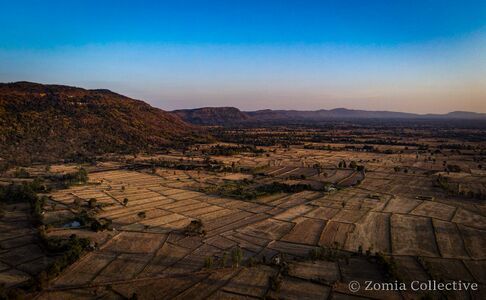 Looking towards the Phu Phan mountains over the rice fields, Sakon Nakhon Province, Thailand, December 2025
See also
References
- ↑ 1.0 1.1 1.2 LaMoreaux, P. E.; Charaljavanaphet, Jumchet; Jalichan, Nitipat; et al. (1958). Reconnaissance of the Geology and Ground Water of the Khorat Plateau, Thailand. Geological Survey Water-Supply Paper 1429. Washington, D.C.: U.S. Government Printing Office. doi:10.3133/wsp1429.
- ↑ 2.0 2.1 Suwanwela, C.; Poshyachinda, V. (1986). "Drug abuse in Asia". Bulletin on Narcotics (1). United Nations: 41–53. Retrieved 4 October 2026.
- ↑ 3.0 3.1 Yodmani, C. (1983). "The role of the Association of South-East Asian Nations in fighting illicit drug traffic". Bulletin on Narcotics (4). United Nations: 97–104. Retrieved 4 October 2026.
- ↑ 4.0 4.1 4.2 Chouvy, Pierre-Arnaud (2019). "Cannabis cultivation in the world: heritages, trends and challenges". EchoGéo. 48. doi:10.4000/echogeo.17591.
- ↑ 5.0 5.1 5.2 Stamler, R. T.; Fahlman, R. C.; Vigeant, H. (1985). "Illicit traffic and abuse of cannabis in Canada". Bulletin on Narcotics (4). United Nations: 37–49.
- ↑ 6.0 6.1 6.2 National Narcotics Intelligence Consumers Committee. Narcotics Intelligence Estimate 1984: The Supply of Illicit Drugs to the United States from Foreign and Domestic Sources in 1984 (With Near Term Projections) (PDF) (Report) – via National Criminal Justice Reference Service.
- ↑ 7.0 7.1 7.2 7.3 "ใหญ่ที่สุดในไทย! ป.ป.ส.ตัดทำลาย 26 แปลงกัญชาลักลอบปลูกป่าลึก" [The largest in Thailand: narcotics office destroys 26 illicit cannabis plots deep in the forest]. Matichon (in ไทย). 6 November 2019. Retrieved 4 October 2026.
- ↑ "สกลนครลุยตัดทำลายแปลงกัญชาผิดกฎหมายบนเขาภูพาน" [Sakon Nakhon cuts down illegal cannabis plots on the Phu Phan]. Post Today (in ไทย). 18 November 2020. Retrieved 12 October 2026.
- ↑ 9.00 9.01 9.02 9.03 9.04 9.05 9.06 9.07 9.08 9.09 9.10 Department of Agriculture (Thailand) (July 2021). ประกาศกรมวิชาการเกษตร เรื่อง โฆษณาคำขอให้ออกหนังสือรับรองพันธุ์พืชขึ้นทะเบียน ตามพระราชบัญญัติพันธุ์พืช พ.ศ. ๒๕๑๘ [Notification of the Department of Agriculture: publication of applications for certificates of registered plant varieties under the Plant Varieties Act B.E. 2518] (PDF) (Report) (in ไทย). Retrieved 4 October 2026.
- ↑ 10.0 10.1 "งัด กฎหมาย ปิดทางนำเข้า 'กัญชา-กัญชง' เมล็ดพันธุ์ ช่อดอก เสรี" [Law invoked to close free import of cannabis and hemp seed and flowers]. Thansettakij (in ไทย). 27 January 2022. Retrieved 4 October 2026.
- ↑ Chenrai, Piyaphong; Jitmahantakul, Sukonmeth; Bissen, Raphael; Assawincharoenkij, Thitiphan (5 August 2022). "A preliminary assessment of geological CO2 storage in the Khorat Plateau, Thailand". Frontiers in Energy Research. 10 909898. doi:10.3389/fenrg.2022.909898.
- ↑ 12.0 12.1 12.2 Jacobson, Herbert S.; Pierson, Charles T.; Danusawad, Thawisak; et al. (1969). Mineral Investigations in Northeastern Thailand. Geological Survey Professional Paper 618. Washington, D.C.: U.S. Government Printing Office. doi:10.3133/pp618.
- ↑ 13.0 13.1 13.2 13.3 "Digitised sheet SN 009255". Forest Herbarium collections. Forest Herbarium, Department of National Parks, Wildlife and Plant Conservation. Retrieved 12 October 2026.
- ↑ 14.0 14.1 "Digitised sheet SN 009254". Forest Herbarium collections. Forest Herbarium, Department of National Parks, Wildlife and Plant Conservation. Retrieved 12 October 2026.
- ↑ 15.0 15.1 "Digitised sheet SN 009258". Forest Herbarium collections. Forest Herbarium, Department of National Parks, Wildlife and Plant Conservation. Retrieved 12 October 2026.
- ↑ 16.0 16.1 16.2 16.3 16.4 16.5 Keyes, Charles F. (March 1967). Isan: Regionalism in Northeastern Thailand. Cornell Thailand Project Interim Reports Series No. 10; Data Paper No. 65. Ithaca, New York: Southeast Asia Program, Department of Asian Studies, Cornell University. hdl:1813/57533.
- ↑ 17.0 17.1 17.2 Choenkwan, Sukanlaya; Fox, Jefferson Metz; Rambo, A. Terry (2014). "Agriculture in the mountains of northeastern Thailand: current situation and prospects for development". Mountain Research and Development. 34 (2): 95–106. doi:10.1659/MRD-JOURNAL-D-13-00121.1.
- ↑ 18.0 18.1 Nawata, Eiji; Nagata, Yoshikatsu; Sasaki, Arimichi; Iwama, Kenji; Sakuratani, Tetsuo (2005). "Mapping of climatic data in Northeast Thailand: rainfall". Tropics. 14 (2): 191–201. doi:10.3759/tropics.14.191.
- ↑ 19.0 19.1 19.2 19.3 19.4 19.5 19.6 Maguire, Peter; Ritter, Mike (2013). Thai Stick: Surfers, Scammers, and the Untold Story of the Marijuana Trade. Foreword by David Farber. Columbia University Press. ISBN 978-0-231-16134-3.
- ↑ Royal Canadian Mounted Police (1983). Stamler, R. T.; Fahlman, R. C. (eds.). National Drug Intelligence Estimate 1982 (with Trend Indicators Through 1985) (PDF) (Report) – via National Criminal Justice Reference Service.
- ↑ Bureau of International Narcotics Matters (March 1990). International Narcotics Control Strategy Report (PDF) (Report). United States Department of State. p. 324. Retrieved 4 October 2026 – via National Criminal Justice Reference Service.
- ↑ Timsuksai, Pijika; Rambo, A. Terry (11 January 2016). "The influence of culture on agroecosystem structure: a comparison of the spatial patterns of homegardens of different ethnic groups in Thailand and Vietnam". PLOS ONE. 11 (1) e0146118. doi:10.1371/journal.pone.0146118.
- ↑ Grandstaff, Terry B.; Grandstaff, Somluckrat; Limpinuntana, Viriya; Suphanchaimat, Nongluck (2008). "Rainfed revolution in Northeast Thailand". Japanese Journal of Southeast Asian Studies. 46 (3): 289–376. doi:10.20495/tak.46.3_289.
- ↑ 24.0 24.1 Martin, Marie Alexandrine (1975). "Ethnobotanical Aspects of Cannabis in Southeast Asia". In Rubin, Vera (ed.). Cannabis and Culture. The Hague: Mouton. pp. 63–76. doi:10.1515/9783110812060.63.
- ↑ 25.0 25.1 "Digitised sheet SN 009253". Forest Herbarium collections. Forest Herbarium, Department of National Parks, Wildlife and Plant Conservation. Retrieved 12 October 2026.
- ↑ Fort, J. (1965). "Giver of delight or liberator of sin: drug use and "addiction" in Asia". Bulletin on Narcotics (3). United Nations: 1–11. Retrieved 4 October 2026.
- ↑ 27.0 27.1 Ritmontree, Sujitta; Kanato, Manop; Leyatikul, Poonrut (2019). "The health, economic, and social effects of cannabis use in Thailand". F1000Research. 8 614. doi:10.12688/f1000research.17391.1.
- ↑ 28.0 28.1 Pongnaratorn, Panicha; Sophon, Natthida; Boueroy, Parichart (March 2025). "In vitro antimicrobial activity of Thai stick cannabis Hang Kra Rog Phu Phan (Cannabis sativa L.), sugar leaves extract against pathogenic bacteria". Journal of Advanced Veterinary and Animal Research. 12 (1): 44–52. doi:10.5455/javar.2025.l870.
- ↑ 29.0 29.1 Watanakul, Phurin; Phattaralerphong, Jessada; Pitija, Kitsada; Nakmee, Pattarawadee Sumthong (2024). "Terpenoid profiling of Thai strain cannabis leaves (Cannabis sativa L. subsp. sativa) by headspace (HS) couple with GC/MS". Journal of Pharmacy. 4 (1): 3–11. doi:10.31436/jop.v4i1.225.
- ↑ Aranyanak, Chiraporn (1991). "Ancient textiles in Thailand". SPAFA Journal. 1 (3): 13–18.
- ↑ "พระราชบัญญัติกัญชา พุทธศักราช ๒๔๗๗" [Cannabis Act, B.E. 2477] (PDF). Royal Gazette (in ไทย). 52 (ก): 339–343. 5 May 1935. Retrieved 12 October 2026.
- ↑ 32.0 32.1 "Digitised sheet SN 009259". Forest Herbarium collections. Forest Herbarium, Department of National Parks, Wildlife and Plant Conservation. Retrieved 12 October 2026.
- ↑ Translations on Narcotics and Dangerous Drugs, No. 310 (Report). Arlington, Virginia: Joint Publications Research Service. 14 July 1977. JPRS 69428 – via HathiTrust.
- ↑ Translations on Narcotics and Dangerous Drugs, No. 311 (Report). Arlington, Virginia: Joint Publications Research Service. 21 July 1977. JPRS 69464 – via HathiTrust.
- ↑ National Narcotics Intelligence Consumers Committee. Narcotics Intelligence Estimate: The Supply of Drugs to the U.S. Illicit Market From Foreign and Domestic Sources in 1983 (With Projections Through 1984) (Report) – via HathiTrust.
- ↑ Bureau of International Narcotics Matters (1 February 1986). International Narcotics Control Strategy Report (PDF) (Report). Vol. I. United States Department of State. p. 212. Retrieved 4 October 2026 – via National Criminal Justice Reference Service.
- ↑ National Narcotics Intelligence Consumers Committee (June 1987). The NNICC Report 1985–1986: The Supply of Illicit Drugs to the United States from Foreign and Domestic Sources in 1985 and 1986 (with Near Term Projections) (PDF) (Report) – via National Criminal Justice Reference Service.
- ↑ Directorate of Intelligence (1 August 1986). Narcotics Review (Report). Central Intelligence Agency – via CIA FOIA Electronic Reading Room.
- ↑ Yodmani, C. (1992). "Law enforcement approaches and measures used in countering illicit drug problems in Thailand". Bulletin on Narcotics (1). United Nations: 23–27.
- ↑ United Nations Office on Drugs and Crime (2011). World Drug Report 2011 (PDF) (Report). New York: United Nations. ISBN 978-92-1-148262-1.
- ↑ "โปรดเกล้าฯ พ.ร.บ.ยาเสพติด ใช้ 'กัญชา-กระท่อม' ทางการแพทย์ได้" [Royal assent to the narcotics act: cannabis and kratom may be used in medicine]. Thai PBS (in ไทย). 19 February 2019. Retrieved 4 October 2026.
- ↑ "ประกาศกระทรวงสาธารณสุข เรื่อง ระบุชื่อยาเสพติดให้โทษในประเภท 5 พ.ศ. 2565 มีผลบังคับใช้ตั้งแต่วันที่ 9 มิถุนายน 2565" [Notification of the Ministry of Public Health naming the category 5 narcotics, B.E. 2565, in force from 9 June 2022]. Cannabisinfo (in ไทย). Food and Drug Administration (Thailand). 20 March 2023. Retrieved 4 October 2026.
- ↑ 43.0 43.1 43.2 "Sakon Nakhon ganja growers fret over unsold stock, change in govt policy". The Nation. 12 May 2024. Retrieved 4 October 2026.
- ↑ Ministry of Public Health (23 November 2022). "ประกาศกระทรวงสาธารณสุข เรื่อง สมุนไพรควบคุม (กัญชา) พ.ศ. 2565" [Notification of the Ministry of Public Health: controlled herb (cannabis), B.E. 2565] (PDF). Royal Gazette (in ไทย). 139 (special part 272 ง): 3–4. Retrieved 12 October 2026.
- ↑ Ministry of Public Health (25 June 2025). "ประกาศกระทรวงสาธารณสุข เรื่อง สมุนไพรควบคุม (กัญชา) พ.ศ. 2568" [Notification of the Ministry of Public Health: controlled herb (cannabis), B.E. 2568]. Royal Gazette (in ไทย). 142 (special part 229 ง): 8–9.
- ↑ "Thailand reclassifies cannabis bud as a controlled herb, restricts sales and advertising". The Nation. 26 June 2025. Retrieved 4 October 2026.
- ↑ 47.0 47.1 47.2 Kamoltham, Thavatchai; Luangpirom, Nophadon; Kuamsab, Napaporn; Kummalue, Tanawan; Chaiphongpachara, Tanawat (October 2025). "Whole-genome sequencing and SNP analysis of Thai Cannabis sativa cultivar 'Hang Kra Rog Phu Phan' (Cannabaceae)". Biodiversitas Journal of Biological Diversity. 26 (10): 4946–4953. doi:10.13057/biodiv/d261010.
- ↑ Nakkliang, Kanittha; Zongram, Onuma; Areesantichai, Chitlada; Rungsihirunrat, Kanchana (2023). "Assessment of genetic relationship among Cannabis sativa L. in Thailand based on ISSR and their phytoconstituents properties". Research Journal of Pharmacy and Technology. 16 (5): 2197–2204. doi:10.52711/0974-360X.2023.00361.
- ↑ Kraisittipanit, Rungroj; Jaiharn, Orawan; Fungnumcharoensab, Kritsada; et al. (September 2025). "Unraveling the genetic diversity of local Thai Cannabis strains using Inter-Simple Sequence Repeat (ISSR) molecular markers". Journal of Medical Globalization. 4 (3): 62–72.
- ↑ 50.0 50.1 Srikul, Pichsiri; Mayong, Amonrat; Matthayatthaworn, Weerachai; Sreewongchai, Tanee (2026). "Comparison of self-pollination and intercrossing for feminized seed production in Thai Hang Kra Rok cannabis (Cannabis sativa L.) landrace". Agriculture and Natural Resources. 60 (5) 600512. doi:10.34044/j.anres.2026.60.5.12.
- ↑ 51.0 51.1 51.2 "กรมวิทย์ฯ ส่งมอบเมล็ดพันธุ์กัญชาพันธุ์ไทย 'ตะนาวศรีก้านแดง' ที่ให้สาร CBD สูง เพื่อใช้ประโยชน์ทางการแพทย์และต่อยอดเชิงเศรษฐกิจ" [Department of Medical Sciences hands over seed of the high-CBD Thai cannabis cultivar Tanao Si Kan Daeng for medical and economic use] (Press release) (in ไทย). Department of Medical Sciences, Ministry of Public Health. 30 June 2022. Retrieved 4 October 2026.
- ↑ National Narcotics Intelligence Consumers Committee (April 1988). The Supply of Illicit Drugs to the United States: The NNICC Report 1987 (PDF) (Report). p. 20. Retrieved 4 October 2026 – via National Criminal Justice Reference Service.
- ↑ 53.0 53.1 Charoenchai, Laksana; Monton, Chaowalit; Wunnakup, Thaniya; Madaka, Famera; Wutthipong, Artimond; Songsak, Thanapat (2023). "TLC densitometry analysis of cannabis flower growing in Thailand". Interprofessional Journal of Health Sciences. 21 (1–2) IJHS-0256.
- ↑ "'อนุทิน' ตัดช่อดอกกัญชาพันธุ์ไทยที่กรมวิทย์ฯ ผลิตพันธุ์กัญชาต้นแบบคุณภาพดี" [Anutin cuts flower heads of the Thai cannabis cultivars produced by the Department of Medical Sciences as good-quality prototypes] (Press release) (in ไทย). Department of Medical Sciences, Ministry of Public Health. 21 June 2021. Retrieved 4 October 2026.


