Jump to content
Toggle menu
Toggle preferences menu
Toggle personal menu
Not logged in
Your IP address will be publicly visible if you make any edits.

Since 7 October 2026 every request to landrace.wiki passes through Cloudflare, a security service brought in after a denial-of-service attack made the site unreachable. The Privacy policy now explains what this means for your data.

Portal:Conservation
Introduction

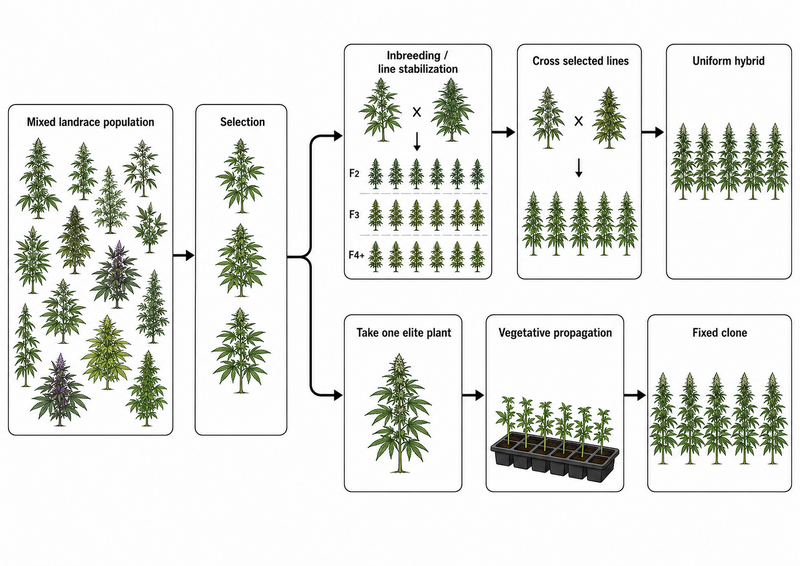
A flow diagram from a mixed landrace population through selection to inbred lines and a uniform hybrid; a second path runs from one elite plant through vegetative propagation to a fixed clone.

Routes from a variable landrace to a uniform cultivar: selection and inbreeding to fixed lines; a repeated cross for a uniform first generation; clonal fixation of a single plant.

Cannabis conservation addresses the urgent threats facing landrace populations worldwide, from systematic eradication campaigns to genetic pollution from hybrid varieties to habitat degradation and climate change. Global prohibition has driven industrial-scale enforcement operations that destroy traditional cultivation, criminalize farmers, suppress cultural knowledge, and cause irreversible loss of genetic diversity representing millennia of local adaptation.

Conservation need is read for each population: its field grade is scored item by item on its page, and its holdings reading comes from the seed lots recorded for it. The Grow-out priorities list populations from the most urgent case down. Major threats include enforcement operations (aerial eradication, military campaigns, systematic crop destruction), genetic pollution (hybridization with introduced varieties causing genetic swamping), habitat loss (land conversion, development, agricultural expansion), climate change (shifting rainfall patterns, temperature extremes, phenological disruption), and legal pressure (prohibition enforcement, farmer criminalization, cultural suppression). Many traditional cultivation regions face multiple simultaneous threats—Himalayan populations suffer both intensive eradication and genetic contamination, while Moroccan Rif populations experience enforcement pressure alongside climate-driven drought.

Conservation requires integrated strategies combining ex-situ preservation (seed banking, living collections, tissue culture), in-situ conservation (on-farm preservation, protected areas, community-based initiatives), population monitoring, threat assessment, and recovery planning. Critical priorities include documenting endangered populations before extinction, establishing redundant preservation systems, supporting traditional farmers, monitoring genetic pollution, analyzing enforcement patterns, and advocating for policy reform that recognizes cannabis landraces as valuable crop genetic resources requiring protection rather than eradication.

Featured article

Genetic pollution from hybridization with modern cannabis varieties represents one of the most insidious threats to landrace integrity, capable of completely overwhelming local populations within a few generations. Unlike eradication which destroys plants but leaves surviving populations genetically intact, genetic pollution irreversibly transforms landrace gene pools through introgression of hybrid alleles. Pollen from introduced high-THC varieties can travel kilometers on wind, reaching isolated mountain fields and contaminating populations that have maintained genetic continuity for centuries.

The process begins subtly—a few hybrid seeds introduced to a region, farmers unknowingly growing contaminated plants, pollen spreading to neighboring traditional fields. Within 3-5 generations of continuous gene flow, landrace characteristics (local adaptation, traditional flowering times, regional morphology, balanced cannabinoid profiles) erode as hybrid genetics dominate. The threat intensifies as enforcement pressure drives farmers to abandon traditional varieties for faster-flowering, higher-yielding hybrids that complete growth before eradication campaigns. Regions like the Western Himalayas now face catastrophic genetic pollution, with truly pure landrace populations restricted to increasingly isolated high-altitude areas. Detection requires molecular analysis—plants may appear morphologically similar while carrying substantial hybrid ancestry. Conservation responses include establishing isolation zones, monitoring gene flow with DNA markers, prioritizing collection from remote populations, and supporting farmers in maintaining traditional varieties despite economic pressure to adopt hybrids.
(Full article...)

Did you know...
  • ...that between 2020-2026, enforcement operations destroyed an estimated hundreds of thousands of tons of cannabis globally, with many operations specifically targeting traditional landrace cultivation zones?
  • ...that pollen from hybrid varieties can travel 5-10 kilometers on wind, making genetic isolation nearly impossible in accessible cultivation regions?
  • ...that minimum viable population size for long-term genetic diversity maintenance is typically 500-1000 breeding individuals, but many landrace populations now number in the dozens?
  • ...that seed banking can preserve genetic diversity for decades or centuries, but requires proper storage conditions (-20°C, low humidity) and periodic viability testing?
  • ...that the Single Convention on Narcotic Drugs (1961) forced global prohibition that directly caused extinction of countless traditional varieties through systematic eradication?
Selected picture

Pressed male and female cannabis plants with long palmate leaves mounted together on a herbarium sheet, with handwritten labels and a colour scale at the edge.

Male and female plants of Cannabis sativa var. indica on one herbarium sheet labelled Simla, Northern India. A. C. 1859 (Christison s.n., Simla (1859), Royal Botanic Garden Edinburgh).
Major topics
Population readings
Grow-out priorities · Populations · Grow-out priority method
Threat Categories
Eradication programs · Enforcement operations · Military operations · Aerial eradication · Genetic pollution · Hybridization threat · Habitat loss · Climate change impacts · Legal pressure · Over-collection · Threat severity
Eradication Tracking & Analysis
Eradication operations · Named campaigns · Operation types · Helicopter operations · Ground operations · Geographic patterns · Enforcement hotspots · Temporal patterns · Impact assessment · Biomass destroyed
Genetic Threats
Gene flow from hybrids · Genetic swamping · Introgression · Population bottlenecks · Genetic drift effects · Inbreeding · Loss of diversity · Isolation breakdown · Genetic monitoring
Habitat & Environmental Threats
Habitat degradation · Soil degradation · Erosion · Water depletion · Deforestation · Cultivation pressure · Access disruption · Environmental change · Pollution impacts
Population Assessment
Population size estimation · Census methods · Breeding population size · Effective population size · Distribution assessment · Habitat quality · Population viability · Minimum viable population · Extinction risk
Conservation Methods - Ex Situ
Seed banking · Seed collection · Seed storage · Cryopreservation · Living collections · Botanical gardens · Tissue culture · In vitro conservation · Documentation collections
Conservation Methods - In Situ
On-farm conservation · Farmer participation · Protected areas · Genetic reserves · Community-based conservation · Community seed banks · Wild population conservation · Traditional cultivation support
Sampling & Collection
Sampling theory · Sample size requirements · Genetic representation · Collection methods · Seed collection protocols · Core collections · Ethical considerations · Community consent · Benefit sharing
Preservation Strategies
Conservation prioritization · Hotspot identification · Critical populations · Integrated conservation · Regional coordination · Long-term planning · Sustainability · Capacity building
Recovery & Restoration
Population restoration · Reintroduction · Population augmentation · Genetic rescue · Habitat restoration · Knowledge restoration · Traditional knowledge revival · Social restoration
International Enforcement
Regional enforcement patterns · South Asian enforcement · Southeast Asian enforcement · Central Asian enforcement · Agency analysis · Military involvement · International cooperation · Enforcement trends
Conservation Monitoring
Monitoring programs · Population monitoring · Status monitoring · Threat monitoring · Indicator species · Remote sensing · Satellite monitoring · Reporting systems
Legal & Policy
International treaties · Single Convention impacts · National policies · Prohibition laws · Indigenous rights · Traditional cultivation rights · Legal reform · Policy change
Conservation Science
Conservation biology · Extinction risk · Conservation genetics applications · Risk assessment · Vulnerability assessment · Conservation economics · Conservation social science
Things you can do
Help improve conservation efforts
  • Report threats: Document eradication operations, genetic pollution, habitat loss
  • Assess status: Contribute to population assessments and status updates
  • Monitor populations: Track status changes in known cultivation zones
  • Support farmers: Assist traditional cultivators in maintaining varieties
  • Collect seeds: Responsibly collect and preserve endangered populations
  • Expand stubs: Genetic monitoring, Population augmentation, Recovery planning
Categories