Toggle menu
Toggle preferences menu
Toggle personal menu
Not logged in
Your IP address will be publicly visible if you make any edits.
Portal:Genetics
Introduction

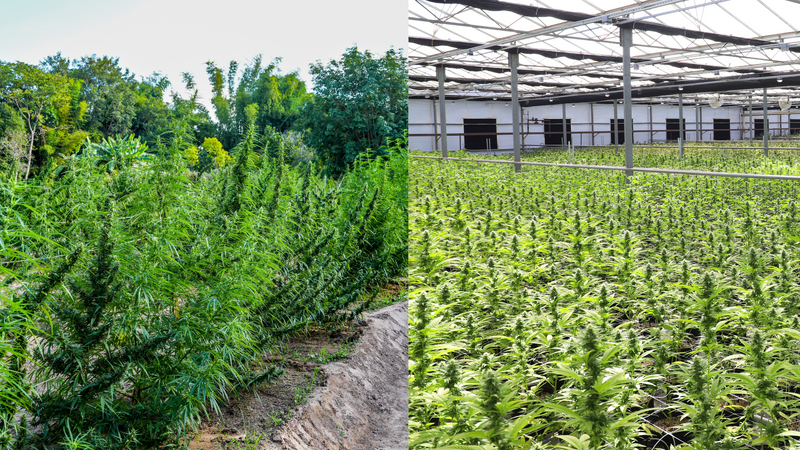
A varied landrace population beside a uniform modern cultivar. Obligate outcrossing keeps every plant in a traditional seed lot genetically distinct; that within-population variation is the diversity this database documents.

Cannabis genetics is the study of inheritance and variation in Cannabis: how traits pass from parent to offspring, how diversity is arranged within and among populations and how selection, drift and gene flow reshape that diversity over time. For a database of landrace populations these are working questions. What a population holds, how distinct it is from its neighbours and what it stands to lose are genetic facts before they are anything else.

Cannabis is dioecious and wind-pollinated, its sex set by an XY chromosome pair, so each seedling in a traditional population is the product of outcrossing between genetically distinct parents. Its characters range from single-gene Mendelian traits to quantitative ones shaped by many genes and the growing environment together. Diversity across the species is organised by use type and geography: the deepest split separates fibre-and-seed hemp from drug-type cannabis, and regional landraces hold much of the variation on either side of it.

The portal follows the discipline's own divisions: Mendelian and quantitative inheritance, the genetics of sex determination, the structure and diversity of populations, molecular study of the genome, the mating systems that keep landraces variable and the selection, natural and human, that fits them to place. Conservation genetics, from effective population size to genetic erosion, ties the science to the documentation work this wiki exists to do.

Featured article
Did you know...
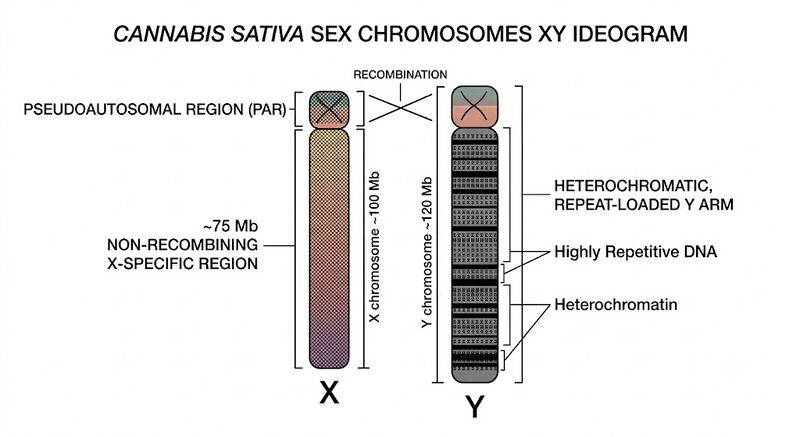
  • ...that the cannabis Y is the largest chromosome in the genome yet substantially degenerate, its genes expressed at about half the level of their X counterparts after some 27 million years without X–Y recombination?
  • ...that monoecious hemp cultivars, which bear male and female flowers on one plant, are chromosomally female (XX) and carry no Y chromosome at all?
  • ...that feminised seed is produced by blocking a female plant's perception of ethylene, so that it sheds pollen carrying only X chromosomes and every seed it sires is female?
  • ...that hemp and drug-type cannabis differ across the whole genome, not only at the cannabinoid genes, to a degree comparable with the differentiation between human continental groups?
  • ...that in surveyed Iranian drug-type landraces some 93–96% of genetic variation lay within each population, with only about 1% separating the populations from one another?
  • ...that truly wild cannabis is probably extinct, today's free-living populations descending from plants once cultivated?
Selected picture

The cannabis sex chromosome pair. Most of its length no longer recombines between X and Y; a short pseudoautosomal region at one tip still does, and the Y has grown large with repetitive DNA.
Major topics
Things you can do
Help improve genetics articles
  • Write the most-wanted articles: Gene flow, Introgression, Mass selection and Natural selection, the targets most often reached for in article prose
  • Write the overview: Cannabis genetics, the portal's own introduction article
  • Expand: Chemotype, a one-line stub that carries the chemotype-inheritance story
  • Document inheritance: record trait segregation and sex ratios in landrace crosses
  • Report chemotypes: add cannabinoid profiles and their inheritance in traditional populations
  • Track gene flow: note hybrid introductions near documented landrace regions