Beach 48 (1948)
More actions
| Beach 48 herbarium specimen, Hsin Chi, Hopei (1948) | |
|---|---|
| Beach 48 (1948) | |
| At a Glance | |
| Classification | Other |
| Location | |
| Country | China |
| Province/State | Hebei |
| Locality | Hsin Chi (Xinji), Sulu Hsien |
| Coordinates | 37.94, 115.21 |
| Collection | |
| Method | Herbarium specimen |
| Sourcing Type | Historical |
| Date | 15 August 1948 |
| Collector | Kay H. Beach |
| Specimen | |
| Repository | Missouri Botanical Garden |
| Catalogue Number | 105700969 |
| Collector Number | Beach 48 |
| Scientific Name | Cannabis sativa L. |
| Occurrence Record | View occurrence record |
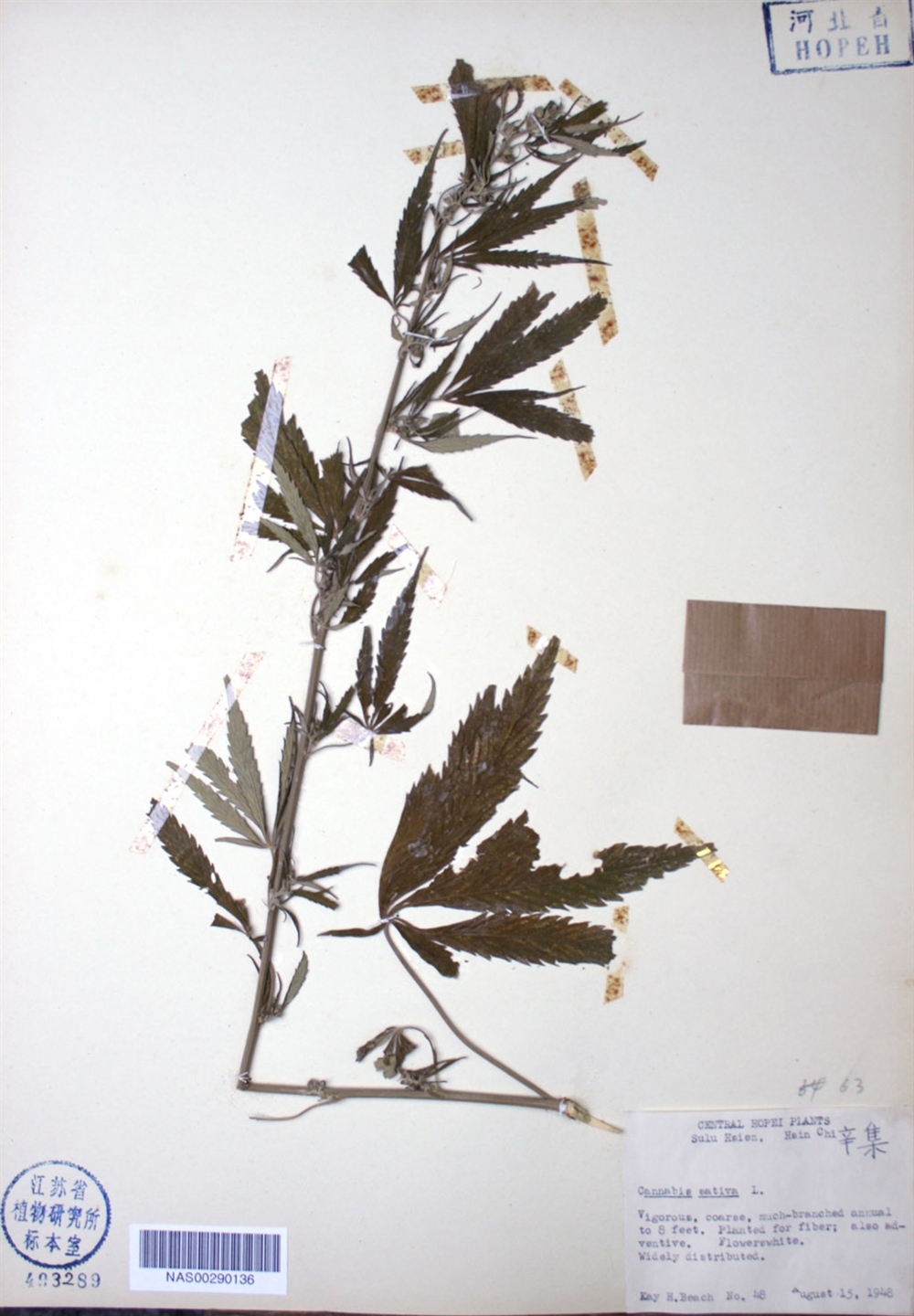
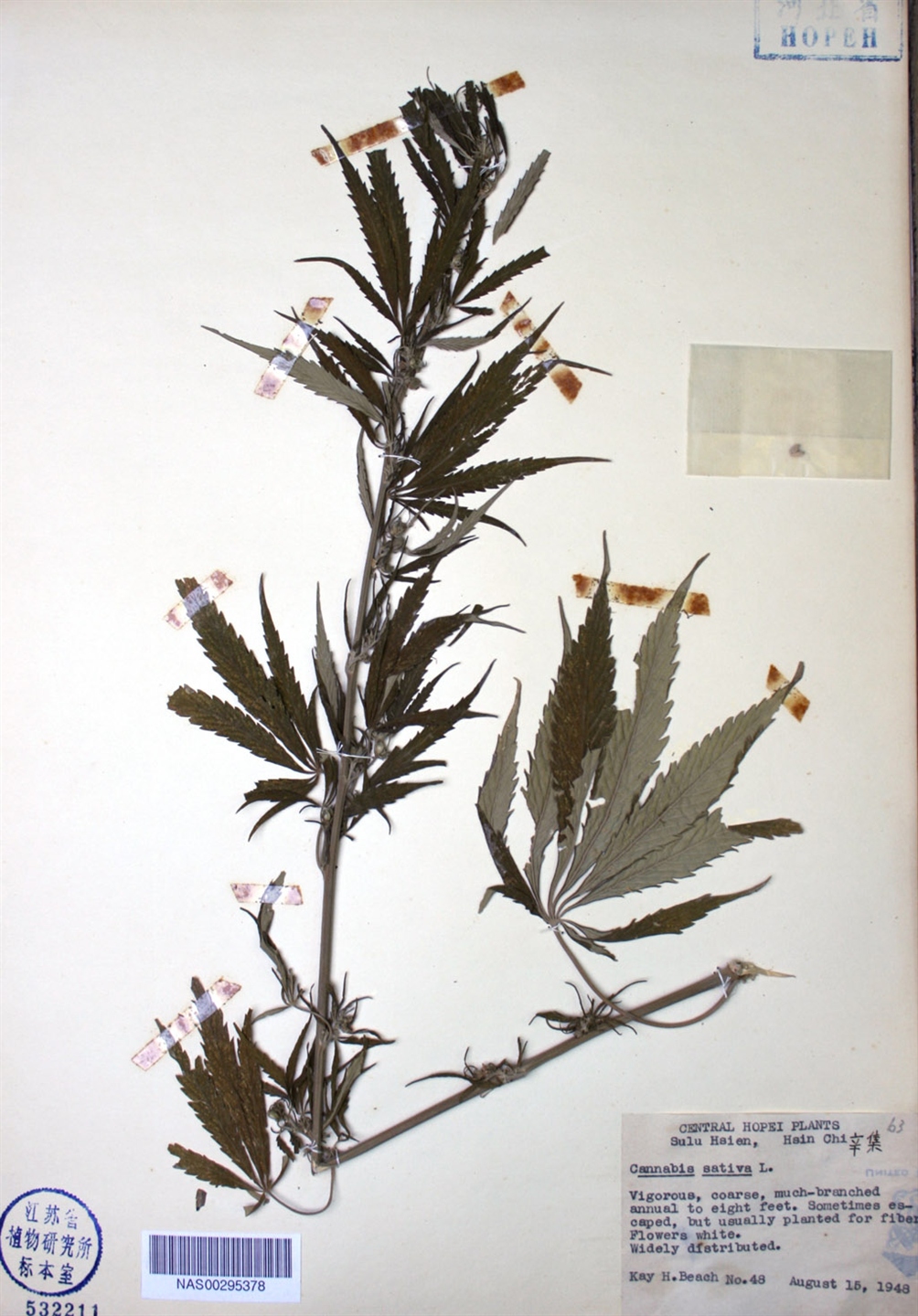
Beach 48 is a herbarium accession of Cannabis sativa collected at Hsin Chi (Xinji), in Sulu county, central Hebei (then Hopei), China, on 15 August 1948 by Kay H. Beach. Its label records the plant as planted for fibre and also growing adventive. The Missouri Botanical Garden holds a sheet as 105700969,[1] and the Institute of Botany, Jiangsu Province and Chinese Academy of Sciences in Nanjing two more, NAS00290136[2] and NAS00295378.[3]
Collection and locality
The label is headed Distributed by the Herbarium of the University of California and Central Hopei Plants. It gives the place as Sulu Hsien, Hsin Chi with the characters 辛集, the collector Kay H. Beach, the number 48 and the date August 15, 1948.[4] The catalogue gives the same place, number and date.[1] The two Nanjing sheets carry the same printed label, Central Hopei Plants, with the place Sulu Hsien, Hsin Chi and 辛集, the collector Kay H. Beach, the number 48 and the date August 15, 1948.[5][6] The Chinese Virtual Herbarium publishes its sheet images under a non-commercial, no-derivatives licence (CC BY-NC-ND 4.0); they are read and cited here, not reproduced. Xinji was formerly the county of Shulu (束鹿), and became a county-level city in 1986.
Recorded use and habit
The label reads: Vigorous, coarse, much-branched annual to 8 feet. Planted for fiber; also adventive. Flowers white. Widely distributed.[4] It records the plant both as a fibre crop and as growing on its own (adventive) in the district. A packet on the sheet holds a slip marked with the male sign.[4] The label on NAS00290136 gives the same description.[5] The label on NAS00295378 is typed differently: Vigorous, coarse, much-branched annual to eight feet. Sometimes escaped, but usually planted for fiber. Flowers white. Widely distributed.[6]
Specimen and identification
The label names the plant Cannabis sativa L., the name the catalogue records.[4][1] The image is published under a non-commercial licence and is not reproduced here.
- ↑ 1.0 1.1 1.2 "Occurrence 6561586263: Cannabis sativa L." GBIF. Global Biodiversity Information Facility. Retrieved 8 October 2026.
- ↑ "Specimen NAS00290136: Cannabis sativa". Chinese Virtual Herbarium. Institute of Botany, Chinese Academy of Sciences. Retrieved 13 October 2026.
- ↑ "Specimen NAS00295378: Cannabis sativa". Chinese Virtual Herbarium. Institute of Botany, Chinese Academy of Sciences. Retrieved 13 October 2026.
- ↑ 4.0 4.1 4.2 4.3 "Digitised sheet MO-105700969: Cannabis sativa L." Tropicos image service. Missouri Botanical Garden. Retrieved 8 October 2026.
- ↑ 5.0 5.1 "Digitised sheet NAS00290136: Cannabis sativa". Chinese Virtual Herbarium image service. Institute of Botany, Chinese Academy of Sciences. Retrieved 13 October 2026.
- ↑ 6.0 6.1 "Digitised sheet NAS00295378: Cannabis sativa". Chinese Virtual Herbarium image service. Institute of Botany, Chinese Academy of Sciences. Retrieved 13 October 2026.