
Portal:Culture
More actions
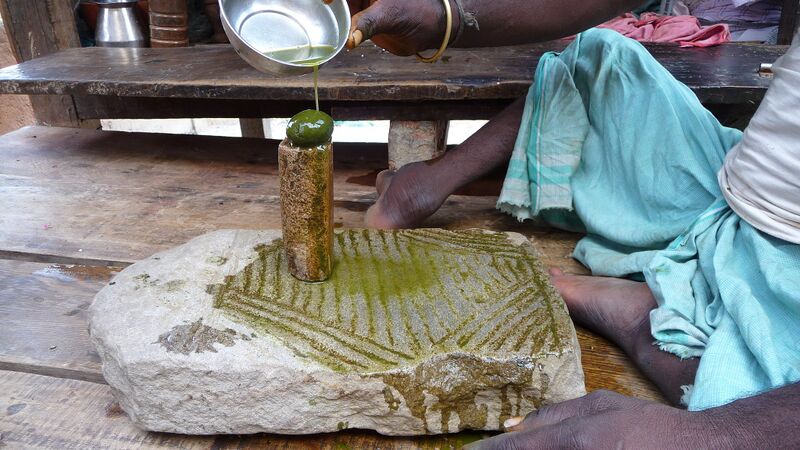
Cannabis culture is what people do with the cannabis plant and what it means to them: its ritual and religious use, its place in medicine and in social life, the pipes and implements it is used with and the names it goes by. This portal covers those practices and the peoples who keep them. How the crop is grown and turned into ganja, charas, hashish, bhang and kif is the subject of the Cultivation portal.
In Sanskrit literature vijayā is one of the names of the plant, used in Ayurvedic, alchemical and Tantric texts from about the 11th century. In Tantric practice the practitioner consecrates the plant by mantra and gesture before consuming it. In Bengal, ethnographers describe ganja smoking and cannabis offerings to deceased teachers among Bauls and fakirs, and criticism of the practice from others who abstain. In western Central Africa the plant is called diamba, a name also documented in Sierra Leone and Brazil. In Cambodia it has served as a culinary herb and a household remedy.
Cannabis is also eaten and drunk, and taken as medicine. Majoun, a confection of the drug cooked with sugar or honey, fat and spices, is recorded at Goa in 1563 and later in Egypt, Morocco and the Netherlands Indies. Thandai is a cooling drink of bhang ground with spices and nuts and mixed with milk or water. Ayurvedic compendia class the drug among the semi-poisonous plants (upaviṣa) and direct that it be purified before it goes into medicines such as the confection madana modaka. In Aceh, cooks and sellers interviewed by journalists and by a 2024 study describe ground cannabis seed used to make meat tender in curries.
The topics below are grouped by the portal's categories.
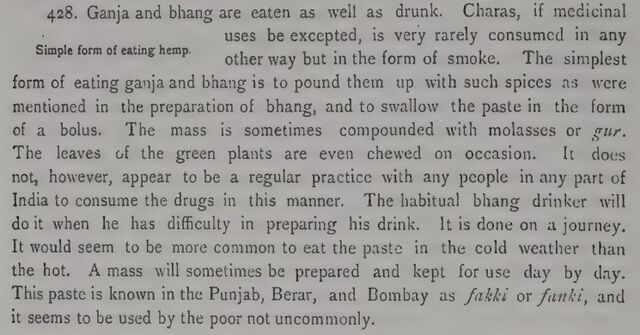
Fakki or fanki is the name recorded in the Punjab, Berar and Bombay in the 1890s for ganja or bhang pounded with spices into a paste and swallowed as a bolus. The Indian Hemp Drugs Commission called it the simplest way of eating the drugs. The paste was sometimes mixed with molasses or gur, and a mass might be made and kept for use day by day.
The habitual bhang drinker ate the paste when he had difficulty preparing his drink, and on a journey. It was eaten more in the cold weather than the hot, and the poor used it "not uncommonly".
In Bijapur the deputy collector described fakki in 1893 as a powder. Bhang powder was washed, parched lightly in a frying pan with a very little ghee, ground fine and mixed with poppy seeds and sugar. …
- ...that the Sanskrit name vijayā is applied to several plants besides cannabis, so that G. Jan Meulenbeld judged it almost useless for tracing the history of cannabis in India?
- ...that a 1910 flora of the Kisantu region records diamba for cannabis and diamba di nseke, "savanna hemp", for a different plant that resembles it?
- ...that bartamān-panthī practitioners among the Bauls of Bengal class smoked ganja as "cooling" and "upward-moving"?
- ...that in the anthropologist Khwaja Hasan's account of north India, a family, a caste or a circle of friends gathered to grind the ingredients of thandai, a cooling bhang drink, and talked over family matters and prices while it was made?
- ...that sambal ganja, a relish of Acehnese cooking, contains no cannabis according to Liputan6 and ANTARA, which report that the name refers to how hard it is to stop eating it?
- ...that the Haschich fudge printed in The Alice B. Toklas Cook Book in 1954 was not Toklas's own recipe, but one sent to her by the painter Brion Gysin?
- ...that in the rural Jamaican community studied by Vera Rubin and Lambros Comitas in the early 1970s, children were given ganja tea from infancy?
- ...that E. Joseph Brand and Zhao Zhongzhen call shuisheng san, a powder of cannabis and datura flowers taken before moxibustion, the first well-documented use of cannabis in an anaesthetic formula in China?
- Overview
- Cannabis culture · Glossary of cannabis culture
- Traditional Uses
- Ritual use · Social consumption · Traditional medicine · Ayurveda · Cannabis in Ayurveda · Cannabis in Thai traditional medicine · Cannabis in traditional Chinese medicine · Cannabis in Khmer medicine
- Medicines
- Akkhiniwakhana · Ammarit osot · Aphai sali · Bromidia · Cannabin tannate · Chlorodyne · Cigarettes indiennes · Compound salicylic collodion · Daemainhwan · Damaren jiu · Extract of Indian hemp · Fai awut · Ganja tea · Ganja tonic · Haschischine · Jatiphaladi churna · Jirakadi modaka · Jvalanala rasa · Kae lom kae sen · Kae rok chit · Kae santhakhat klon haeng · Kameshwari modakaya · Licor Montecristo de Haschisch · Madana modaka · Majoun · Maziren wan · Maziren zhou · Piso's Cure for Consumption · Runchang tang · Shuisheng san · Squire's extract · Suk saiyat · Thamlai Phra Sumen · Thap yathikhun · Thipphakat · Tincture of Indian hemp · Zhigancao tang
- Smoking Implements
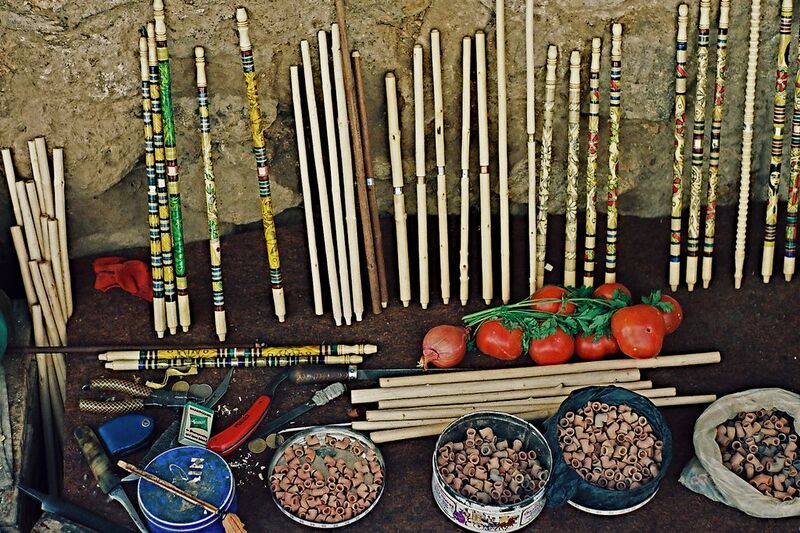
- Chilam · Hookah · Water pipes · Sebsi · Bamboo pipes · Rolling techniques
- Oral Consumption
- Majoun · Thandai · Cannabis edibles · Bhang
- Regional Cultural Practices
- Cannabis in Khmer culture · Cannabis in Bengali culture · Cannabis in Rajbanshi culture · Cannabis in Santal culture · Cannabis in Riffian culture · Cannabis in Rastafari culture · Cannabis in Thai culture · Cannabis in Afghan culture · Cannabis in Ethiopian culture · Cannabis in Mexican culture · Cannabis in Jamaican culture · Cannabis in India
- Social Contexts & Customs
- Sharing customs · Gender roles · Kif cafes
- Preparation & Serving Rituals
- Kif · Charas · Ganja · Hashish
- Material Culture & Implements
- Pipe craftsmanship · Grinding stones · Mortars and pestles · Storage of cannabis
- Cannabis & Identity
- Diamba · Indian hemp · Sadhu · Fakir
- Traditional Knowledge Systems
- Folk taxonomy · Quality assessment · Oral transmission of knowledge · Cultural taboos
- Music, Art & Expression
- Cannabis in music · Cannabis in art · Religious iconography · Cannabis poetry · Sufi poetry · Folklore
- Economic & Trade Culture
- Bhang shops · Kif markets · Trade customs · Gift economy · Hospitality offerings
- Modern Traditional Culture
- Diaspora culture · Cannabis tourism · Cultural preservation
- Etiquette & Protocol
- Consumption etiquette · Ritual purity
- Cannabis & Religion
- Tantric cannabis use in India · Vijaya · Baul · Fakirs in Bengali culture · Cannabis in Hinduism · Cannabis in Bengali Religion · Mahanirvana Tantra · Shiva · Maha Shivaratri · Holi · Tantra · Trinath · Sufism · Rastafari · Cannabis in Buddhism · Sacramental use · Shamanic use
- Food Culture
- Cannabis cuisine · Cannabis in Bengali Cuisine · Cannabis in Khmer cuisine · Cannabis in Acehnese cuisine
- Foods and drinks
- Aaksalu · Bhang ki chutney · Bhang pakora · Bhang parantha · Bhangi-subjee · Bhangolu · Boja · Churum · Dawamesk · Fakki · Ganja tea · Garawish · Ghota · Gulai kameng · Gulkand · Halwa · Hari gulfi · Haschich fudge · Huoma tang · Ie bu peudah · Kaeng phet · Kari sie itek · Khomy · Kopi ganja · Kuah beulangong · Licor Montecristo de Haschisch · Lutki · Majoun · Mangolu · Manzul · Maziren zhou · Mie Aceh · Mudra · Pepperpot soup · Pillai legiyam · Pleskana · Purnadhi · Purnadhi legiyam · Samla kako · Shichimi togarashi · Siddu · Siemieniotka · Sngao moan · Thandai · Yakuti
- Write the implements: the pipes Chilam and Sebsi
- Write the food articles the overviews link: Cannabis in Bengali Cuisine and Cannabis edibles
- Write the religious topics the articles already link: Shiva, Maha Shivaratri, Rastafari, Sadhu and Holi
- Write the community articles: Cannabis in Bengali culture, Cannabis in Riffian culture and Cannabis in Rastafari culture
- Document traditions: record how people use cannabis in ritual, medicine and social life, with the words they use for it
- Photograph implements: pipes, grinding stones and the other objects used to prepare and share cannabis
Culture · Traditional Uses · Medicines · Smoking Implements · Oral Consumption · Regional Practices · Social Customs · Preparation and Serving · Material Culture · Identity · Traditional Knowledge · Music and Art · Economy and Trade · Modern Culture · Etiquette · Religion · Food · Foods and drinks · Ethnic groups