Toggle menu
Toggle preferences menu
Toggle personal menu
Not logged in
Your IP address will be publicly visible if you make any edits.

Portal:Botany

From Landrace.Wiki - The Landrace Cannabis Wiki
Portal:Botany
Introduction

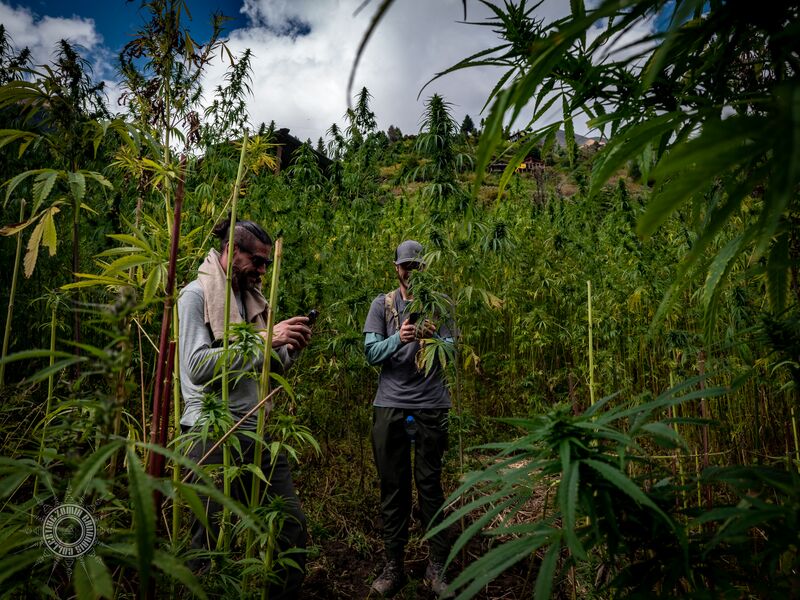
Cannabis field at peak flowering, showing characteristic morphology and growth patterns

Cannabis botany examines the plant biology of Cannabis sativa L., covering morphology, physiology, reproductive biology, chemical ecology and environmental adaptation. As one of humanity's oldest cultivated plants, cannabis exhibits remarkable diversity in growth patterns, chemical profiles and ecological adaptations across traditional growing regions.

Cannabis is a dioecious annual herb in the family Cannabaceae, characterized by palmate leaves with serrated leaflets, pistillate and staminate flowers on separate plants and dense resinous trichomes producing cannabinoids and terpenes. The species shows extraordinary morphological variation, from compact highland varieties adapted to short growing seasons to tall tropical cultivars flowering under equatorial photoperiods.

Key botanical themes include photoperiod response and flowering triggers, trichome development and resin production, phenotypic plasticity and climate adaptation, life cycle phenology across climates and the relationship between environmental conditions and chemical profiles.

Featured article

Landrace cannabis is a cultivated cannabis population that has evolved over time in a specific geographic region, shaped by local environmental pressures and the selection practices of farmers. Cannabis landraces are genetically diverse and locally adapted, often valued for distinctive traits such as flavour, resilience or suitability for traditional uses.

The defining mechanism of landrace maintenance is mass selection, in which farmers save seed in bulk from open-pollinated populations rather than from individually selected plants. This sustains genetic diversity within a recognisable population while applying gradual selection pressure toward locally favoured traits. Landraces are dynamic rather than static and continue to evolve through ongoing seed exchange and occasional introgression.

Cannabis landraces face pressures distinct from most food-crop landraces. Decades of prohibition and eradication have disrupted traditional growing regions and the rapid global spread of high-yield hybrids has driven extensive genetic displacement. … read more →

Did you know...
  • ...that cannabis is one of the few dioecious annual crop plants, meaning every seed is the product of outcrossing between genetically distinct male and female parents?
  • ...that wind-borne cannabis pollen has been documented travelling several kilometres, making genetic isolation of landrace populations from nearby hybrid crops extremely difficult?
  • ...that some highland autoflowering varieties complete their entire lifecycle in as little as 75 days, while equatorial sativas may require 20+ weeks of flowering?
  • ...that cannabis exhibits extreme phenotypic plasticity, with genetically identical clones producing dramatically different chemotypes under different environmental conditions?
  • ...that the resin produced by cannabis trichomes likely evolved as a defence against UV radiation, herbivores and desiccation rather than for any purpose related to human use?
  • ...that tetraploid cannabis populations have been documented growing at altitudes above 3,000 m in the Lahaul-Spiti cold desert of the Indian Himalayas?
Selected picture

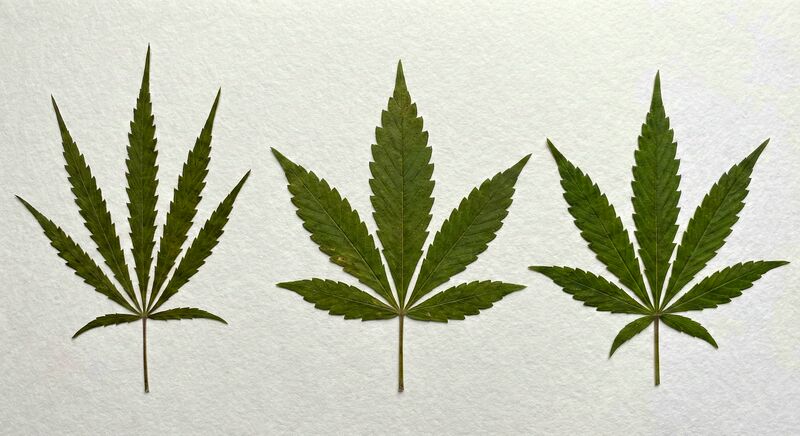
Leaf morphology variation across landrace populations, showing differences in leaflet number, serration depth and overall form
Major topics
Taxonomy & Classification
Cannabis taxonomy · Cannabaceae · Cannabis sativa · Cannabis indica · Cannabis ruderalis · Sativa vs Indica · NLD/BLD classification · Phylogenetics of Cannabis · Landrace Cannabis · Cannabis use types · Cultivar · Hybrid · Heirloom variety · Feral and ruderal cannabis
Plant Morphology
Plant morphology · Growth patterns · Branching morphology · Leaf morphology · Stem morphology · Seed morphology · Root architecture · Fibre morphology
Reproductive Biology
Reproductive biology · Dioecy · Sex expression · Hermaphroditism · Pollination biology · Inflorescence morphology · Vegetative propagation
Life Cycle & Phenology
Life cycle and phenology · Cannabis life cycle · Photoperiod response · Autoflowering · Flowering time · Phenology
Trichome Biology
Trichome biology · Resin · Capitate-stalked trichomes · Trichome types · Trichome development
Chemical Ecology
Chemical ecology · Secondary metabolites · Chemotype · Cannabinoid profiles · Terpene profiles
Ecology
Cannabis ecology · Herbivory and defence · Pathogens and disease
Environmental Adaptation
Environmental adaptation · Phenotypic plasticity · Terroir in Cannabis · Climate adaptation in Cannabis · Abiotic stress tolerance · Epigenetics in Cannabis · Soil adaptation · Polyploidy
Population Biology
Population biology · Centre of origin · Mass selection · Gene pool · Genetic diversity · Local adaptation · Natural selection · Genetic drift · Gene flow · Introgression · Genetic contamination · Genetic erosion
Things you can do
Help improve botany articles