
Phu Phan
More actions
| Phu Phan | |
|---|---|
| Phu Phan Mountains, Phu Phan Hills | |
| ActiveCannabis last recorded here in 2025 | |

| |
| The Phu Phan hills above harvested rice fields in the dry season. | |
| Hierarchy | |
| Regional Complex | Mekong Basin |
| Growing Region | Northeastern Thailand |
| Geography | |
| Country | Thailand |
| Province/State | Sakon Nakhon |
| District | Phu Phan District |
| Landscape | |
| Elevation | 200–301 m |
| Terrain | Long, narrow sandstone range trending north-west to south-east across the Khorat Plateau; forested hills with valleys and stream gullies, and foothill plains on the Sakon Nakhon side |
| Climate | |
| Climate Type | Tropical savanna (Köppen Aw) |
| Rainfall | 1,724 mm |
| Seasons | Rainy (May–Sep), cool (Oct–Jan), hot (Feb–Apr) |
| Growing history | |
| Dated accessions | 2024–2025 |
| Documentation | |
| Appellations | 0 |
| Accessions | 37 |
| Conservation | |
| Populations | none documented yet |
Phu Phan is a landrace cannabis growing area in the Northeastern Thailand growing region, formed by the Phu Phan range on the Khorat Plateau of Thailand. The range is a long, narrow belt of sandstone hills that runs north-west to south-east through the middle of the plateau and extends into southern Laos.[1]: 273[2]: 4 The cannabis documented from it comes from villages in Phu Phan District and Kut Bak District of Sakon Nakhon Province, with a few accessions from Na Kae and Si Songkhram districts of Nakhon Phanom Province.
The range gives its name to Hang Kra Rog Phu Phan, a cannabis type that the applicants for its registration as a cultivar in 2021 placed along the Phu Phan range in Sakon Nakhon and Kalasin provinces, above all in Sakon Nakhon.[3]: 2 Illicit plots were found in its forests and valleys in 2009, 2019 and 2020; in 2019 the regional director of the narcotics control office called the Kut Bak area the largest growing area in Thailand.[4][5][6] Thirty-seven accessions, collected in 2024 and 2025, come from the growing area, most of them from Ban Nan Toeng in Phu Phan District and from Ban Bua in Kut Bak District.
Geography
The accessions were collected in villages at 200 to 301 metres above sea level, most of them in Phu Phan and Kut Bak districts. Phu Phan District lies on the range itself, on high, undulating ground with steep slopes and little flat land. Phu Phan, Kut Bak and neighbouring Tao Ngoi, the districts of Sakon Nakhon with the highest malaria rates in 2012 to 2014, are almost wholly hill and forest.[7]: 59–60 In Kok Pla Sio subdistrict of Phu Phan District the land is mostly foothill plain on the undulating flank of the range, with sloping hill soils, and most of it lies inside national reserved forest or national park.[8]: 178
The range is an anticlinorium, a broad upfold of the rock, that divides the plateau into the Sakon Nakhon basin to the north and the Khorat basin to the south.[2]: 2, 4 Its rock is the Phu Phan Formation, greyish-white, medium- to coarse-grained cross-bedded sandstone with thin lenses of siltstone and mudstone, laid down by braided rivers in the Early Cretaceous; it forms the cuestas along the outer rims of the range.[9] When the range was raised is disputed: some geologists date the uplift to the Mid-Cretaceous and others to the Tertiary.[2]: 6
Two national parks cover parts of the range in Sakon Nakhon. Phu Phan National Park, 415,439 rai of sandstone hills between 200 and 567 metres, reaches its highest point at Phu Khiao in Kalasin. Dry dipterocarp forest grows from the centre of the park to its north between 200 and 400 metres, dry evergreen forest above 400 metres, and mixed deciduous forest in the south.[10] Phu Pha Lek National Park, in Song Dao district, is part of the same range; most of it lies between 200 and 600 metres, and it rises to 695 metres at Phu Ang So. Its soils are sandy loams under the evergreen and mixed forest and lateritic gravel under the dipterocarp forest, over sandstone.[11]
Streams rising in Phu Phan National Park run to the Un and Phung rivers, to the Lam Pao and to the lake of Nong Han.[10] In Kut Bak District the range is the watershed of the Nam Un, the most important tributary in Thailand of the Songkhram, a river of the Mekong basin.[12]: 1768 The forest of Phu Pha Lek feeds the Songkhram itself and the Yam and Um rivers.[11]
Climate
The climate is tropical savanna in the Köppen classification, with a rainy season from May to September and a long dry season for the rest of the year. Among the mountain ranges of the north-east the Phu Phan is the wettest, with a mean of 1,724 mm a year over 2000 to 2012, varying between 1,301 mm in 2003 and 2,142 mm in 2008.[13]: 96 Phu Phan National Park divides its year into a cool season from October to January, a hot season from February to April and the rains from May to September, with a December minimum of about 11.5 °C and a mean of about 26.3 °C.[10] In Phu Phan District mean maximum temperatures reach 35 °C from February to April and mean minimums fall to 10 °C in November and December.[7]: 60
At the meteorological station in Sakon Nakhon town, on the basin floor at 171 metres, mean annual rainfall over 1991 to 2020 was 1,658 mm, of which 1,390 mm fell from May to September; December and January each averaged less than 7 mm. Mean minimum temperatures fell to 16.8 °C in January. Mean relative humidity ranged from 63 per cent in March to 84 per cent in August.[14]: 27
History
From 1961 to 1982 the forests of the range sheltered a movement led by the Communist Party of Thailand. A history of the movement in the Phu Phan area traces it to rural poverty and to problems in the relations between the state and villagers; the party pointed farmers to revolution as the way out. Under government pressure the movement worked from the forest outward to the villages. The terrain helped it spread but also left it open to suppression. Armed struggle with the government lasted from 1965 to 1982; conflict within the Thai communist movement brought it to an end in the Phu Phan in 1982.[15] The party had moved its cadres to the Phu Phan region four years before its first armed confrontation with government forces, at Ban Na Bua in Nakhon Phanom in August 1965.[16]: 4
In September 1971 the United States embassy in Bangkok reported a briefing, given to Prime Minister Thanom, General Praphat and Marshal Dawee, on "the expanding covert village infra-structure which the CPT has built in the Phuphan Mountain area in the northeast, particularly in the Nakae District of Nakhon Phanom".[17] The Prime Minister's Office Order 66/2523 of April 1980 moved government policy towards the insurgency from military suppression to an approach that put politics before military force.[16]: 1, 11 In November 1982 the Phu Phan Development Study Centre was set up on about 365 hectares in Mueang Sakon Nakhon District to study and promote development methods suited to the north-east, among them the restoration of forest with simple irrigation.[18]
Demography
The Sakon Nakhon basin below the range is home to the Lao majority and to several smaller Tai-speaking peoples, the Kaloeng (also written Kalaeng), Nyaw, Phu Thai and Yoy, believed to have settled there in the early 19th century after the Siamese army moved them by force from Laos.[19]: 3 The Kaloeng who came to Sakon Nakhon in the Rattanakosin period settled mostly around Nong Han and in the Phu Phan range. Some groups moved up into the area of Kut Bak and Phu Phan districts. Ban Kut Haet in Kut Bak District is a large and long-established Kaloeng village. Its people's ancestors came from Mueang Maha Chai Kong Kaeo, now in the Lao province of Khammouane.[20]: 18 Its population was 624 in an ethnobotanical study made there in 2016 and 2017.[21]: 4618–4619
Kok Pla Sio subdistrict of Phu Phan District had the lowest average household income of any subdistrict in Sakon Nakhon Province in the provincial community-development data for 2012.[8]: 178
Culture

Two named types of cannabis are associated with the range. Hang kra rog (หางกระรอก), "squirrel's tail", is named for inflorescences that resemble the tail of a squirrel; the name is joined to the range in Hang Kra Rog Phu Phan. The range itself lies mainly in Sakon Nakhon, with parts in Kalasin.[22]: 47 When the Department of Medical Sciences and Rajamangala University of Technology Isan applied in 2021 to register a line of it, they matched its seed against what village sages and folk doctors in Sakon Nakhon, the Phu Phan range and the country nearby said of it: a large inflorescence in clusters like a squirrel's tail, with a scent like ripe mango and no pungent smell.[3]: 2 Hang suea (หางเสือ) is the name of a second Thai type.[3]: 12 At a forum in Sakon Nakhon in April 2019 the vice-president of the National Farmers Council called hang kra rog, foi thong and hang suea folk types of the Phu Phan range, where, he said, cannabis was still used in villagers' remedy books.[23]
The accessions from the range carry the same names in English, "Squirrel Tail" for hang kra rog, "Tiger Tail" for hang suea and "Foytong". The local name on some of them is หางกระรอก or หางเสือ. Licensed growers in Sakon Nakhon Province interviewed in 2019 and 2020 call the tufted female inflorescence kari and the round male flower cluster khai, "egg".[24]: 38 Researchers at the Sakon Nakhon campus of Kasetsart University write that hang krarok is commonly grown in the province and that its leaves have been used in folk medicine for epilepsy, paralysis, stomach ache, nausea and lack of appetite and as a sleeping aid.[25]: 4
Traditional cultivation

The collection data of the 37 accessions describe the crop in the villages. It is grown outdoors from seed sown directly into prepared plots, as a mono-crop, in polyculture or in rotation. The seed is kept from the farm's own previous crop or passed through local networks. Male plants are culled. The plants grow 2 to 3 metres tall. Growers in Sakon Nakhon tell the sex of a plant as it nears flowering from the node of the stem: white hairs there mark a female, small grains a male.[24]: 34
The illicit plots found in the forest of Kut Bak were small. Those located in 2019 lay along valley and stream gullies, the largest about 100 square wa (about 400 square metres), with three or four plants to a hole and plants 2.5 to 3 metres tall.[5] The 14 plots cut in November 2020 lay in dense forest along winding paths, with about ten plants each; the plants were of the hang kra rok type, four to five months old and on average 2.5 metres tall.[6]
Planting season
Seed is sown from July to September, in the later months of the rains. For the north-east as a whole, a broker quoted by Peter Maguire and Mike Ritter said that growers "plant at nearly the end of the rainy season".[26]: 63
Harvest
The harvest runs from December or January to March, in the dry season. The seed of the accessions was collected between January 2024 and February 2025. In 1990 the United States State Department wrote that the main north-eastern crop was "planted in the late fall and harvested in December, January, and February".[27]
Processing
The product of every accession's population is ganja, the dried flower. Whole branches are dried and cured in semi-darkness, often in outdoor sheds. In Maguire and Ritter's account of the north-east during the export trade, the harvested plants were hung upside down in the shade and the buds wrapped in banana leaves, which turned brown when the cannabis was dry.[26]: 65
Appellations
No appellation pages exist for this growing area yet.
Accessions
| Accession ID | Name | Locality | Elevation | Collected |
|---|---|---|---|---|
| ZOM-THA-NKP-0320250001 | Phiman 'Mango Tail' IBL General Population 2025 | Phiman | ||
| ZOM-THA-PHU-0120250001 | Ta Lo Farm Squirrel Tail Selection 2024 | Ta Lo Farm | 200 m | |
| ZOM-THA-PHU-0120250002 | Ta Lo Farm 'Tiger Tail' Selection 2024 | Ban Bua | 200 m | |
| ZOM-THA-PHU-0120250003 | Ta Lo Farm Foytong Selection 2024 | Ban Bua | 200 m | |
| ZOM-THA-PHU-0120250004 | Khun Aek Farm General Population 2024 | Ban Nan Toeng | 230 m | |
| ZOM-THA-PHU-0120250005 | Khun Aek Farm 'Tiger Tail' Selection 2024 | Ban Nan Toeng | 230 m | |
| ZOM-THA-PHU-0220250001 | Krabangkham 'Squirrel Tail' Selection 2024 | Ban Nan Toeng | 231 m | |
| ZOM-THA-PHU-0220250002 | Krabangkham Farm 'Tiger Tail' Selection 2024 | Ban Nan Toeng | 231 m | |
| ZOM-THA-PHU-0220250003 | Krabangkham Farm 'Suriyan’s' Selection 2024 | Ban Nan Toeng | 231 m | |
| ZOM-THA-PHU-0220250004 | Khok Phu OG Phu Phan General Population 2024 | Khok Phu | 289 m | |
| ZOM-THA-PHU-0320250001 | Khun Aek Farm 'Squirrel Tail' Selection 2024 | Ban Nan Toeng | 230 m | |
| ZOM-THA-PHU-0320250002 | Ban Nan Toeng 'Mama Somchai' General Population 2024 | Khok Phu | 230 m | |
| ZOM-THA-PHU-0420240001 | Krabangkham General Population 2023 | Ban Nan Toeng | 231 m | |
| ZOM-THA-PHU-0420240002 | Krabangkham 'Squirrel Tail' Selection 2023 | Ban Nan Toeng | 231 m | |
| ZOM-THA-PHU-0420240003 | Krabangkham Farm 'Tiger Tail' Selection 2023 | Ban Nan Toeng | 231 m | |
| ZOM-THA-PHU-0420240004 | Krabangkham 'Suriyan's' Selection 2023 | Ban Nan Toeng | 231 m | |
| ZOM-THA-PHU-0420240005 | Ban Nan Toeng General Population 2023 | Ban Nan Toeng | 231 m | |
| ZOM-THA-PHU-0420240006 | Nam Phung 'Squirrel Tail' Selection 2024 | Nam Phung | 267 m | |
| ZOM-THA-PHU-0420240007 | Kok Phu 'Squirrel Tail' Selection 2024 | Kok Phu | 301 m | |
| ZOM-THA-PHU-0420240008 | Kok Do 'Squirrel Tail' Selection 2024 | Kok Do | 206 m | |
| ZOM-THA-PHU-1120240001 | Ban Nan Toeng 'The Boys' Selection 2024 | Ban Nan Toeng | 233 m | |
| ZOM-THA-PHU-1120240002 | Ban Nan Toeng General Population 2024 | Ban Nan Toeng | 231 m | |
| ZOM-THA-PHU-1120240003 | Ban Nan Toeng 'Elite' Selection #1 2024 | Ban Nan Toeng | 231 m | |
| ZOM-THA-PHU-1120240004 | Ban Nan Toeng 'Elite' Selection #2 2024 | Ban Nan Toeng | 231 m | |
| ZOM-THA-PHU-1120240005 | Ban Nan Toeng 'Elite' Selection #3 2024 | Ban Nan Toeng | 231 m | |
| ZOM-THA-PHU-1120240006 | Ban Nan Toeng 'Elite' Selection #4 2024 | Ban Nan Toeng | 231 m | |
| ZOM-THA-PHU-1120240007 | Ban Nan Toeng 'Elite' Selection #5 2024 | Ban Nan Toeng | 231 m | |
| ZOM-THA-PHU-1120240008 | Ban Nan Toeng 'Elite' Selection #6 2024 | Ban Nan Toeng | 231 m | |
| ZOM-THA-PHU-1120240009 | Ban Nan Toeng 'Elite' Selection #7 2024 | Ban Nan Toeng | 231 m | |
| ZOM-THA-PHU-1120240010 | Ban Nan Toeng 'Elite' Selection #8 2024 | Ban Nan Toeng | 231 m | |
| ZOM-THA-PHU-1120240011 | Ban Nan Toeng 'Purple' Selection 2024 | Ban Nan Toeng | 231 m | |
| ZOM-THA-PHU-1120240012 | Krabangkham Farm General Population 2024 | Ban Nan Toeng | 231 m | |
| ZOM-THA-PHU-1220240001 | Lin Pooh General Population 2024 | Ban Nan Toeng | 232 m | |
| ZOM-THA-PHU-1220240002 | Ta Lo General Population 2024 | Ban Bua, Impang | 200 m | |
| ZOM-THA-PHU-1220240003 | Ban Bua 'Tiger Tail' Selection 2024 | Ban Bua | 209 m | |
| ZOM-THA-PHU-1220240004 | Ban Bua 'Squirrel Tail' Selection 2024 | Ban Bua | 209 m | |
| ZOM-THA-PHU-1220240005 | Ban Bua General Population 2024 | Ban Bua | 209 m |
The 37 accessions come from Ban Nan Toeng (24) and Khok Phu (2) in Phu Phan District, from Ban Bua and the Ta Lo farm (7) in Kut Bak District, from Phiman in Na Kae District (1) and from Nam Phung, Kok Phu and Kok Do in Si Songkhram District (3). Twenty-four are selections and 13 general populations; the selections include "Squirrel Tail", "Tiger Tail" and "Foytong" selections from the same farms. They were collected as seed on the expeditions ISAN01 and ISAN02, at elevations between 200 and 301 metres.
Enforcement
During the export trade in Thai sticks, Maguire and Ritter write, kamnan, local leaders who controlled several villages, hired villagers to grow cannabis and to carry it over the Phu Phan range at night to avoid police checkpoints.[26]: 71
On 31 October 2009 a police special-operations unit from Sakon Nakhon raided a site in a valley of the Phu Phan by Wat Tham Phra, beside the Huai Krachoe stream at Ban Bua in Kut Bak District. It found five plots of about 700 plants, weighing about a tonne, with watering equipment, pellet and liquid fertiliser and formalin, but no growers; the police said that financiers from outside the area had hired villagers to plant. The plants were burned.[4]
A survey under the narcotics control office's 2019/20 survey plan found 30 illicit plots on 24 September 2019, 26 of them in Kut Bak District. On 6 November about 80 staff from the army, the border patrol police, the provincial police, the Phu Phan and Phu Pha Lek national parks and other agencies set out from the Kut Bak district office to cut and burn them, guided by positions taken from a police helicopter. Chulalongkorn University and the Department of Medical Sciences took part, and an academic team collected samples for research. The regional director said the growers had made their plots smaller and hidden them in dense forest, and that awareness work would follow at Ban Bua.[5] In November 2020 the deputy governor of Sakon Nakhon sent out a task force to cut 14 plots in Kut Bak District, found under the 2020/21 survey plan.[6]
Regulated cultivation
Thailand amended its narcotics law in February 2019 to allow the medical use of cannabis.[28] The licensed growers interviewed in Sakon Nakhon in 2019 and 2020 had received the amnesty announced by the Ministry of Public Health on 26 February 2019.[24]: 31 In March 2019 an official of the Department of Thai Traditional and Alternative Medicine said that it had turned to Sakon Nakhon because old texts named a quality cannabis there called hang kra rok, and announced planting on about 1,400 rai with Kasetsart University's Sakon Nakhon campus and Rajamangala University of Technology Isan.[29] The Sakon Nakhon campus of Rajamangala University held a licence to grow up to 2,000 kg for research and traditional medicine by December 2019, working on the hang suea and hang kra rok lines.[30] With the Department of Medical Sciences it selected seed received under the amnesty, sowed the first generation at its Faculty of Natural Resources on 30 June 2019 and, over three generations, bred the line registered as Hang Kra Rog Phu Phan ST1.[3]: 2–5 By January 2022 the Department of Agriculture listed it among five registered cannabis cultivars.[31] In June 2025 the Ministry of Public Health made cannabis flower a controlled herb, available only for medical use.[32]
Conservation status
Conservation status: Unknown. No formal assessment of the range's cannabis populations has been made. Thirty-three of the 37 accessions carry high conservation priority, one critical, two medium and one low. Cultivation is active at every collecting site, introgression is judged minimal wherever it was assessed, and the seed is held in the Zomia Genetic Library. The Department of Medical Sciences stated in May 2021 that genetic comparison with world cannabis databases showed the four Thai cultivars it was developing, Hang Kra Rog Phu Phan ST1 among them, to be found only in particular localities and rare,[33] and in August 2022 that their seed and cuttings were held for research and had not been sold or distributed.[34] Flower sold under the name Hang Kra Rog Phu Phan does not always match the registered line: a 2023 study found that samples claimed to be the cultivar held far more THC than CBD, unlike the equal proportions given in its registration.[35]
Recent news
No news items are recorded for the Phu Phan area yet.
Gallery
-
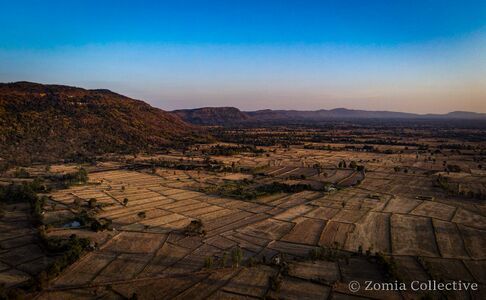 Late afternoon over the Phu Phan hills in the dry season.
-
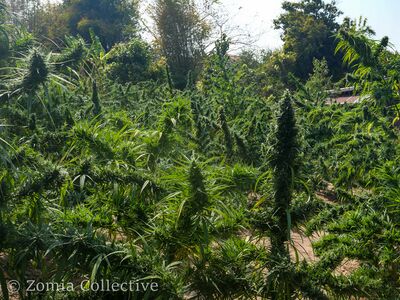 A cannabis field in flower in the Phu Phan hills, January 2025.


See also
References
- ↑ Rujirawan, Attapol; Yodthong, Siriporn; Wanchai, Pratyaporn; Stuart, Bryan L.; Aowphol, Anchalee (14 October 2025). "A new caruncle-bearing Limnonectes (Anura: Dicroglossidae) from the Phu Phan Mountain Range in northeastern Thailand". Tropical Natural History (Supplement 8): 258–275. doi:10.58837/tnh.25.8.266987.
- ↑ 2.0 2.1 2.2 Chenrai, Piyaphong; Jitmahantakul, Sukonmeth; Bissen, Raphael; Assawincharoenkij, Thitiphan (5 August 2022). "A preliminary assessment of geological CO2 storage in the Khorat Plateau, Thailand". Frontiers in Energy Research. 10 909898. doi:10.3389/fenrg.2022.909898.
- ↑ 3.0 3.1 3.2 3.3 Department of Agriculture (Thailand) (July 2021). ประกาศกรมวิชาการเกษตร เรื่อง โฆษณาคำขอให้ออกหนังสือรับรองพันธุ์พืชขึ้นทะเบียน ตามพระราชบัญญัติพันธุ์พืช พ.ศ. ๒๕๑๘ [Notification of the Department of Agriculture: publication of applications for certificates of registered plant varieties under the Plant Varieties Act B.E. 2518] (PDF) (Report) (in ไทย). Retrieved 4 October 2026.
- ↑ 4.0 4.1 "นปพ.สกลฯบุกภูพานเผากัญชาสดมูลค่าร่วม 2 ล้านบาท" [Sakon Nakhon special police raid the Phu Phan and burn fresh cannabis worth nearly 2 million baht]. MGR Online (in ไทย). 31 October 2009. Retrieved 12 October 2026.
- ↑ 5.0 5.1 5.2 "ใหญ่ที่สุดในไทย! ป.ป.ส.ตัดทำลาย 26 แปลงกัญชาลักลอบปลูกป่าลึก" [The largest in Thailand: narcotics office destroys 26 illicit cannabis plots deep in the forest]. Matichon (in ไทย). 6 November 2019. Retrieved 4 October 2026.
- ↑ 6.0 6.1 6.2 "สกลนครลุยตัดทำลายแปลงกัญชาผิดกฎหมายบนเขาภูพาน" [Sakon Nakhon cuts down illegal cannabis plots on the Phu Phan]. Post Today (in ไทย). 18 November 2020. Retrieved 12 October 2026.
- ↑ 7.0 7.1 คุ้มบ้านชาติ, ยุทธศิลป์; จิระพรกุล, ชนัญญา; ตั้งศรีทอง, เนาวรัตน์ (October–December 2015). "ปัจจัยที่มีความสัมพันธ์กับการติดเชื้อมาลาเรียในอำเภอภูพาน จังหวัดสกลนคร" [Factors associated with malaria infection in Phu Phan District, Sakon Nakhon Province]. KKU Journal for Public Health Research (in ไทย). 8 (4): 57–64.
- ↑ 8.0 8.1 พรมพินิจ, สุขขี; วงษ์ชาชม, จำนง; สุทธิบาก, ศมณพร (January–March 2018). "ระบบสารสนเทศภูมิศาสตร์การจัดการน้ำเพื่อการเกษตร พื้นที่ราบลุ่มเชิงเขา ที่ลอนตื้นถึงลอนลึกเทือกเขาภูพาน ตำบลกกปลาซิว อำเภอภูพาน จังหวัดสกลนคร" [Geographical information system for agricultural drainage management on foothill plain, shallow through deep undulating area in Phupan mountain range, Plasew sub-district, Phupan, Sakon Nakon Province]. Graduate Studies Journal (in ไทย). 15 (68). Sakon Nakhon Rajabhat University.
- ↑ "Phu Phan Fm". Thailex: Lexicon of Stratigraphic Names of Thailand. Geolex. Retrieved 12 October 2026.
- ↑ 10.0 10.1 10.2 "อุทยานแห่งชาติภูพาน (Phu Phan)" [Phu Phan National Park]. กองอุทยานแห่งชาติ (in ไทย). Department of National Parks, Wildlife and Plant Conservation. Retrieved 12 October 2026.
- ↑ 11.0 11.1 "อุทยานแห่งชาติภูผาเหล็ก (Phu Pha Lek)" [Phu Pha Lek National Park]. กองอุทยานแห่งชาติ (in ไทย). Department of National Parks, Wildlife and Plant Conservation. Retrieved 12 October 2026.
- ↑ Ruksajai, Narathip; Konyai, Supasit; Sriboonlue, Vichai (2023). "Forecasting soil erosion risk using GIS and remote sensing for the Nam Un Basin, Sakon Nakhon Province, Thailand". Polish Journal of Environmental Studies. 32 (2): 1767–1780. doi:10.15244/pjoes/156791.
- ↑ Choenkwan, Sukanlaya; Fox, Jefferson Metz; Rambo, A. Terry (2014). "Agriculture in the mountains of northeastern Thailand: current situation and prospects for development". Mountain Research and Development. 34 (2): 95–106. doi:10.1659/MRD-JOURNAL-D-13-00121.1.
- ↑ Thai Meteorological Department (2023). สถิติภูมิอากาศของประเทศไทย ในคาบ 30 ปี (พ.ศ.2534-2563) / Climatological Data of Thailand for 30 Year Period (1991–2020) (PDF) (Report). Bangkok: Meteorological Department. Meteorological Data Report No. 551.586-13-2023.
- ↑ มงคลวรวรรณ, พุทธพล (2005). ขบวนการคอมมิวนิสต์ในเขตภูพาน พ.ศ. 2504-2525 [Communist movement in Phu Phan area, 1961–1982] (MA thesis) (in ไทย). Chulalongkorn University. doi:10.58837/CHULA.THE.2005.1849.
- ↑ 16.0 16.1 Nibhatsukit, Warangkana (January–April 2025). "A paradigm shift in policy-making: the evolution of Thailand's anti-communism strategy through Prime Minister's Office Order No. 66/2523". Journal of Arts and Thai Studies. 47 (1) E4312.
- ↑ "Telegram From the Embassy in Thailand to the Department of State, Bangkok, September 17, 1971". Foreign Relations of the United States, 1969–1976, Volume XX, Southeast Asia, 1969–1972. Office of the Historian, United States Department of State. Document 137. Retrieved 12 October 2026.
- ↑ "ศูนย์ศึกษาการพัฒนาตามพระราชดำริภูพาน" [Phu Phan Royal Development Study Centre] (DOC). Environmental Training Kit, Case Study 12 (in ไทย). Mekong River Commission. Retrieved 12 October 2026 – via IW:LEARN archive.
- ↑ Timsuksai, Pijika; Rambo, A. Terry (11 January 2016). "The influence of culture on agroecosystem structure: a comparison of the spatial patterns of homegardens of different ethnic groups in Thailand and Vietnam". PLOS ONE. 11 (1) e0146118. doi:10.1371/journal.pone.0146118.
- ↑ Somkham, Thanatip (2025). "ดนตรีในพิธีกรรมเลี้ยงผีปู่ตาของชาวไทกะเลิง บ้านกุดแฮด อำเภอกุดบาก จังหวัดสกลนคร" [Music in the ancestral spirit ritual of the Tai-Kaleng community in Ban Kut Hat, Kud Bak District, Sakon Nakhon Province]. Rajabhat Maha Sarakham University Journal (in ไทย). 19 (3): 16–24.
- ↑ Appamaraka, Sombat; Saensouk, Surapon; Saensouk, Piyaporn; Junsongduang, Auemporn; Setyawan, Ahmad Dwi (August 2023). "Ethnobotanical knowledge of medicinal plants in the Don Pu Ta Forest by Kaloeng ethnic group, Sakon Nakhon Province, Northeastern Thailand". Biodiversitas Journal of Biological Diversity. 24 (8): 4617–4635. doi:10.13057/biodiv/d240844.
- ↑ Pongnaratorn, Panicha; Sophon, Natthida; Boueroy, Parichart (March 2025). "In vitro antimicrobial activity of Thai stick cannabis Hang Kra Rog Phu Phan (Cannabis sativa L.), sugar leaves extract against pathogenic bacteria". Journal of Advanced Veterinary and Animal Research. 12 (1): 44–52. doi:10.5455/javar.2025.l870.
- ↑ "สภาเกษตรกรฯ จัดเวทีกัญชาที่สกลนคร ถิ่นกัญชาดีที่สุดในโลก" [The Farmers Council holds a cannabis forum in Sakon Nakhon] (Press release) (in ไทย). National Farmers Council. 1 April 2019. Retrieved 12 October 2026.
- ↑ 24.0 24.1 24.2 Hongsuwan, Noppadol; Intaket, Rattana; Khotsombat, Athitaya; Thapseekaeo, Butsaraporn (2022). "ภูมิปัญญาการวิเคราะห์คุณลักษณะภายนอกเพื่อบ่งชี้เพศของต้นกัญชา ในพื้นที่เขตจังหวัดสกลนคร" [The wisdom of analyzing external attributes to determine the sex of the cannabis plant in the area of Sakon Nakhon Province]. Udon Thani Rajabhat University Journal of Sciences and Technology (in ไทย). 10 (1): 27–44.
- ↑ Watanakul, Phurin; Phattaralerphong, Jessada; Pitija, Kitsada; Nakmee, Pattarawadee Sumthong (2024). "Terpenoid profiling of Thai strain cannabis leaves (Cannabis sativa L. subsp. sativa) by headspace (HS) couple with GC/MS". Journal of Pharmacy. 4 (1): 3–11. doi:10.31436/jop.v4i1.225.
- ↑ 26.0 26.1 26.2 Maguire, Peter; Ritter, Mike (2013). Thai Stick: Surfers, Scammers, and the Untold Story of the Marijuana Trade. Foreword by David Farber. Columbia University Press. ISBN 978-0-231-16134-3.
- ↑ Bureau of International Narcotics Matters (March 1990). International Narcotics Control Strategy Report (PDF) (Report). United States Department of State. p. 324. Retrieved 4 October 2026 – via National Criminal Justice Reference Service.
- ↑ "โปรดเกล้าฯ พ.ร.บ.ยาเสพติด ใช้ 'กัญชา-กระท่อม' ทางการแพทย์ได้" [Royal assent to the narcotics act: cannabis and kratom may be used in medicine]. Thai PBS (in ไทย). 19 February 2019. Retrieved 4 October 2026.
- ↑ "กรมแพทย์แผนไทยฯประกาศผลิต 16 ตำรับยากัญชาไทยเสร็จ ก.ค.นี้ ใช้รักษาคนไข้ไม่คิดเงิน!!" [Department of Thai Traditional Medicine to finish producing 16 Thai cannabis formulas by July, for patients free of charge]. Matichon (in ไทย). 7 March 2019. Retrieved 12 October 2026.
- ↑ "ป.ป.ส.ตรวจระบบควบคุมแปลงปลูกกัญชาทำยา และระบบคัดกรองผู้ป่วยรับยา จ.สกลนคร" [Narcotics office inspects the controls on the medical cannabis plots and the patient screening system in Sakon Nakhon]. Thai PBS (in ไทย). 19 December 2019. Retrieved 12 October 2026.
- ↑ "งัด กฎหมาย ปิดทางนำเข้า 'กัญชา-กัญชง' เมล็ดพันธุ์ ช่อดอก เสรี" [Law invoked to close free import of cannabis and hemp seed and flowers]. Thansettakij (in ไทย). 27 January 2022. Retrieved 4 October 2026.
- ↑ "Thailand reclassifies cannabis bud as a controlled herb, restricts sales and advertising". The Nation. 26 June 2025. Retrieved 4 October 2026.
- ↑ "กรมวิทย์ฯ-มทร.อีสาน-ม.มหิดล ร่วมพัฒนากัญชา 4 สายพันธุ์ไทยเพื่อใช้ทางการแพทย์" [Department of Medical Sciences, Rajamangala University of Technology Isan and Mahidol University develop four Thai cannabis cultivars for medical use]. InfoQuest (in ไทย). 6 May 2021. Retrieved 12 October 2026.
- ↑ "เตือนอย่าหลงเชื่อ! ขาย "เมล็ดพันธุ์กัญชา" อ้างขึ้นทะเบียนกรมวิทย์ฯ" [Warning: cannabis seed sold with false claims of registration by the Department of Medical Sciences]. Thai PBS (in ไทย). 30 August 2022. Retrieved 12 October 2026.
- ↑ Charoenchai, Laksana; Monton, Chaowalit; Wunnakup, Thaniya; Madaka, Famera; Wutthipong, Artimond; Songsak, Thanapat (2023). "TLC densitometry analysis of cannabis flower growing in Thailand". Interprofessional Journal of Health Sciences. 21 (1–2) IJHS-0256.