
ZOM-IND-HIM-1120251700
More actions
| Grahan Village General Population 2025 | |
|---|---|
| ZOM-IND-HIM-1120251700 | |

| |
| Landrace Cannabis growing in Grahan Village | |
| At a Glance | |
| Classification | Landrace |
| Accession Type | General population |
| Selection Type | Multiple plants |
| Pollination Type | Open pollination |
| Sex expression | Dioecious |
| Primary Purpose | Multipurpose |
| Flowering time | 16–20 weeks |
| Plant height | 1.5–3.0 m |
| Photoperiod response | Short-day |
| Aroma | Mango, carrot, passion fruit |
| Botanical Characteristics | |
| Plant shape | Columnar |
| Leaflet width | Medium |
| Leaf green colour | Dark |
| Stem colour | Medium green |
| Stigma colour | Brown |
| Leaflet serration | Shallow |
| Also noted | Apical dominance |
| Processing | |
| Method | Charas |
| Hierarchy | |
| Regional Complex | Himalayas |
| Growing Region | Western Himalayas |
| Growing Area | Parvati Valley |
| Appellation | Grahan |
| Location | |
| Country | India |
| Province/State | Himachal Pradesh |
| District | Kullu District |
| Tehsil | Bhuntar Tehsil |
| Block | Bhuntar Block |
| Locality | Grahan |
| Coordinates | 31.973064, 77.348296 |
| Point type | Obfuscated field point |
| Uncertainty | about 500 m |
| Elevation | 2,370 m |
| Aspect | W, SW |
| Traditional Names | |
| Local Name | गाँजा |
| Pronunciation | Gāñjā |
| Collection | |
| Method | Seeds |
| Sourcing Type | Point of Origin |
| Autochthonous | Yes |
| Date | 28 October 2025 |
| Harvest Date | 2024 |
| Collector | Roy |
| Farmer | Ravi |
| Expedition | HIM25 |
| Provenance Evidence | |
| Regional Corroboration | Kullu police report cannabis destroyed on 6,175 bighas in 2019 against 2,700 bighas in 2018 Central Bureau of Narcotics destroys cannabis on 12,900 bighas of forest land in Kullu district |
| Population Corroboration | Police arrest 34 and find 2.83 lakh cannabis plants on forest land in the Manikaran valley |
| Identity Confirmation | None recorded |
| Conservation | |
| Population | Grahan population |
| Field grade | Data deficient · 0 of 23 items |
| Holdings | Data deficient |
| Main lot | Zomia Genetic Library Seed lot: Urgent backup copy backup copy: no backup copy
|
| Legal Threats | Active eradication campaigns |
| Population Est. | 1,000,000 |
| M/F Ratio | 20% |
| Hermaphroditism | 0% |
| Culling | Some |
| Introgression | Minimal |
| Cultivation | |
| Status | Active |
| System Type | Rotating, Monoculture |
| Scale | Widespread regional cultivation |
| Seed Sourcing | Seeds are grown on the farm |
| Planting Method | Broadcasting |
| Cycle 1 Planting | March–May |
| Cycle 1 Harvest | September–December |
| Preservation | |
| Seed Storage | Zomia Genetic Library |
Grahan Village General Population 2025 is a domesticate landrace cannabis accession collected by Roy of the Zomia Collective in Himachal Pradesh, India.
Geography
Grahan village is located in Kullu District, Himachal Pradesh, India, within the Parvati Valley landrace cannabis growing area of the Western Himalayas growing region. The appellation is also named Grahan.
Administratively, the village belongs to Bhuntar Block in the Bhuntar Tehsil of Kullu District, Himachal Pradesh state. The village sits at 2,370 metres elevation on west to southwest facing slopes.
Collection Details
This accession was documented by Roy as part of the HIM25 expedition. A total of 4857 were purchased from a local farmer alias 'Ravi'.
This is a general population accession, the seeds collected from female plants selected by Ravi for rubbing throughout the 2025 growing season.
The seeds come from an autochthonous, cultivated landrace cannabis population of 10000+ plants grown by Ravi in several plots throughout Grahan village and the wider valley.
Cultivation Details
Grahan sits within a traditional charas producing area of the Parvati Valley. Ravi cultivates cannabis on a large scale, within a broader context of widespread regional cultivation. His cultivation of cannabis is guerrilla in style, with plots hidden throughout the village and above it.
The plants are cultivated in terraces, typically in monoculture and historically using a rotational system, though this has largely been disrupted in recent times. The main source of nutrients is cow manure added during vegetative growth and urea during flowering. Beyond cannabis, Ravi grows diverse crops, including but not limited to pulses, grains, local vegetables and herbs.
Ravi heavily culls males but does not select his plants. Pollen comes primarily from nearby feral males and the odd male survivor within the population.
Farmers propagate their own seed stock from year to year, broadcasting seed directly onto prepared plots.
Planting typically occurs between March and May. Harvest takes place between September and December.
Introgression from foreign genetics is considered minimal at this location.
Indoors, the plants are estimated to flower within 16 to 20 weeks.
Botanical Characteristics
The plants reach between 1.5 and 3 metres in height, growing in a columnar pattern with strong apical dominance. Leaf shape is intermediate with shallow serration. Foliage is dark green while the stems run lighter green.
Processing Details
The fresh plants from this valley are traditionally processed into charas by hand rubbing.
Aroma
Mango, carrot, passion fruit.
Effects
Main article: Charas
When processed as charas, the effects vary according to the quality and age of the material. Fresh charas is uplifting, energetic and quite intense with a strong head high. Aged charas tends to be more relaxing, introspective and focused on the body.
Conservation Status
Cultivation remains active across the valley, though the wider area is subject to active eradication campaigns by law enforcement. The 2025 harvest saw moderate police activity with eradications limited largely to the lower elevations of Grahan village.
Gallery
-
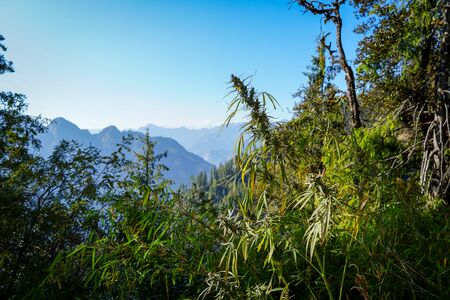 Landrace Cannabis growing in the 'Kutla' fields above Grahan Village (2025)
-
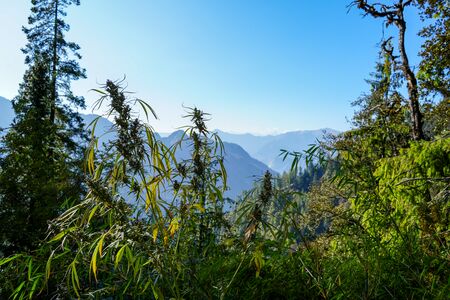 Landrace Cannabis growing in the 'Kutla' fields above Grahan Village (2025)

Smoke Reports
Notes
We arrived late in the season, almost all of the plants had already been cut down by the time we reached Grahan.