Dêqên
More actions
| Dêqên | |
|---|---|
| Diqing; 迪庆 (Díqìng); Deqin; 德钦 (Déqīn); A-tun-tzu | |
| ActiveGrown here in 2000 or later | |
| Hierarchy | |
| Growing Region | Yunnan |
| Geography | |
| Country | China |
| Province/State | Yunnan |
| Tibetan autonomous prefecture | Diqing |
| Coordinates | 27.83, 99.71 |
| Landscape | |
| Area | 23,000 km² |
| Terrain | Valleys of the Yangtze (Jinsha) and Mekong in north-western Yunnan, in Shangri-La City and the counties of Dêqên and Weixi; approximately the Dêqên (Diqing) Tibetan Autonomous Prefecture; ground above 4,000 m and bare ground are left out |
| Growing history | |
| Dated accessions | 1935–1937 |
| Documentation | |
| Appellations | 0 |
| Accessions | 3 |
| Conservation | |
| Populations | none documented yet |
Dêqên is a cannabis growing area in north-western Yunnan, China, drawn on the Dêqên (Diqing, 迪庆) Tibetan Autonomous Prefecture. Herbarium labels of the 1930s print the name of its county, Deqin (德欽, now written 德钦), with A-tun-tze,[1] the A-tun-tzu of Joseph Rock[2]: vol. 2, p. 334 and the A-tun-tsi of Frank Kingdon Ward. The area is part of the Yunnan growing region. Travellers counted the country as part of Kham: in his chapter on A-tun-tsi, Kingdon Ward writes of "the native of S.E. Tibet or Kham".[3]: 53 In 1911 he saw hemp grown in quantity on terraced slopes above the Yangtze.[3]: 174 The Naxi of Baidi village, in Shangri-La, use hemp seed for oil,[4] and in 2025 and 2026 the police of Xiaruo, in Dêqên County, cleared plants they identified as wild cannabis.[5][6]
Hemp fields on the Yangtze
Kingdon Ward spent 1911 collecting plants in western China and south-eastern Tibet for the Liverpool horticultural firm Bees Ltd.[3]: preface On his second journey to the Yangtze he spent a night at the village of Tung-chu-ling, below its monastery, and sent his porters on to Pang-tsi-la, a ferry on the river.[3]: 162–163 Where the valley opened on the Yangtze, a terraced and irrigated alluvial fan carried crops of cotton, tobacco and hemp, fields of barley and pomegranate, peach, orange and walnut trees.[3]: 163
On a third journey he reached Mo-ting, a village of 40 or 50 families on a spur 300 m or more (a thousand feet) above the Yangtze. Its slope was terraced and watered by a mountain torrent led into side channels. Hemp was grown there in quantity and reached about 3 m (ten feet), with crops of millet, wheat, barley and buckwheat.[3]: 174
Hemp cloth
In Kingdon Ward's account the poor Tibetan of A-tun-tsi wore one long robe, tied up into a kilt by day and slept in at night: "Year in and year out, night and day, this coarse hempen cloak serves the poor Tibetan for clothing."[3]: 53 From late May to the end of September the herdsmen grazed sheep and yak on the alpine pastures above the town, living in small ridge-tents of brown hemp cloth.[3]: 110–111
Rock quotes the provincial gazetteer, the Yün-nan T'ung-chih, on the La-mao people of the Mekong valley at Hsiao-wei-hsi, in Weixi: "They weave hemp cloth, plant fields, and pay taxes in kind."[2]: vol. 2, pp. 304–305 At Baidi, some Naxi still spin hemp, a craft rarely seen in other Naxi districts. The Naxi call hemp sa and its cloth pei, which also served for the long painted scrolls of their priests.[7]
Seed
Yanfei Geng and colleagues interviewed 86 Naxi of Baidi, in Sanba township of Shangri-La, in 2013 and 2014 about the wild plants they eat. They list hemp seed, which the Naxi call samei, dried and boiled in water, among the plants used for oil and fat; hemp and the walnut Juglans mandshurica were the two most commonly used.[4]
Wild stands
On 11 September 2025 the Dêqên County police reported that officers of the Xiaruo station had come upon plants they took for cannabis while at work in their area, confirmed on the spot that they were wild cannabis and pulled up more than 30 plants.[5] In September 2026 officers of the same station found several plants by a roadside, identified them as wild cannabis and cleared them, more than 10 in all. They told villagers that private planting, picking and eating were strictly forbidden.[6]
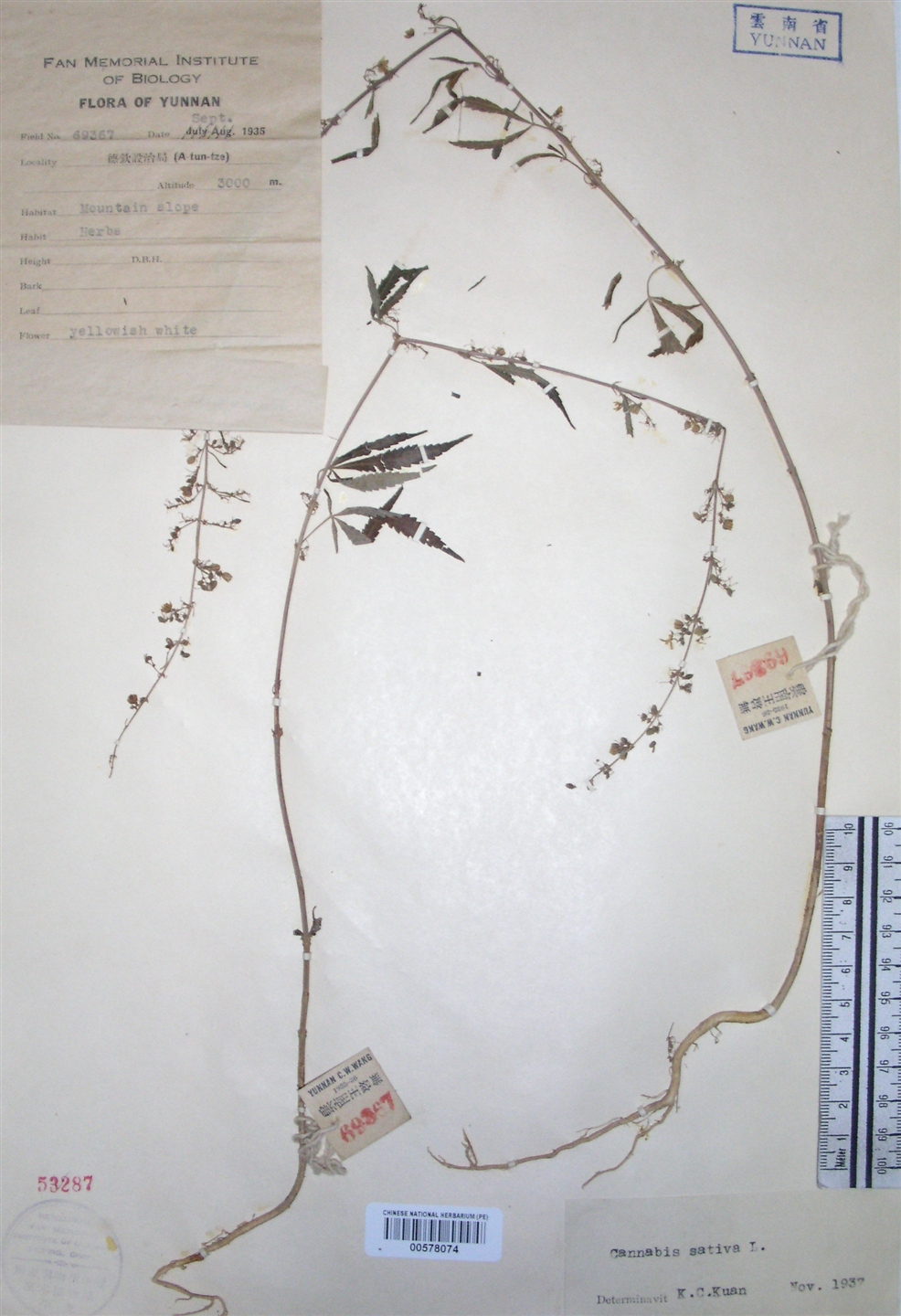
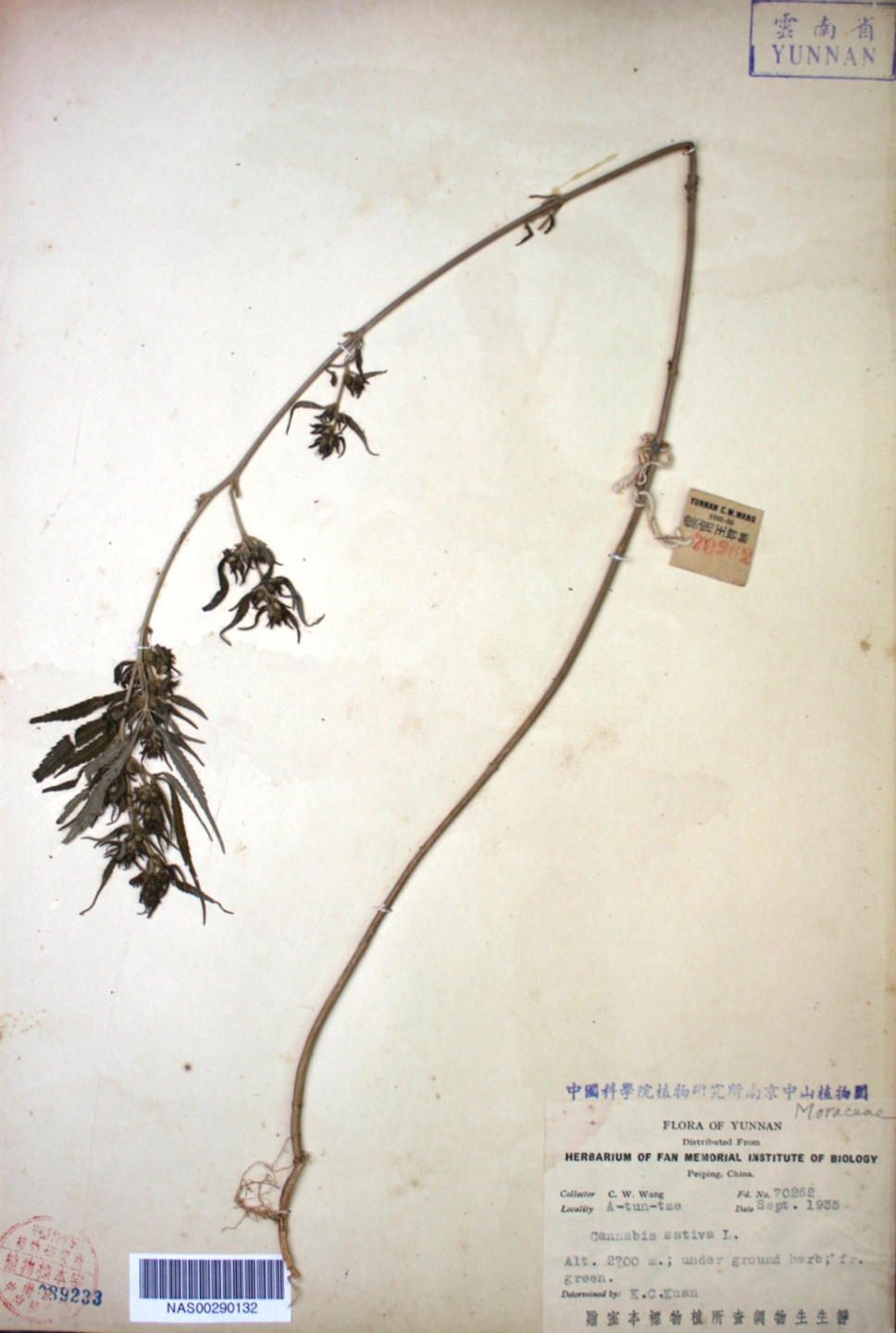
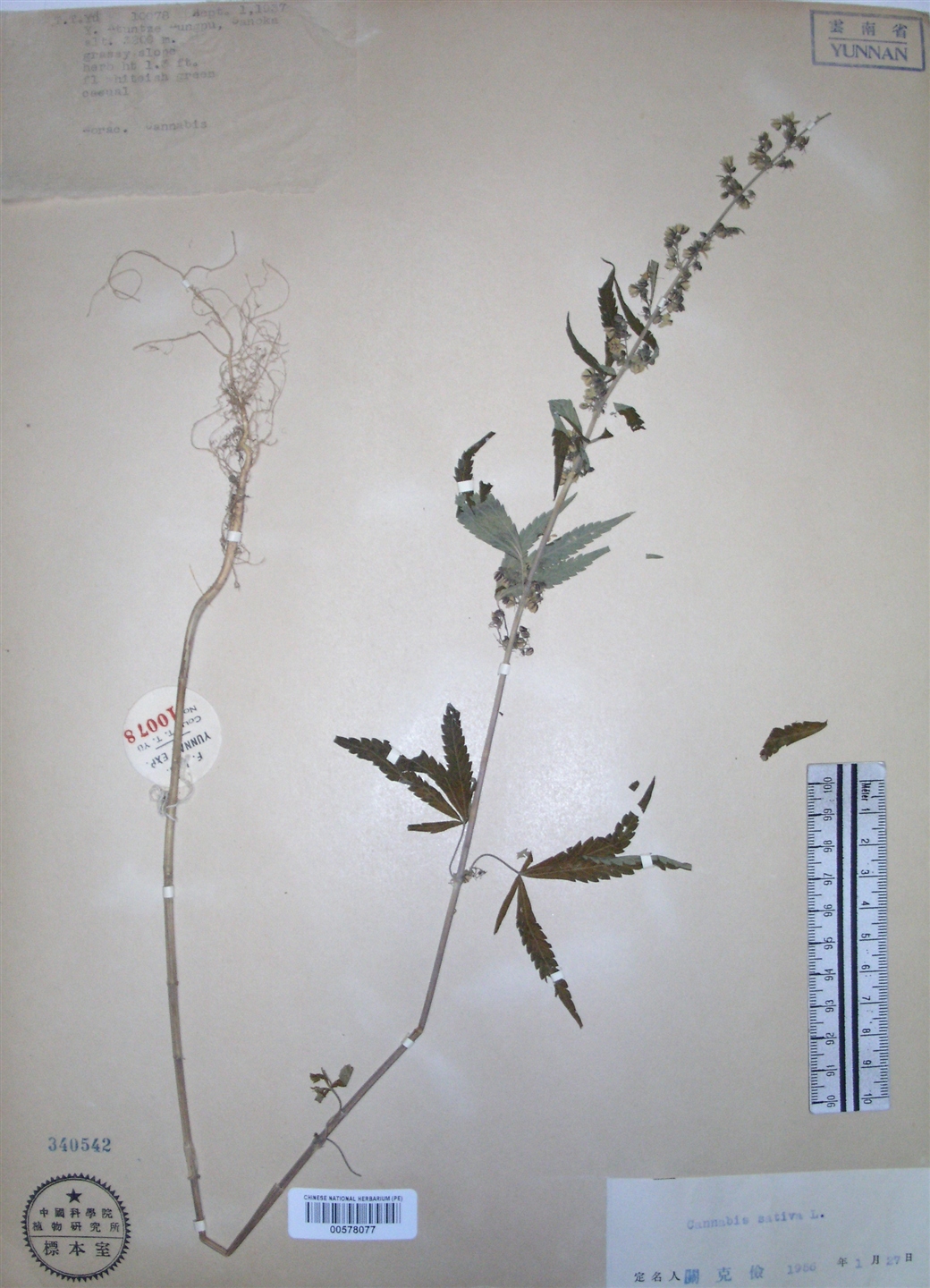
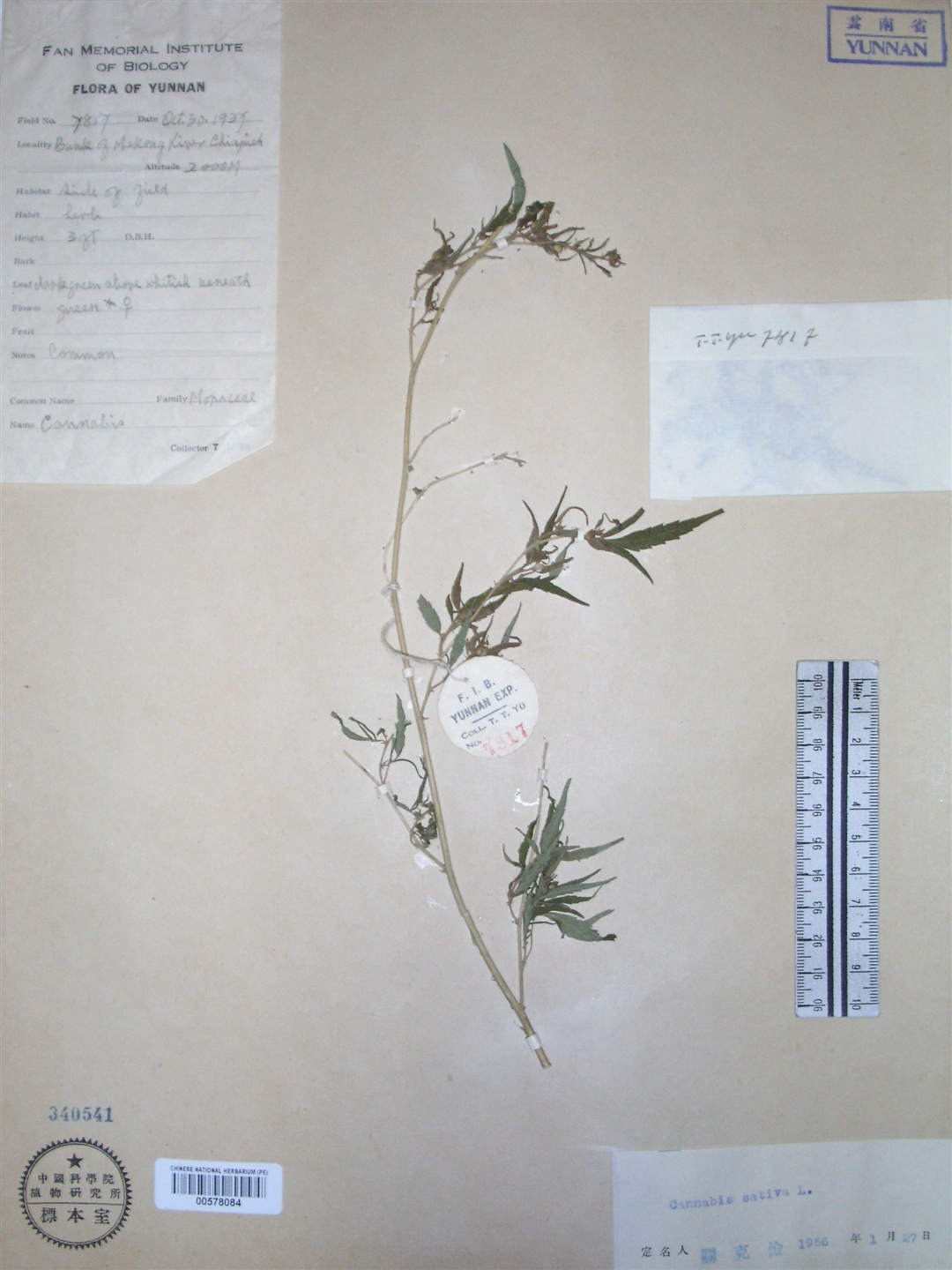
Collectors of the Fan Memorial Institute of Biology gathered cannabis in the area in the 1930s. C. W. Wang collected it at A-tun-tze in September 1935, on a mountain slope at 3,000 m (Wang 69367 (1935))[1] and at 2,700 m (Wang 70262 (1935)).[8] T. T. Yü found it on a grassy slope at 3,200 m on 1 September 1937, with the note casual (Yu 10078 (1937)),[9] and at the side of a field on the bank of the Mekong at Chiapieh on 30 October 1937, with the note Common (Yu 7817 (1937)).[10] An earlier sheet of J. A. Soulié, from Tsekou, is labelled Thibet oriental (eastern Tibet) and was received in Paris on 8 July 1903 (Soulié 1224 (by 1903)).[11]
Appellations
No appellation pages exist for this growing area yet.
Accessions
| Accession ID | Name | Locality | Elevation | Collected |
|---|---|---|---|---|
| Wang 69367 (1935) | Wang 69367 herbarium specimens, A-tun-tze, Yunnan (1935) | 德欽設治局 (A-tun-tze) | 3,000 m | |
| Yu 10078 (1937) | Yu 10078 herbarium specimens, Atuntze, Yunnan (1937) | 3,200 m | ||
| Yu 7817 (1937) | Yu 7817 herbarium specimens, Mekong River at Chiapieh, Yunnan (1937) | Bank of Mekong River, Chiapieh | 2,000 m |
Recent news
No news items are recorded for this growing area yet.
See also
References
- ↑ 1.0 1.1 "Digitised sheet PE 00578074: Cannabis sativa". Chinese Virtual Herbarium image service. Institute of Botany, Chinese Academy of Sciences. Retrieved 13 October 2026.
- ↑ 2.0 2.1 Rock, Joseph F. (1947). The Ancient Na-khi Kingdom of Southwest China. Harvard-Yenching Institute Monograph Series. Cambridge, Mass.: Harvard University Press.
- ↑ 3.0 3.1 3.2 3.3 3.4 3.5 3.6 3.7 Kingdon Ward, F. (1913). The Land of the Blue Poppy: Travels of a Naturalist in Eastern Tibet. Cambridge: Cambridge University Press.
- ↑ 4.0 4.1 Geng, Yanfei; Zhang, Yu; Ranjitkar, Sailesh; Huai, Huyin; Wang, Yuhua (2016). "Traditional knowledge and its transmission of wild edibles used by the Naxi in Baidi Village, northwest Yunnan province". Journal of Ethnobiology and Ethnomedicine. 12 (1) 10. doi:10.1186/s13002-016-0082-2.
- ↑ 5.0 5.1 发现即铲除!禁毒踏查铲除野生大麻30余株 [Cleared on sight: an anti-drug patrol eradicates more than 30 wild cannabis plants]. 德钦县人民政府 (in 中文). 德钦县公安局. 11 September 2025. Retrieved 22 October 2026.
- ↑ 6.0 6.1 霞若派出所开展禁种铲毒专项行动 [Xiaruo police station carries out a campaign against illicit planting and for eradication]. 迪庆禁毒 (in 中文). 德钦警方. 22 September 2026. Retrieved 22 October 2026 – via 搜狐.
- ↑ "【香格里拉故事】纳西族传统纺麻技艺" [Shangri-La stories: the traditional Naxi hemp-spinning craft]. 澎湃新闻 (in 中文). 香格里拉发布. 19 August 2021. Retrieved 3 October 2026.
- ↑ "Digitised sheet NAS00290132: Cannabis sativa". Chinese Virtual Herbarium image service. Institute of Botany, Chinese Academy of Sciences. Retrieved 13 October 2026.
- ↑ "Digitised sheet PE 00578077: Cannabis sativa". Chinese Virtual Herbarium image service. Institute of Botany, Chinese Academy of Sciences. Retrieved 13 October 2026.
- ↑ "Digitised sheet PE 00578084: Cannabis sativa". Chinese Virtual Herbarium image service. Institute of Botany, Chinese Academy of Sciences. Retrieved 13 October 2026.
- ↑ "Digitised sheet P06884291: Cannabis sativa L." Herbier national, images. Muséum national d'Histoire naturelle. Retrieved 12 October 2026.