Yunnan
More actions
| Yunnan | |
|---|---|
| ActiveCannabis last recorded here in 2024 | |

| |
| Hani rice terraces in southern Yunnan | |
| Location | |
| Coordinates | 25.04, 102.71 |
| Country | China |
| Provinces/States | Yunnan |
| Area | 382,800 km² |
| Growing history | |
| Dated accessions | 1906–1941 |
| Dated news reports | 2024 |
| Conservation | |
| Populations | none documented yet |
Yunnan is a cannabis growing region of China, drawn on Yunnan Province in the south-west of the country, on the frontiers with Myanmar, Laos and Vietnam. Hemp was grown there for fibre, cloth and seed before the province began to license industrial hemp in 2010: a survey published in 1993 classified 23 principal varieties from 17 of its counties,[1] and herbarium labels of 1906 and 1940 record the plant cultivated at Dali and at Songming.[2][3] On the Myanmar border the police clear wild stands.[4] The region's growing areas are Dêqên, Lijiang and Nujiang.
Geography
The region follows the borders of Yunnan Province. High ground above 4,000 m, glaciers and bare rock are left out at the outer edge; in the north-west, where the region takes in its growing areas Dêqên and Nujiang whole, the edge follows the ridges round their valleys. This leaves about 382,800 km².
Local hemp
A survey of 23 principal varieties from 17 counties of Yunnan, published in 1993, classed 43.5 per cent as drug type, 26.1 per cent as intermediate and 30.4 per cent as fibre type.[1] The first industrial-hemp cultivar of the province, Yunma No. 1 (云麻1号), was selected from a Yunnan local variety and approved by the provincial variety approval committee in July 2001.[5] Hemp was grown in Yunnan before the licensing regulation existed, and in 2019 people in parts of the province still ate the seed.[6]
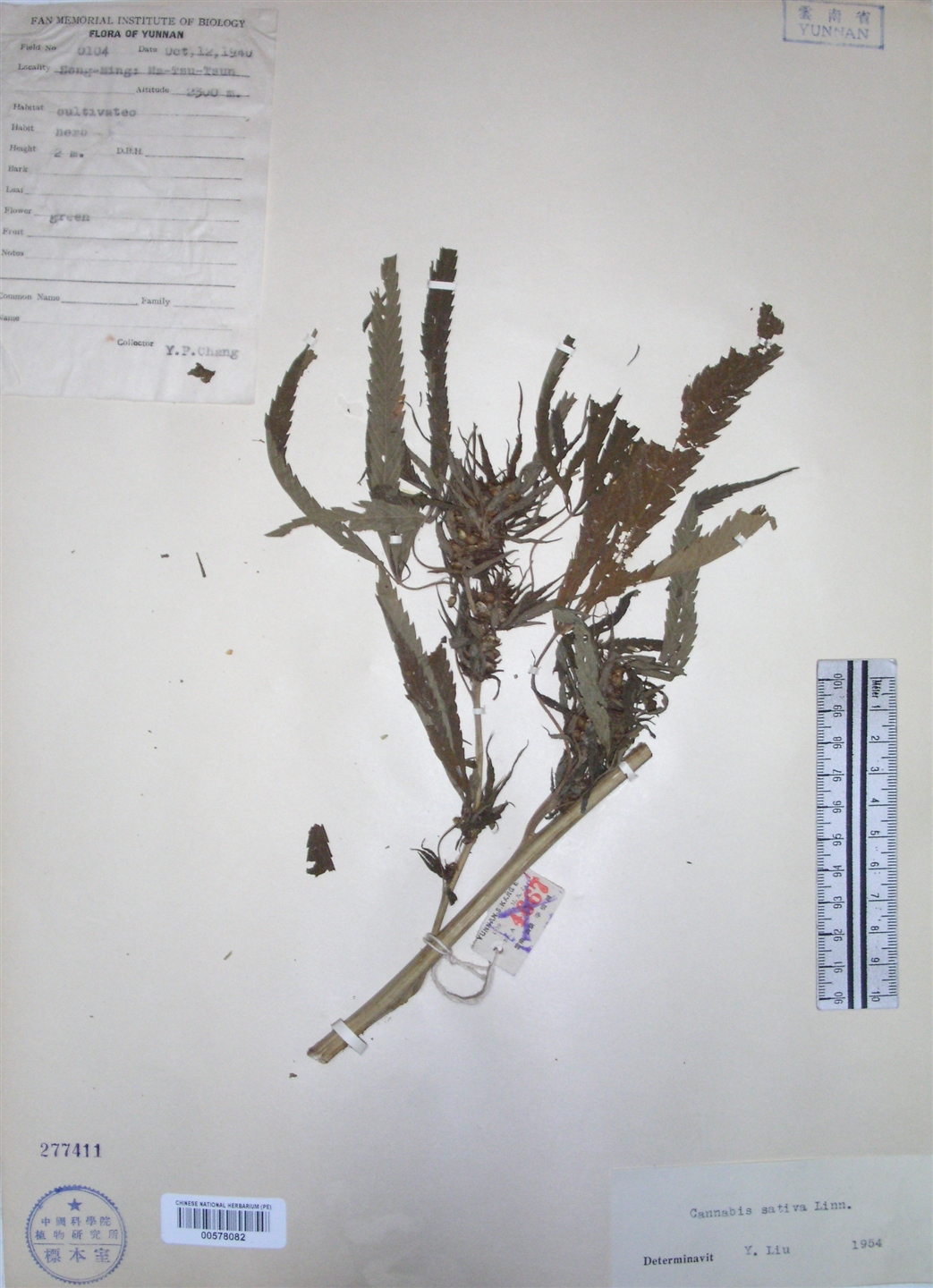
Herbarium sheets record the crop. George Forrest found it on open, stony ground around the city of Dali (Tali) in the summer of 1906 and wrote on his label Cultivated by the Chinese (Forrest 4761 (1906)).[2] The three sheets of Augustine Henry's number 11209, one labelled Yunnan, Mengtze (Mengzi) and two Feng Chen Lin at 6,000 feet, are all marked cultd.; the two add woven into cloth worn by the aborigines, and the Edinburgh sheet was bought in 1898 (Henry 11209 (s.d.)).[7][8][9] In October 1940 Y. P. Chang collected a cultivated plant 2 m high at Ma-Tsu-Tsun in Songming (Chang 0104 (1940)).[3]
Peoples and uses
The Yi of Mile press oil from hemp seed, which they call zime, and use the seed and root as a deobstruent and to moisten the lungs.[10] The Yi of Xiaoliangshan, in Lijiang, name cannabis among the plants they have cultivated for a very long time.[11] At Baidi village in Sanba township, Shangri-La, some Naxi artisans still spin hemp; the Naxi name for hemp is sa and its cloth is pei.[12] Hemp seed, samei, is among the plants the Naxi of Baidi use most for oil and fat.[13] The costume of the Miao of Changning, in Baoshan, entered on the first national list of intangible cultural heritage in 2006, is made mainly of locally produced huǒmá (火麻, hemp) homespun.[14] Among the Hmong of Wenshan cotton replaced hemp in everyday dress from the 1980s, but burial clothing must still be made of hemp.[15]
Wild stands
Zhang and colleagues sampled wild cannabis in Yunnan between 2011 and 2016. Yunnan is one of the seven provinces whose wild populations they describe as covering "the only distribution ranges of extant wild" cannabis in China.[16]
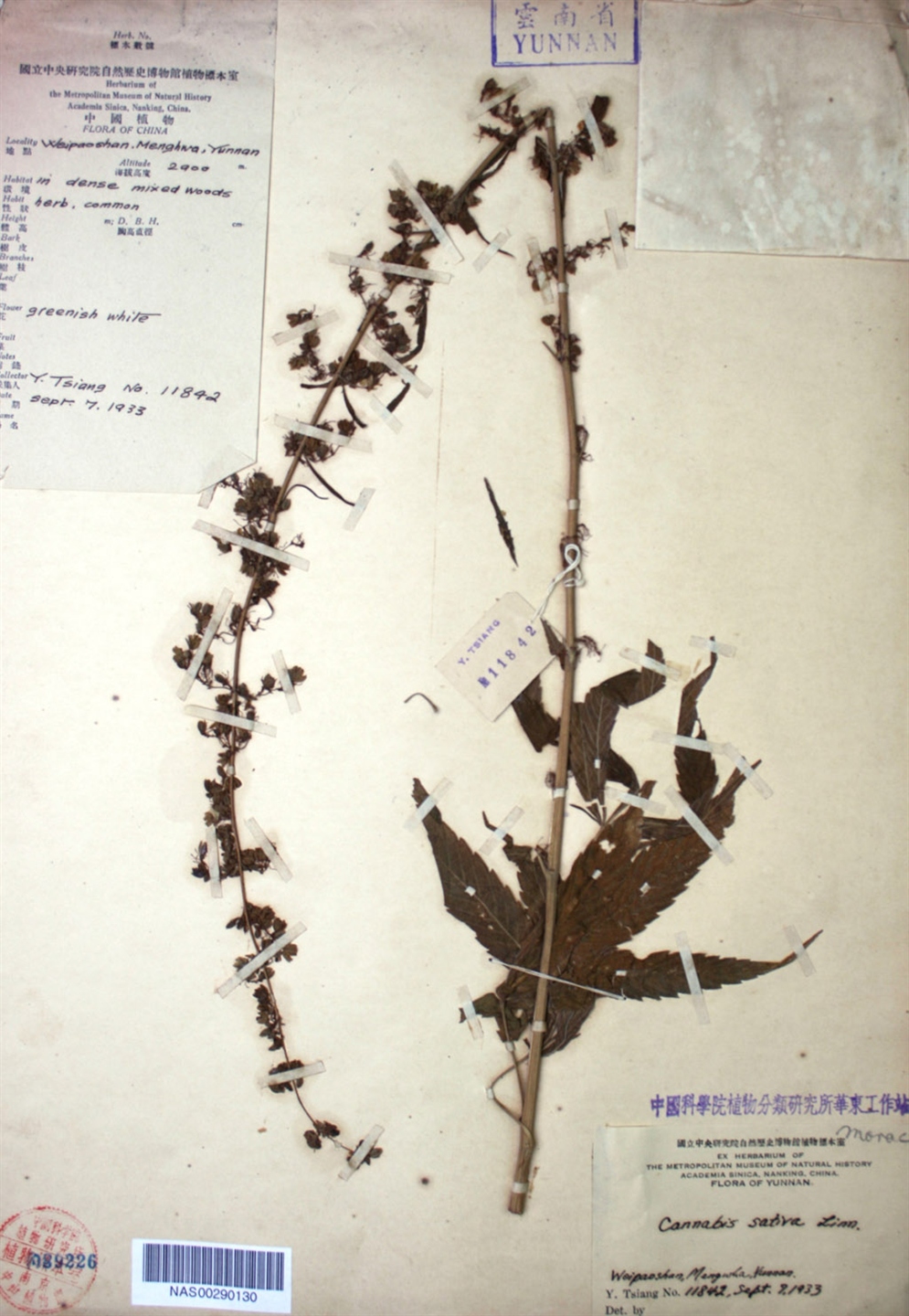
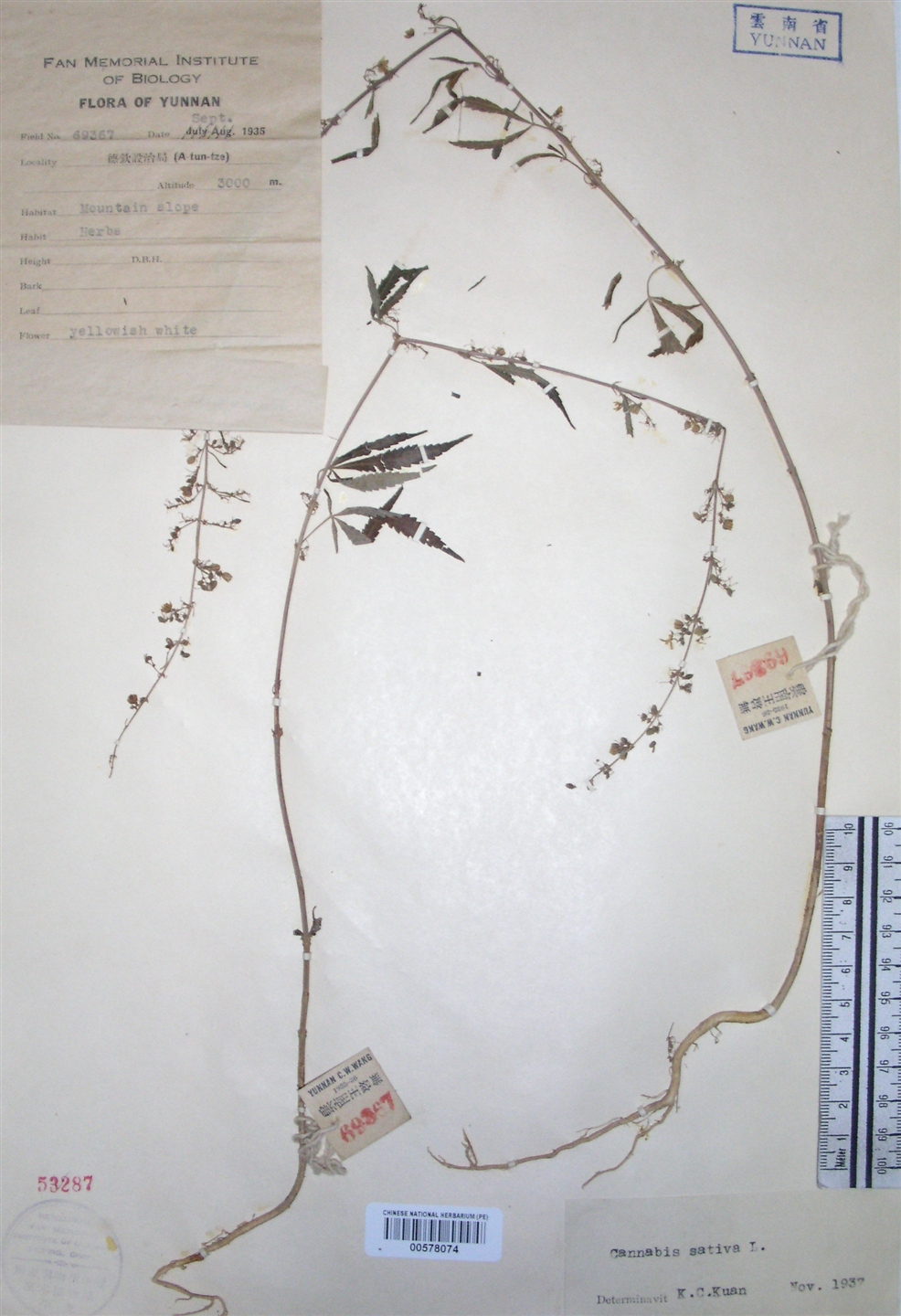
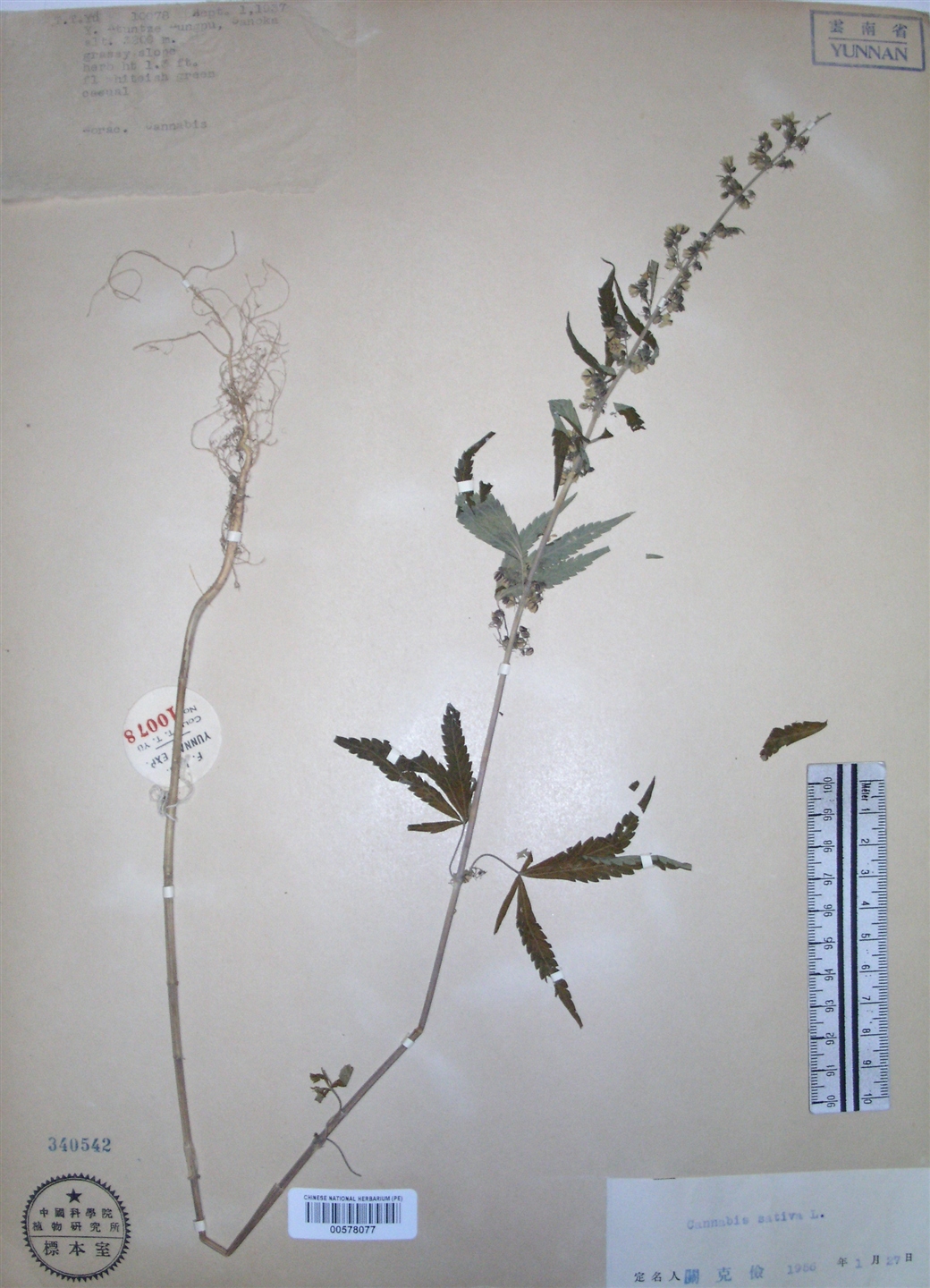
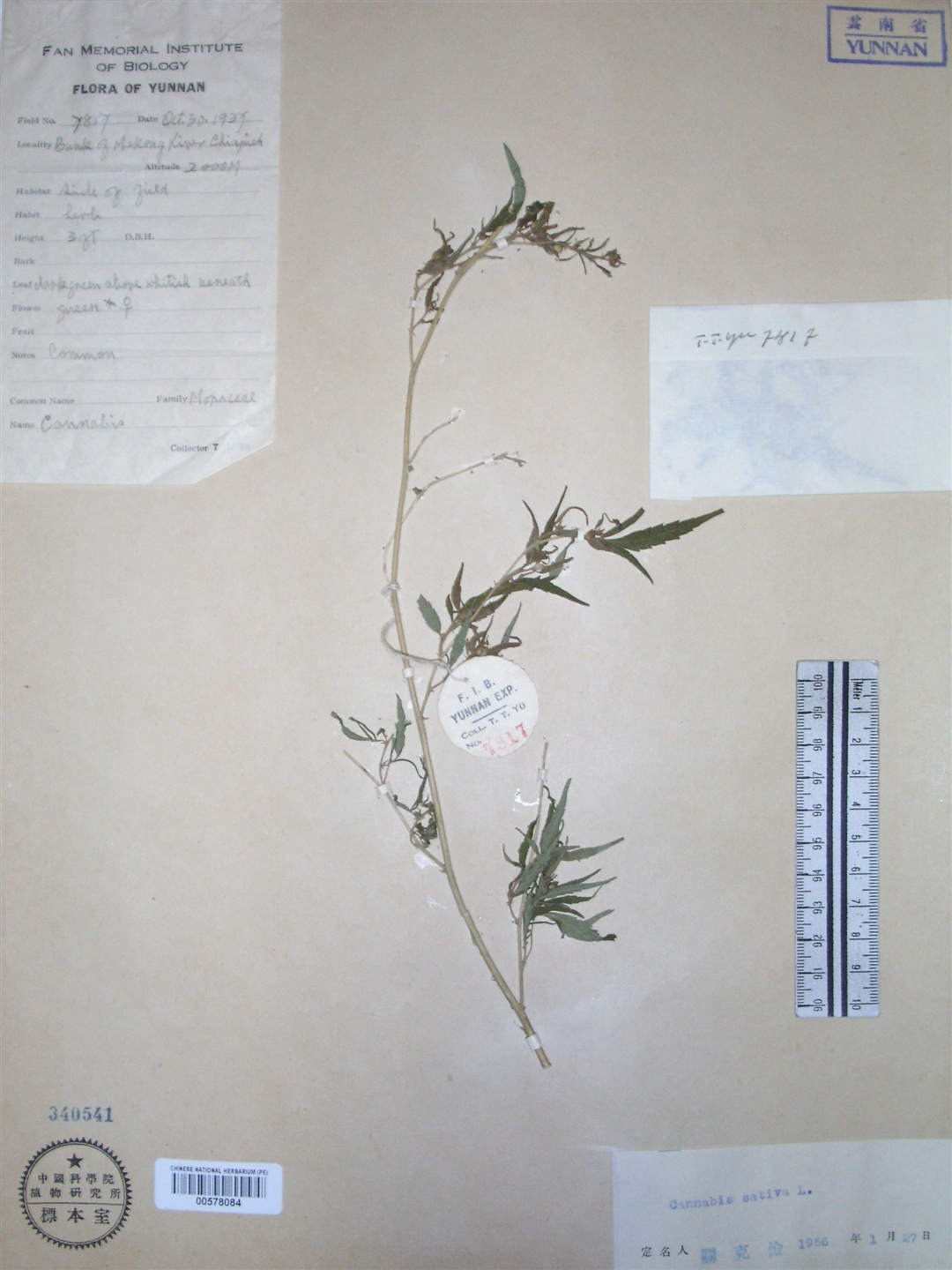
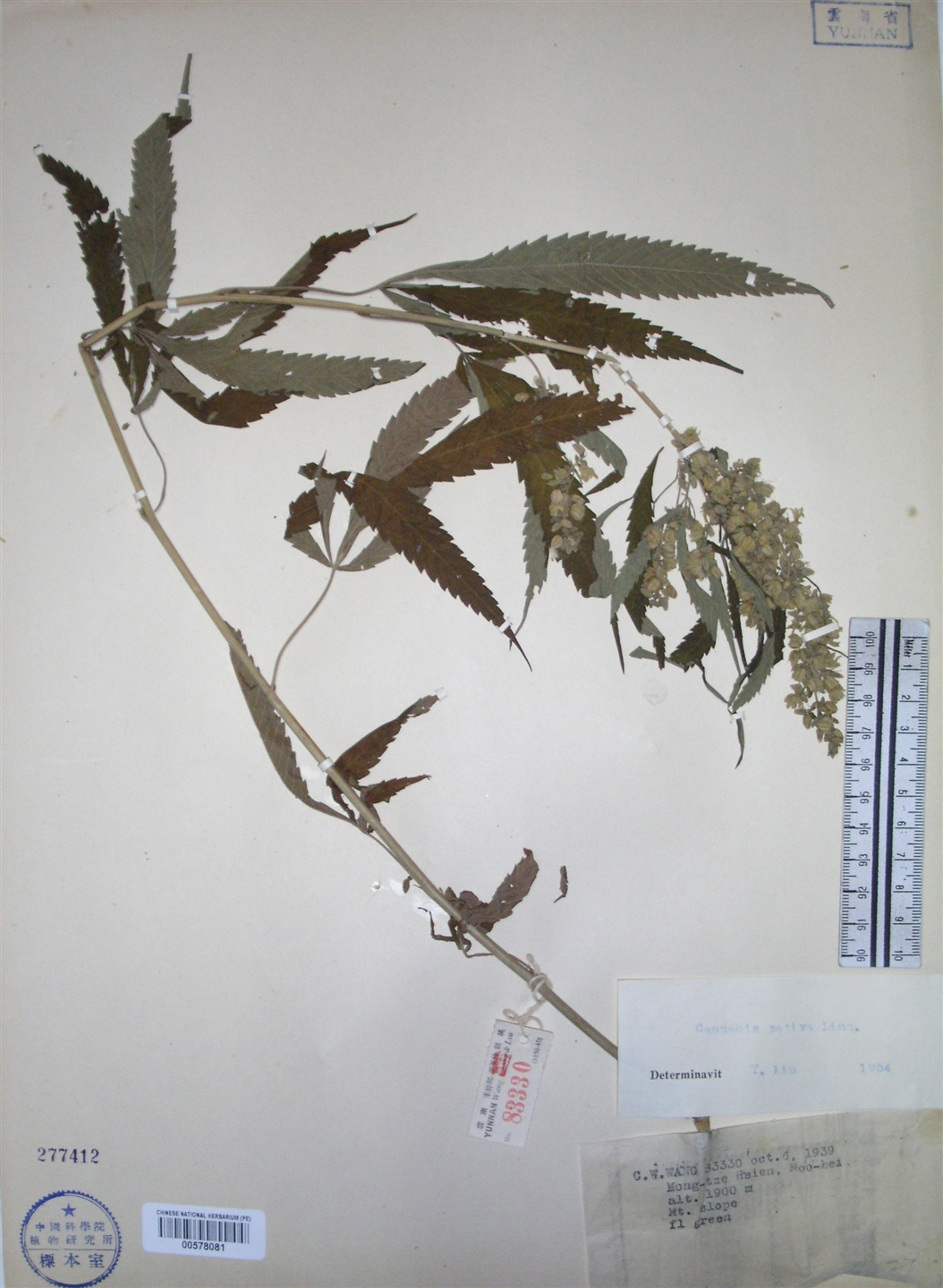
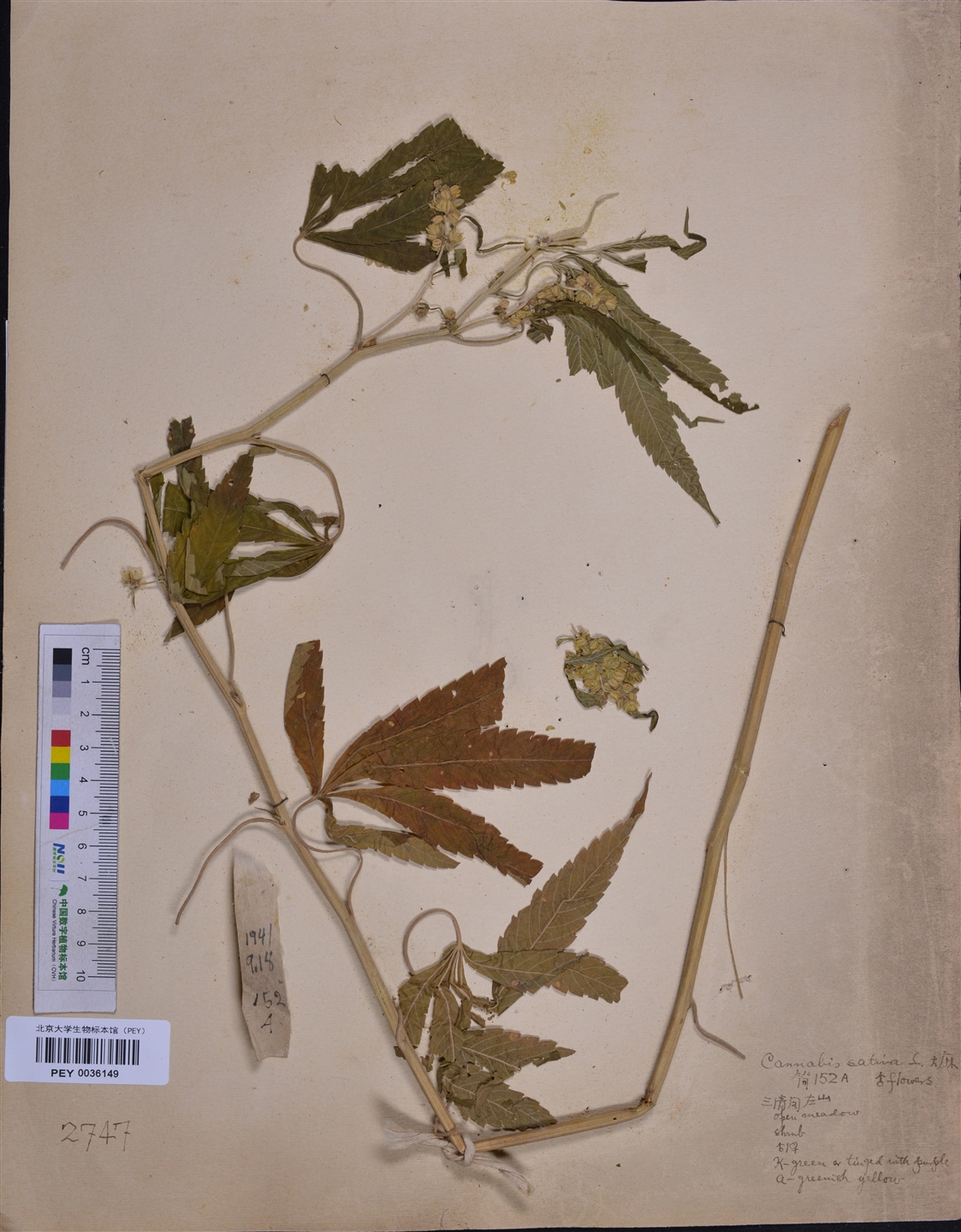
Herbarium collectors of the 1930s and 1940s gathered it away from fields. Y. Tsiang found it in dense mixed woods at 2,900 m on Weibao Shan, Menghua, in September 1933 (Tsiang 11842 (1933)).[17] Near Deqin (Atuntze), in Dêqên, C. W. Wang collected it on a mountain slope at 3,000 m in 1935 (Wang 69367 (1935)), and T. T. Yü on a grassy slope at 3,200 m in 1937, with the note casual (Yu 10078 (1937)).[18][19] Yü's label of October 1937 from the side of a field on the bank of the Mekong at Chiapieh calls it Common (Yu 7817 (1937)).[20] Wang collected it again on a mountain slope in Mengzi county in 1939 (Wang 83330 (1939)),[21] and a collector who signed the sheet 簡 (Chien) gathered it in an open meadow on the hill beside the Sanqing Ge at Kunming in 1941 (Chien 152 (1941)).[22]
In 2022 a man went several times into the mountains of Fugong County to pick the leaves of wild cannabis, which he dried for his own use and sold; in 2024 the Yunnan High People's Court published the Fugong court's sentence of five years as one of its typical drug cases.[23] On the Myanmar border in Lincang, by a report of 7 September 2026 the Nuoliang border police station had used a drone for the first time to search forests and gullies that patrols on foot could hardly reach, and had found a continuous stand of about 500 wild plants, which the police and border guards counted and cleared.[4] Police of the Junsai station in Zhenkang County found wild plants by a road on patrol in 2026 and cleared them.[24] In Weixi County, in July 2026, the Tacheng town police found plants they called wild cannabis growing in a resident's vegetable garden; after explaining the law to the resident, they cleared them with the resident's help.[25]
Licensed industrial hemp
Yunnan's licensing regulation, Order 156 of the provincial government, came into force on 1 January 2010. It defines industrial hemp as plants with less than 0.3 per cent THC by dry weight, and requires licensed growers to eradicate other cannabis within 3 kilometres of their fields or report it to the police.[26] The provincial police were still citing the regulation as the basis for licences in April 2026.[27] Between 2010 and 2014, according to the narcotics bureau of the provincial police, more than 220,000 mu of industrial hemp were licensed in 38 counties of 13 prefectures, among them Kunming, Yuxi, Honghe, Wenshan, Chuxiong, Lijiang, Baoshan, Qujing and Xishuangbanna.[28] In 2020 more than 90 companies held cultivation licences and grew 90,000 mu (about 6,000 hectares);[29] by April 2021 the province had issued 171 cultivation licences.[30] In 2024 the cultivar Yunma 8 covered more than 90 per cent of the province's industrial-hemp area.[31]
In the Xishuangbanna communities surveyed by Shen and colleagues, hemp was a cash crop that the government had promoted since 2004.[32] At Douwen village in Shizong County, where a company set up an industrial-hemp base in 2016, no one in the village had grown hemp before.[6]
Growing Areas
Accessions
| Accession ID | Name | Collected | Locality | Area |
|---|---|---|---|---|
| Chang 0104 (1940) | Chang 0104 herbarium specimen, Song-Ming, Yunnan (1940) | Song-Ming: Ma-Tsu-Tsun | ||
| Chien 152 (1941) | Chien 152 herbarium specimens, Sanqing Ge, Kunming (1941) | 三清閣左山 (the hill left of the Sanqing Ge) | ||
| Forrest 4761 (1906) | Forrest 4761 herbarium specimen, Tali, Yunnan (1906) | Around the city of Tali (Dali) | ||
| Henry 11209 (s.d.) | Henry 11209 herbarium specimen, Feng Chen Lin, Yunnan (undated) | Feng Chen Lin | ||
| Rock 10802 (1923–1924) | Rock 10802 herbarium specimen, Likiang Snow Range (1923–1924) | Eastern slopes of the Likiang Snow Range | Lijiang | |
| Tsiang 11842 (1933) | Tsiang 11842 herbarium specimens, Weipaoshan, Menghwa (1933) | Weipaoshan, Menghwa | ||
| Wang 69367 (1935) | Wang 69367 herbarium specimens, A-tun-tze, Yunnan (1935) | 德欽設治局 (A-tun-tze) | Dêqên | |
| Wang 83330 (1939) | Wang 83330 herbarium specimen, Mong-tze Hsien, Yunnan (1939) | Mong-tze Hsien, Moo-bei | ||
| Yu 10078 (1937) | Yu 10078 herbarium specimens, Atuntze, Yunnan (1937) | Dêqên | ||
| Yu 7817 (1937) | Yu 7817 herbarium specimens, Mekong River at Chiapieh, Yunnan (1937) | Bank of Mekong River, Chiapieh | Dêqên |
Recent news
| Article | Date | Category | Area | Locality | Plants |
|---|---|---|---|---|---|
| News:2024-06-26/Enforcement/fugong-county-court-sentences-a-man-to-five-years-for-repeatedly-selling-wild-picked-cannabis-leaves-nujiang-y | Enforcement | Nujiang |
See also
References
- ↑ 1.0 1.1 Chen, Qiben; Yu, Lihui; Yang, Ming; Yin, Jianye; Xu, Wei (1993). 云南栽培大麻的化学类型 [Chemical types of cultivated cannabis in Yunnan]. 广西植物 (in 中文) (2): 184–187. Retrieved 3 October 2026 – via 云南省农业科学院机构知识库.
- ↑ 2.0 2.1 "Digitised sheet E01459306, IIIF manifest". RBGE IIIF image service. Royal Botanic Garden Edinburgh. Retrieved 9 October 2026.
- ↑ 3.0 3.1 "Digitised sheet PE 00578082: Cannabis sativa". Chinese Virtual Herbarium image service. Institute of Botany, Chinese Academy of Sciences. Retrieved 13 October 2026.
- ↑ 4.0 4.1 "中缅边境一线500株野生大麻植株被铲除" [500 wild cannabis plants cleared on the China–Myanmar border]. 光明网 (in 中文). 法治日报. 7 September 2026. Retrieved 21 October 2026.
- ↑ Yang, Ming; Guo, Hongyan; Wen, Guosong; Wu, Wei; Qian, Jinliang (2003). 大麻新品种云麻1号的选育及其栽培技术 [Breeding of the new hemp cultivar Yunma No. 1 and its cultivation techniques]. 中国麻业 (in 中文). 25 (1). ISSN 1671-3532. Retrieved 3 October 2026 – via 云南省农业科学院机构知识库.
- ↑ 6.0 6.1 张译予 (22 April 2019). "从种植到产品,关于工业大麻你不知道的还有这些" [From planting to products: what you may not know about industrial hemp]. 界面新闻 (in 中文). Retrieved 21 October 2026.
- ↑ "Digitised sheet 01414425: Henry 11209". Virtual Herbarium image service. New York Botanical Garden. Retrieved 8 October 2026.
- ↑ "Digitised sheet E01459302, IIIF manifest". RBGE IIIF image service. Royal Botanic Garden Edinburgh. Retrieved 8 October 2026.
- ↑ "Digitised sheet MO-105656990: Cannabis sativa L." Tropicos image service. Missouri Botanical Garden. Retrieved 8 October 2026.
- ↑ Sun, Jingxian; Xiong, Yong; Li, Yanhong; Yang, Qingsong; Chen, Yijian; Jiang, Mengyuan; Li, Yukui; Li, Hongrui; Bi, Zizhen; Huang, Xiangzhong; Lu, Shugang (2020). "Medicinal dietary plants of the Yi in Mile, Yunnan, China". Journal of Ethnobiology and Ethnomedicine. 16 (1) 48. doi:10.1186/s13002-020-00400-5.
- ↑ Addi, Yi-Won; Zhang, Yu; Ding, Xiao-Yong; Guo, Chang-An; Wang, Yu-Hua (2022). "A study of the plant folk nomenclature of the Yi people in Xiaoliangshan, Yunnan Province, China, and the implications for protecting biodiversity". Journal of Ethnobiology and Ethnomedicine. 18 (1) 18. doi:10.1186/s13002-022-00504-0.
- ↑ "【香格里拉故事】纳西族传统纺麻技艺" [Shangri-La stories: the traditional Naxi hemp-spinning craft]. 澎湃新闻 (in 中文). 香格里拉发布. 19 August 2021. Retrieved 3 October 2026.
- ↑ Geng, Yanfei; Zhang, Yu; Ranjitkar, Sailesh; Huai, Huyin; Wang, Yuhua (2016). "Traditional knowledge and its transmission of wild edibles used by the Naxi in Baidi Village, northwest Yunnan province". Journal of Ethnobiology and Ethnomedicine. 12 (1) 10. doi:10.1186/s13002-016-0082-2.
- ↑ "苗族服饰(昌宁苗族服饰)" [Miao costume (Changning Miao costume)]. 中国非物质文化遗产网 (in 中文). X-65. Retrieved 3 October 2026.
- ↑ Sato, Wakana (2018). 宮脇千絵『装いの民族誌―中国雲南省モンの「民族衣装」をめぐる実践』 [Review of Miyawaki Chie, Ethnography of Dress: Practices Related to "Ethnic Dress" among the Hmong in Yunnan, China]. 東南アジア研究 [Japanese Journal of Southeast Asian Studies] (in 日本語). 55 (2): 412–414. doi:10.20495/tak.55.2_412.
- ↑ Zhang, Q.; Chen, X.; Guo, H.; Trindade, L.M.; Salentijn, E.M.J.; Guo, R.; Guo, M.; Xu, Y.; Yang, M. (2018). "Latitudinal adaptation and genetic insights into the origins of Cannabis sativa L." Frontiers in Plant Science. 9 1876. doi:10.3389/fpls.2018.01876.
- ↑ "Digitised sheet NAS00290130: Cannabis sativa". Chinese Virtual Herbarium image service. Institute of Botany, Chinese Academy of Sciences. Retrieved 13 October 2026.
- ↑ "Digitised sheet PE 00578074: Cannabis sativa". Chinese Virtual Herbarium image service. Institute of Botany, Chinese Academy of Sciences. Retrieved 13 October 2026.
- ↑ "Digitised sheet PE 00578077: Cannabis sativa". Chinese Virtual Herbarium image service. Institute of Botany, Chinese Academy of Sciences. Retrieved 13 October 2026.
- ↑ "Digitised sheet PE 00578084: Cannabis sativa". Chinese Virtual Herbarium image service. Institute of Botany, Chinese Academy of Sciences. Retrieved 13 October 2026.
- ↑ "Digitised sheet PE 00578081: Cannabis sativa". Chinese Virtual Herbarium image service. Institute of Botany, Chinese Academy of Sciences. Retrieved 13 October 2026.
- ↑ "Digitised sheet PEY0036149: Cannabis sativa". Chinese Virtual Herbarium image service. Institute of Botany, Chinese Academy of Sciences. Retrieved 15 October 2026.
- ↑ "云南省高院发布一批打击毒品犯罪典型案例" [Yunnan High People's Court publishes typical cases of drug crime]. 云南日报网 (in 中文). 26 June 2024. Retrieved 21 October 2026.
- ↑ "火眼金睛!巡逻民警偶遇野生大麻,当场铲除" [Patrolling police spot wild cannabis and clear it on the spot]. 光明网 (in 中文). 中国禁毒. 2 October 2026. Retrieved 21 October 2026.
- ↑ "一株不留!塔城派出所铲除野生大麻,清除潜在"毒"害" [Not one plant left: Tacheng police station clears wild cannabis]. 网易 (in 中文). 维西融媒体中心. 10 July 2026. Retrieved 21 October 2026.
- ↑ "云南省工业大麻种植加工许可规定" [Regulations on the Licensing of Industrial Hemp Cultivation and Processing in Yunnan Province] (in 中文). 云南省人民政府. 22 October 2009. 云南省人民政府令第156号. Retrieved 3 October 2026 – via 中国政府网.
- ↑ "云南省公安厅关于发布行政许可事项实施规范的公告" [Announcement of the Yunnan Provincial Public Security Department on implementation specifications for administrative licensing] (in 中文). 云南省公安厅. 2 April 2026. Retrieved 3 October 2026.
- ↑ 曾金秋 (8 April 2019). "工业大麻的红海与管控" [Industrial hemp: a crowded market and its control]. 界面新闻 (in 中文). Retrieved 21 October 2026.
- ↑ "云南省工业大麻行业协会在昆成立" [Yunnan Industrial Hemp Industry Association founded in Kunming]. 人民网云南频道 (in 中文). 30 October 2020. Retrieved 3 October 2026.
- ↑ 杜苏敏; 黄嘉祥 (19 August 2022). "工业大麻冰点时刻:牌照从叫价10亿到少人问津" [Industrial hemp at freezing point: licences from a billion yuan to no takers]. 虎嗅网 (in 中文). Retrieved 21 October 2026.
- ↑ Xu, Yanping; Guo, Hongyan; Zhang, Qingying; Chen, Xuan; Guo, Mengbi; Lü, Pin; Guo, Rong; Yang, Ming (2024). 多用途型工业大麻新品种云麻8号的选育 [Breeding of the new multipurpose industrial hemp cultivar Yunma 8]. 中国麻业科学 (in 中文). 46 (2): 74–79. Retrieved 3 October 2026.
- ↑ Shen, Shicai; Xu, Gaofeng; Li, Diyu; Clements, David Roy; Zhang, Fudou; Jin, Guimei; Wu, Jianyong; Wei, Pingfang; Lin, Song; Xue, Dayuan (2017). "Agrobiodiversity and in situ conservation in ethnic minority communities of Xishuangbanna in Yunnan Province, Southwest China". Journal of Ethnobiology and Ethnomedicine. 13 (1) 28. doi:10.1186/s13002-017-0158-7.