
RSC-THA-UNK-0120080001
More actions
| Highland Thai General Population 2008 | |
|---|---|
| RSC-THA-UNK-0120080001 | |

| |
| Highland Thai in flower outdoors in Thailand (RSC listing caption, 2019) | |
| At a Glance | |
| Classification | Landrace |
| Accession Type | General population |
| Primary Purpose | Multipurpose |
| Plant Height | 2–6 m |
| Photoperiod | Short-day |
| Aroma | Musky citrus (green type); mango-carrot (purple-blue type) |
| Effects | Dreamy, heady, centred |
| Location | |
| Country | Thailand |
| Coordinates | 19.00, 99.52 |
| Collection | |
| Method | Seeds |
| Sourcing Type | Point of Origin |
| Autochthonous | Yes |
| Date | 2008 |
| Conservation | |
| Priority | High |
| Introgression | Minimal |
| Cultivation | |
| Status | Unknown |
| System Type | Unknown |
| Cycle 1 Harvest | December–December |
| Preservation | |
| Seed Storage | The Real Seed Company |
| Genetic Relationships | |
Reproductions of this accession | |
Highland Thai General Population 2008 is a landrace cannabis accession from Northern Thailand, listed as Highland Thai in the seed catalogue of The Real Seed Company (RSC).[1] RSC describes it as an unusual landrace from the highlands of northern Thailand and the nearby border regions of Burma.[1] RSC has never sold seed of the collection itself: the seed it lists is a second generation grown outside Thailand, 2008 RSC Highland Thai Reproduction.[1]
Geography
RSC gives a latitude of about 19° N.[1] According to RSC, several ethnic groups in the highland border regions of the north grow the line. They include the Lahu, a hill people living across the borders of northern Thailand, northern Laos, Burma and Yunnan.[1]
History
RSC suggests that the landrace may have arisen through hybridisation of Yunnanese hemp with Thai ganja domesticates, a process through which it says some Indochinese strains are believed to have originated.[1] The Kwik Seeds listing of the same line, on the shop RSC calls its other site,[2] names the Yunnanese parent "chinensis", as versions of the RSC listing did from 2019 to January 2021.[3][4][5] Those versions gave the genetics of the line as "Thai-Burmese or Yunnanese x Thai".[4][5]
Collection Details
RSC gives the sourcing as The Real Seed Company, through collectors at source in northern Thailand, and gives no year.[1] Kwik Seeds gives the sourcing as The Real Seed Company, northern Thailand (2008).[3] RSC files the line in its Hemp & Multipurpose, Landraces, Sativas and Southeast Asia categories.[1]
Cultivation Details
RSC gives the regional harvest as December and lists greenhouse or outdoor growing.[1] It reports that, given space, the plants can grow exceptionally tall outdoors, potentially over 4 metres, and that plants set close together or in restricted spaces grow to a single stem.[1]
Botanical Characteristics
RSC and Kwik Seeds give a height of 2 to 5 metres.[1][3] Versions of the RSC listing gave 3 to 5 metres in 2019 and 3 to 6 metres from August 2020 to January 2023.[4][6][7] RSC reports that the plants can have leaflets "notably broader" than those of typical Sativa-type Thai ganja landraces. It adds that the seeds are large and the stems hollow, which it says also suggests a genetic connection to Yunnanese seed and fibre plants.[1]
RSC describes large, resinous bracts and denser bud formation than is usual in ganja landraces, and reports two phenotypes, green and purple.[1] According to RSC, both the appearance of the line and its smoother, gentler effect differ markedly from the Thai-Lao ganja gene pool of the Mekong region of Isan.[1] Its classification line reads Cannabis sativa subsp. indica var. indica × C. sativa subsp. sativa var. sativa.[1]
Aroma
RSC describes unusual musky citrus aromas. It reports that green plants often have a musky citrus aroma and that purple-blue plants can show mango-carrot scents.[1]
Effects
RSC describes a dreamy, heady yet centred high.[1] It quotes a grower in Hawaii who found the high "potent but unique in providing a clear conscious expansion with a calm quality". RSC considers the effects milder and more centred than those of the Isan and Lao strains that produced "Thai stick".[1]
Notes
RSC points buyers to its Burmese line (Burmese General Population 2025), which it considers arguably much better. It says the Burmese line shows the same hollow-stemmed fibre trait while being clearly selected for ganja production.[1]
Smoke Reports
Gallery
-
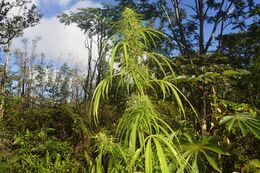 Tall Highland Thai plant among forest vegetation (RSC listing)
 -
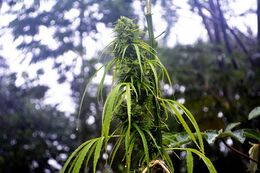 Highland Thai plant in flower among trees (RSC listing)
 -
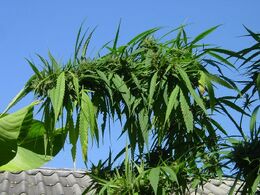 Highland Thai above a roof, outdoors in Thailand (RSC listing caption, 2019)


See Also
References
- ↑ 1.00 1.01 1.02 1.03 1.04 1.05 1.06 1.07 1.08 1.09 1.10 1.11 1.12 1.13 1.14 1.15 1.16 1.17 1.18 "Highland Thai". The Real Seed Company. Retrieved 16 September 2026.
- ↑ "Hemp & Multipurpose". The Real Seed Company. Retrieved 16 September 2026.
- ↑ 3.0 3.1 3.2 "Highland Thai". Kwik Seeds. Retrieved 16 September 2026.
- ↑ 4.0 4.1 4.2 "Highland Thai". The Real Seed Company. Archived from the original on 19 August 2019. Retrieved 16 September 2026.
- ↑ 5.0 5.1 "Highland Thai". The Real Seed Company. Archived from the original on 25 January 2021. Retrieved 16 September 2026.
- ↑ "Highland Thai". The Real Seed Company. Archived from the original on 5 August 2020. Retrieved 16 September 2026.
- ↑ "Highland Thai". The Real Seed Company. Archived from the original on 30 January 2023. Retrieved 16 September 2026.