
RSC-RUS-CHE-0120240001
More actions
| 2024 RSC Siberian Ruderalis Feral Reproduction | |
|---|---|
| RSC-RUS-CHE-0120240001 | |

| |
| A flowering top of Selected Siberian, third generation (RSC listing) | |
| At a Glance | |
| Classification | Feral |
| Accession Type | Reproduction |
| Primary Purpose | N/A |
| Plant height | 1–2.5 m |
| Photoperiod response | Day-neutral |
| Aroma | Intense pine, sweet floral, citrus |
| Processing | |
| Method | N/A |
| Location | |
| Country | Russia |
| Province/State | Chelyabinsk Oblast |
| Collection | |
| Method | Seeds |
| Autochthonous | No |
| Conservation | |
| Main lot | The Real Seed Company Seed lot: At risk handed out handed out: handed out (sold) |
| Introgression | Unknown |
| Cultivation | |
| Status | Unknown |
| System Type | Feral |
| Cycle 1 Harvest | August–September |
| Preservation | |
| Seed Storage | The Real Seed Company |
| Genebanks and Sequence Data | |
Genebank accessions | |
| Genetic Relationships | |
2024 RSC Siberian Ruderalis Feral Reproduction is a feral cannabis accession listed as Siberian Ruderalis in the seed catalogue of The Real Seed Company (RSC).[1] The listing calls it the third generation of a line it titled Selected Siberian to be acclimatised by open pollination at 50° N and 1,200 metres, and traces the original accession to a day-neutral (autoflowering) population at Chebarkul, in Chelyabinsk Oblast, Russia, close to Kazakhstan.[1] The line is on sale at RSC and on its Kwik Seeds site (checked 27 October 2026).[1][2]
Geography
History
RSC calls the plants something of a mystery. It reports a theory among local people that they may have come from seed recently brought in from Kazakhstan, and writes that their pink stigmas, partly domesticated seed, substantial resin, strong aromas and some THC suggest they may descend from an imported hashish landrace, perhaps as a hybrid between a Kazakh landrace and local wild-type Siberian populations.[1] In August 2025 RSC named Selected Siberian and Kazakh as the pure autoflowering varieties in its collection, both feral forms of the Eurasian Steppe, and suggested that the Siberian accession might represent the population popularly known as "Ruderalis".[3]
Collection Details
The listing was titled Selected Siberian (3rd Gen) from its earliest archived version, of May 2024, to July 2025, and has been titled Siberian Ruderalis since December 2025.[4][5] It says the seed is the third generation acclimatised at 50° N and 1,200 metres, and refers readers to RSC's listing of the original accession, titled Siberian, which describes it as from Bashkortostan.[1]
In July 2024 Angus gave a packet of Selected Siberian 3rd Gen seed to the U.S. National Plant Germplasm System, which holds it as accession G 33889 at its Plant Genetic Resources Unit in Geneva, New York.[6][7]
Cultivation Details
Botanical Characteristics
RSC gives a height of 1 to 2.5 metres and describes very early, resinous and very hardy plants, autoflowering, with intense pine, sweet floral and citrus aromas. It writes that the seeds are small, silver and mottled, some with elongated horseshoe-shaped bases, which it takes as a sign of ruderal ("wild") genetics, and that most plants are likely to have chemotypes with a high ratio of CBD to THC.[1]
Smoke Reports
Gallery
-
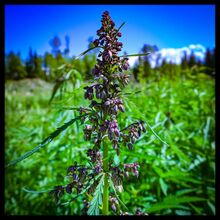 A flowering stem of Selected Siberian, third generation (RSC listing)

See Also
References
- ↑ 1.00 1.01 1.02 1.03 1.04 1.05 1.06 1.07 1.08 1.09 "Siberian Ruderalis". The Real Seed Company. Retrieved 27 October 2026.
- ↑ "Siberian Ruderalis". Kwik Seeds. Retrieved 26 October 2026.
- ↑ "Auto and Semi-Auto Traits in Landrace and Feral Cannabis". The Real Seed Company. 15 August 2025. Retrieved 27 October 2026.
- ↑ "Selected Siberian (3rd Gen)". The Real Seed Company. Archived from the original on 25 May 2024. Retrieved 27 October 2026.
- ↑ "Siberian Ruderalis". The Real Seed Company. Archived from the original on 11 December 2025. Retrieved 27 October 2026.
- ↑ "G 33889, Cannabis sativa L., Selected Siberian 3rd Gen". GRIN-Global. USDA Agricultural Research Service, National Plant Germplasm System. Retrieved 27 October 2026.
- ↑ "Northeast Regional Plant Introduction Station (NE9)". GRIN-Global. USDA Agricultural Research Service, National Plant Germplasm System. Retrieved 27 October 2026.