
RSC-KAZ-JAM-0120190001
More actions
| 2019 RSC Kazakh Ruderalis Feral Reproduction | |
|---|---|
| RSC-KAZ-JAM-0120190001 | |

| |
| Kazakh Ruderalis outdoors at around 55° N (RSC blog post, August 2025) | |
| At a Glance | |
| Classification | Feral |
| Accession Type | Reproduction |
| Primary Purpose | N/A |
| Plant height | 2–5 m |
| Photoperiod response | Day-neutral |
| Aroma | Intensely pungent and sweet, fruit, melon |
| Botanical Characteristics | |
| Branching | Strong |
| Leaflet width | Narrow |
| Flower cluster size | Large |
| Processing | |
| Method | N/A |
| Location | |
| Country | Kazakhstan |
| Province/State | Jambyl Region |
| Collection | |
| Method | Seeds |
| Autochthonous | No |
| Date | 2019 |
| Harvest Date | 2023 |
| Conservation | |
| Main lot | The Real Seed Company Seed lot: Urgent grow-out history grow-out history: grown out; isolation not recorded |
| Introgression | Unknown |
| Cultivation | |
| Status | Unknown |
| System Type | Feral |
| Cycle 1 Harvest | Early August–Late August |
| Preservation | |
| Seed Storage | The Real Seed Company |
| Genebanks and Sequence Data | |
Genebank accessions | |
| Genetic Relationships | |
Reproduction of | |
2019 RSC Kazakh Ruderalis Feral Reproduction is a feral cannabis accession from Jambyl Region, Kazakhstan, listed as Kazakh Ruderalis in the seed catalogue of The Real Seed Company (RSC).[1] RSC describes it as wild-type Kazakh cannabis.[1] The Real Seed Company offers the line for sale on its Kwik Seeds site (checked 17 October 2026).[2]
Geography
RSC reports that the seeds were collected in the northwestern Tien Shan range, in the southern Qarataū, a name of Turkic origin meaning "Black Mountains". It gives a latitude of about 44° N.[1] RSC's blog described the line in October 2019 as coming from Jambyl, which borders Uzbekistan and Kyrgyzstan, and in November 2023 as coming from the mountains of eastern Kazakhstan.[3][4]
According to RSC, cannabis is well adapted to the desert steppe of the Qarataū, with its meltwater-fed streams. RSC compares this environment with that of the likely centre of origin of the species, which it places on the Qinghai Plateau of eastern Tibet, where it says cannabis apparently diverged from its nearest relative, Humulus, some 28 million years ago. Kwik Seeds gives 30 million years.[1][5]
History
RSC writes that the accession comes from a broad region of eastern Central Asia that was among the earliest centres of cannabis domestication, where the crop was probably crucial to the first human settlement of the grasslands and desert oases.[1] It says millennia of cultivation have inevitably affected any truly wild populations, as the Russian botanist Nikolai Vavilov understood in the 1920s.[1] According to RSC, archaeological finds from late Bronze Age and early Iron Age Central Asia are among the earliest evidence for the use of cannabis as an "intoxicant", and the THC-dominant subspecies Cannabis sativa subsp. indica was probably first domesticated in this broad region.[1]
RSC considers the accession difficult to classify, because drug-type and fibre-type domesticates have been introduced extensively in Kazakhstan in the modern era.[1] The Kwik Seeds listing of the same line, on the shop RSC calls its other site,[6] describes the variety as best conceptualised as feral or weedy.[5] RSC's November 2023 post says wild-type strains such as this accession are not domesticates, although their populations have almost certainly exchanged genes with regional landraces at points in their history.[4] Its August 2025 post calls the Kazakh accession a feral form indigenous to the Eurasian Steppe.[7]
Collection Details
The listing gives the sourcing as Russian Landrace Bureau in Jambyl, Kazakhstan (2019), and Kwik Seeds gives the same.[1][5] That collection is recorded at Kazakh Ruderalis General Population 2019, and RSC sold its seed until the maintenance grow replaced it. RSC states that the seeds on sale come from a 2023 ex situ maintenance grow; Kwik Seeds dates the grow to winter 2023.[1][5] Neither listing names the collector or the site. RSC files the line under its Crop Wild Relatives and CBD categories.[8][9] Kwik Seeds counts it, with other wild-growing forms such as the Siberian Ruderalis, as a vitally important Crop Wild Relative.[5]
In July 2024 Angus gave a packet of seed, listed by the system as Kazakh, to the U.S. National Plant Germplasm System, with a donor's note describing it as new 2023 seed from an ex situ maintenance grow of feral Jambyl seed. The system holds the seed as accession G 33875 at its Plant Genetic Resources Unit in Geneva, New York.[10][11]
Cultivation Details
The listings give no purpose, give the harvest as early to late August and list outdoor or greenhouse growing.[1][5] RSC describes the line as very early maturing to day-neutral ("autoflowering"), and its August 2025 post names Kazakh as one of the two pure auto varieties in its collection.[1][7] RSC advises freezing the seeds as cold as possible before germination and warns that wild-type seeds germinate slowly and unevenly.[1] Its January 2025 post says cold stratification helps with feral and wild-type cannabis from northern latitudes such as Kazakhstan.[12]
Botanical Characteristics
RSC reports that the plants can exceed 4 metres and are heavily branched, with large colas denser than might be expected for wild-type cannabis, predominantly narrow leaflets and intensely aromatic buds.[1] Versions of the listing from November 2019 to May 2025 gave a height of 2 to 5 metres; Kwik Seeds gives the height as variable.[13][14][5]
In November 2019 the listing called the accession a pure Kazakh landrace of intermediate domestication, best classified as ruderal, that is, C. sativa subsp. indica var. kafiristanica.[13] Versions from August 2020 to January 2023 classified it as C. sativa subsp. sativa var. spontanea × C. sativa subsp. indica, with a question mark until April 2021.[15][16]
RSC sees breeding potential in the line's very early finish, likely drug-plant ancestry and adaptation to drought, and calls the accession invaluable as a repository of biodiversity.[1]
Aroma
Smoke Reports
Gallery
-
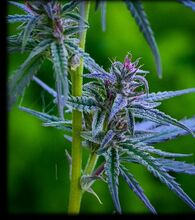 Flowering Kazakh Ruderalis branches (RSC listing)
-
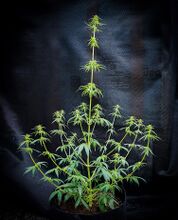 A potted Kazakh Ruderalis plant (RSC listing)
-
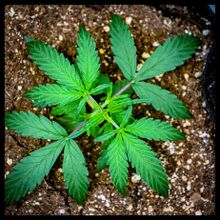 Kazakh Ruderalis seedling (RSC listing)
-
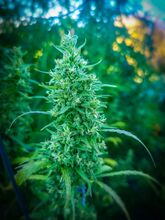 Kazakh Ruderalis flower top (RSC listing)


See Also
References
- ↑ 1.00 1.01 1.02 1.03 1.04 1.05 1.06 1.07 1.08 1.09 1.10 1.11 1.12 1.13 1.14 1.15 "Kazakh Ruderalis". The Real Seed Company. Retrieved 17 September 2026.
- ↑ "Kazakh Ruderalis". Kwik Seeds. Retrieved 17 October 2026.
- ↑ "Ruderalis: New ruderal ('wild') Cannabis seeds". The Real Seed Company. 22 October 2019. Retrieved 17 September 2026.
- ↑ 4.0 4.1 "Wild Cannabis Strain – Kazakh". The Real Seed Company. 5 November 2023. Retrieved 17 September 2026.
- ↑ 5.0 5.1 5.2 5.3 5.4 5.5 5.6 5.7 "Kazakh Ruderalis". Kwik Seeds. Retrieved 17 September 2026.
- ↑ "Hemp & Multipurpose". The Real Seed Company. Retrieved 17 September 2026.
- ↑ 7.0 7.1 "Auto and Semi-Auto Traits in Landrace and Feral Cannabis". The Real Seed Company. 15 August 2025. Retrieved 17 September 2026.
- ↑ "Crop Wild Relatives". The Real Seed Company. Retrieved 17 September 2026.
- ↑ "CBD". The Real Seed Company. Retrieved 17 September 2026.
- ↑ "G 33875, Cannabis sativa L., Kazakh". GRIN-Global. USDA Agricultural Research Service, National Plant Germplasm System. Retrieved 3 October 2026.
- ↑ "Northeast Regional Plant Introduction Station (NE9)". GRIN-Global. USDA Agricultural Research Service, National Plant Germplasm System. Retrieved 3 October 2026.
- ↑ "Should you 'cold stratify' landrace seeds?". The Real Seed Company. 24 January 2025. Retrieved 17 September 2026.
- ↑ 13.0 13.1 "Kazakh Ruderalis". The Real Seed Company. Archived from the original on 18 November 2019. Retrieved 17 September 2026.
- ↑ "Kazakh Ruderalis". The Real Seed Company. Archived from the original on 20 May 2025. Retrieved 17 September 2026.
- ↑ "Kazakh Ruderalis". The Real Seed Company. Archived from the original on 5 August 2020. Retrieved 17 September 2026.
- ↑ "Kazakh Ruderalis". The Real Seed Company. Archived from the original on 30 January 2023. Retrieved 17 September 2026.