
RSC-NPL-BAG-0120220001
More actions
| Nepalese Mountain Ganja General Population 2022 | |
|---|---|
| RSC-NPL-BAG-0120220001 | |

| |
| Flowering plants photographed at night (RSC listing) | |
| At a Glance | |
| Classification | Landrace |
| Accession Type | General population |
| Primary Purpose | Recreation |
| Plant Height | 2–6 m |
| Photoperiod | Short-day |
| Aroma | Floral, ganja, spicy, herbal |
| Effects | Soaring, speedy |
| Processing | |
| Method | Ganja |
| Notes | Bud; also dry-sieved garda charas |
| Location | |
| Country | Nepal |
| Province/State | Bagmati Province |
| District | Makwanpur District |
| Coordinates | 27.44, 85.06 |
| Collection | |
| Method | Seeds |
| Sourcing Type | Point of Origin |
| Autochthonous | Yes |
| Date | 2022 |
| Harvest Date | 2022 |
| Collector | Angus |
| Conservation | |
| Priority | Medium |
| Introgression | Minimal |
| Cultivation | |
| Status | Unknown |
| System Type | Unknown |
| Cycle 1 Harvest | October–October |
| Preservation | |
| Seed Storage | The Real Seed Company |
| Viability | Marginal |
| Genebanks and Sequence Data | |
Genebank accessions | |
Nepalese Mountain Ganja General Population 2022 is a landrace cannabis accession from Makwanpur District, Nepal, listed as Nepalese Mountain Ganja in the seed catalogue of The Real Seed Company (RSC).[1] RSC classifies it as a Himalayan "mountain ganja" landrace.[1]
Geography
RSC gives the place of sourcing as Makwanpur in the Nepal Himalaya, "in the highlands south of Kathmandu, which are closely connected to the Terai", at a latitude of about 27° N.[1] It describes the type as grown for mountain ganja and garda charas in subtropical and temperate areas of Central and Mid-West Nepal.[1]
History
The listing states that the mountain ganja populations "may have been affected" by large-scale ganja cultivation that Indian groups introduced to lowland Nepal in the late 1930s, after the Trans-Himalayan charas trade collapsed, and that ganja cultivation in the Terai goes back to at least the 18th century.[1] An RSC blog post of April 2023 groups Nepali cannabis into three types: Himalayan multipurpose plants, mountain ganja, and the true ganja landraces of the Terai. It describes mountain ganja as a specialised form grown in alpine regions around Kathmandu and west towards Pokhara, names this accession and Dakshinkali as examples, and suggests that the type may have arisen by hybridisation between ganja landraces and wild-growing mountain bhang.[2]
Collection Details
The listing gives the sourcing as The Real Seed Company, Makwanpur, Nepal Himalaya, from the 2022 harvest.[3][4] RSC reports that the seed's viability has fallen below 80 per cent, and that a recent germination test found it about 60 to 70 per cent viable.[1]
In August 2023 Angus gave seed sold as Nepalese Mountain Ganja to the U.S. National Plant Germplasm System, which holds it as accession G 33749 at its Northeast Regional Plant Introduction Station.[5][6] The USDA entry gives the origin as "Collected – Nepal".[5]
Cultivation Details
RSC gives the purpose as ganja (bud) and garda charas (sieved resin), the harvest as October, and an outdoor height of up to about 4 metres; earlier versions of the listing gave 2 to 5 metres and up to about 6 metres. It lists greenhouse or outdoor growing.[1][3][4] RSC's April 2023 post describes the mountain ganja strains as finishing early, at around five months from seed to harvest, and as releasing their resin glands readily for dry-sieving.[2]
Botanical Characteristics
RSC describes the plants as hardy and tolerant of humidity. It says the seeds are mottled and smaller than those of typical Himalayan multipurpose plants, and that potency is markedly higher and the aromas redolent of ganja.[1] The listing quotes an unnamed cultivator, said to have much experience with landraces, who found "three really distinct phenos" in the accession: half of the plants semidwarf, with some wild-type leaves and bud structure, and the other half more classic Sativa type, with two different flower structures.[1] Curator notes on the USDA entry for the donated seed list it among the tallest accessions evaluated in the 2024 New York trials, measured 100 days after sowing, and as exceptionally late flowering.[5]
Aroma
RSC lists floral, ganja, spicy and herbal aromas.[1]
Effects
RSC describes a soaring, "speedy" high.[1]
Smoke Reports
Gallery
-
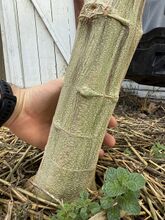 The base of a stem held in a hand (RSC listing)
 -
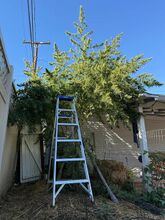 A tall plant beside a stepladder (RSC listing)
 -
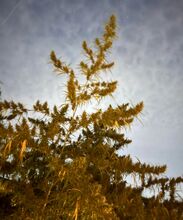 Flowering tops against the sky (RSC listing)
 -
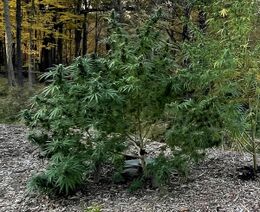 A branching plant among trees in autumn (RSC listing)


See Also
References
- ↑ 1.00 1.01 1.02 1.03 1.04 1.05 1.06 1.07 1.08 1.09 1.10 "Nepalese Mountain Ganja". The Real Seed Company. Retrieved 7 October 2026.
- ↑ 2.0 2.1 "Nepali Landrace Strains & Three New Accessions from Nepal". The Real Seed Company. 16 April 2023. Retrieved 7 October 2026.
- ↑ 3.0 3.1 "Nepalese Mountain Ganja". The Real Seed Company. Archived from the original on 23 April 2023. Retrieved 7 October 2026.
- ↑ 4.0 4.1 "Nepalese Mountain Ganja". The Real Seed Company. Archived from the original on 4 August 2025. Retrieved 7 October 2026.
- ↑ 5.0 5.1 5.2 "G 33749, Cannabis sativa L., Nepalese Mountain Ganja". GRIN-Global. USDA Agricultural Research Service, National Plant Germplasm System. Retrieved 7 October 2026.
- ↑ "Northeast Regional Plant Introduction Station (NE9)". GRIN-Global. USDA Agricultural Research Service, National Plant Germplasm System. Retrieved 7 October 2026.