Talk:Hummel 679 (1928)
More actions
Discussion for: Hummel 679 (1928) • View • Links • Related changes
Use this page for verification notes, disputes, and action items. Keep narrative content on the article.
Discussion
Evidentiary scope
The label places a plant it names Cannabis on waste ground (in ruderatis) by the monastery of Fu-Shu-Shi in the Bogdo Ola, at about 1,900 m, in August 1928. Ruderal describes the habitat, disturbed ground by buildings; the label does not say whether the plant was escaped from cultivation, sown or wild. The accession is classified Other and no conservation priority is assigned.
Label reading
Read from the holder's large image (1950 × 3000 pixels). Printed label: Expeditio centrali-asiatica sub duce D:ris Sven Hedin. / Turkestania sinensis (Prov. Sinkiang): in montibus / Bogdo Ola, / D. Hummel. Handwritten: 679 / Fu-Shu-Shi, in ruderatis ad monasterium, ca. 1900 m. (on waste ground by the monastery, at about 1,900 m) / 1/8 1928.
Georeferencing
The point 43.90, 88.12 is the Daoist temple 福寿观 (Fushou Guan), also called 铁瓦寺 (Tiewa Si), on the slope west of Tianchi, the lake on the north side of the Bogda Shan. OpenStreetMap has the temple's outline as way 1517169807 and a node tagged with both names, node 5188364827; the outline's middle is 43.8968, 88.1158, and the point in its two-decimal form lies about 500 m from it. The temple was founded in 1776 as 福寿寺 (Fushou Si), taking its name from the mountain, which the Qianlong emperor had named 福寿. It was rebuilt in 1881, burned in March 1933, rebuilt again and destroyed by 1975. Its foundations were excavated in 2002, and the present temple stands on that site.
The label's Fu-Shu-Shi, in ruderatis ad monasterium is read as this temple for three reasons. Sven Hedin's History of the Expedition in Asia, 1927–1935, part II (Stockholm, 1943), says that in 1928 the governor let Hummel go to the Bogdo-ula and asked him to take soundings in "the little alpine lake near the temple Fo-shu-ssu" (p. 2). Hedin writes the mountain where the governor had wished to be buried as "Fo-shu-shan in the Bogdo-ula" (p. 4); the mountain's Qing name was 福寿, so his Fo-shu is read as 福寿 in both places. The label's altitude, about 1,900 m, is 62 m below the SRTM elevation at the temple (1,962 m) and close to the lake surface (1,908 m). Hedin does not name the lake, and no source read states that Hummel gathered this plant there; the point rests on the temple's name, the altitude and Hedin's account of the errand.
OpenStreetMap has a second node named 福寿观, node 5188308323, on the lake's west shore about 1.6 km to the south-east (43.8844, 88.1256; SRTM 1,943 m). It carries the name and no other detail and has not been edited since it was entered in 2017, while the outline and the node also named 铁瓦寺 are at the northern site. A description of the excavated site puts it on a terrace facing north-east over the lake towards its northern dam, which fits the northern site. The uncertainty below covers both. Hedin also places the expedition's mountain weather station "at the monastery, 2,500 m. above sea-level" in the Bogdo-ula from August 1928 (p. 84) without naming it; the label's name and altitude fit Fushou, not a site at that height.
The point places the gathering at the temple, on the waste ground the label describes, not at a spot within it. An earlier version of this note gave no point because no source then read connected Hummel's monastery with the temple. The province field takes Xinjiang. The point lies inside the OpenStreetMap boundary of Fukang (阜康市), a county-level city of the Changji Hui Autonomous Prefecture (relation 2752406), and the admin fields take the bare names Changji and Fukang. Basis: settlement point. Uncertainty: about 2 km.
Editorial treatment
Collector. The collector field keeps the label's D. Hummel; the prose links David Hummel (1893–1984), the physician of Hedin's Sino-Swedish Expedition.
Taxon. The label gives the genus only, and the holder's catalogue name is Cannabis L. The infobox takes Urtica cannabina L. from the comparison under Identification below. The identified-by field is empty, since no examination of the sheet is recorded. The accession is not shown on the accessions map, which plots cannabis.
Elevation. The infobox stores the label's ca. 1900 m.
Source discrepancies
- None. The catalogue's locality, altitude and date match the label.
These notes were recorded during accession preparation. Source citations remain in the article. Éloise 05:05, 9 October 2026 (+07)
Identification
The label names the plant Cannabis, and the holder's catalogue name is Cannabis L. No later determination is recorded.
How the identification was reached. The sheet was first read as cannabis, as the label has it, but with leaves far more finely divided than the usual cannabis leaf: each palmate segment is cut pinnately into narrow lobes. Three other plants with hemp-like leaves were checked against flora descriptions and set aside: Datisca cannabina, whose leaves are pinnate with stalked leaflets; Artemisia, whose leaves are alternate and whose flowers are in heads; and Ambrosia, whose leaf is a single lobed blade. On those characters the sheet still read as a cannabis plant with unusually dissected leaves. A second possibility was that insects had eaten the leaves down to their veins, which can make an ordinary leaf look dissected; the leaf-division point below gives the reasons it does not fit. The stiff hairs on the lower stem and petioles were also first read as spines; at sheet resolution a stinging hair, a long single cell on a many-celled base, looks much like a small spine with a swollen base. A Xinjiang sheet first labelled as Urtica cannabina and later filed under cannabis (described below) then led to a comparison with that nettle.
The comparison. The characters the holder's image resolves (1950 × 3000 pixels, about 7 pixels per mm) were compared with the Flora of China descriptions of Cannabis and of Urtica cannabina (hemp-leaved nettle). On each of them the sheet matches U. cannabina:
- Bristles. Sparse, stiff, spreading bristles about 1.5–3 mm long stand on the petioles, the main leaf veins and the stem, some with a thickened base. In Flora of China, U. cannabina is "sparsely armed with stinging hairs" on the stem, and its petioles and leaf veins carry stinging hairs. Cannabis there is strigose (with flat-lying hairs) and has cystolith hairs on the upper leaf surface; bristles are not part of its description.
- Leaf arrangement. The leaves are opposite at every node the image resolves, up to the apex. Flora of China gives Urtica opposite leaves, and Cannabis leaves "alternate or opposite basally on stem".
- Leaf division. Each leaf is divided into three to five segments, and each segment is cut pinnately into narrow lobes that shorten towards its tip. Flora of China describes the leaf of U. cannabina with "primary lobes pinnatisect, gradually shortened distally". The margins are smooth and the sinuses rounded, and the same cut repeats on every leaf, the youngest included, so the division is not feeding damage.
- Inflorescences and buds. Loose, branched clusters stand in the lower leaf axils and dense, erect spikes on thick axes in the upper ones, the two kinds Flora of China describes for U. cannabina. The round buds in the lower clusters are about 1.5–1.8 mm across, and several appear divided in four. Urtica staminate flowers have four tepals and four stamens; the Flora of the USSR gives the staminate Cannabis flower a five-parted perianth and five stamens. At about 12 pixels a bud, the count is made by eye.
A pressed U. cannabina collected in Ürümqi on 3 October 2019 (Royal Botanic Gardens, Kew, K001871180), viewed at the same scale, carries petiole hairs of the same form.
Hummel's other cannabis sheets, 164, 874, 908, 909 and 1330, fit Cannabis on the same comparison: compound leaves with serrate leaflets, or single serrate leaves; no long bristles; and, where the sheet shows them, alternate upper leaves or fruits enclosed in bracts.
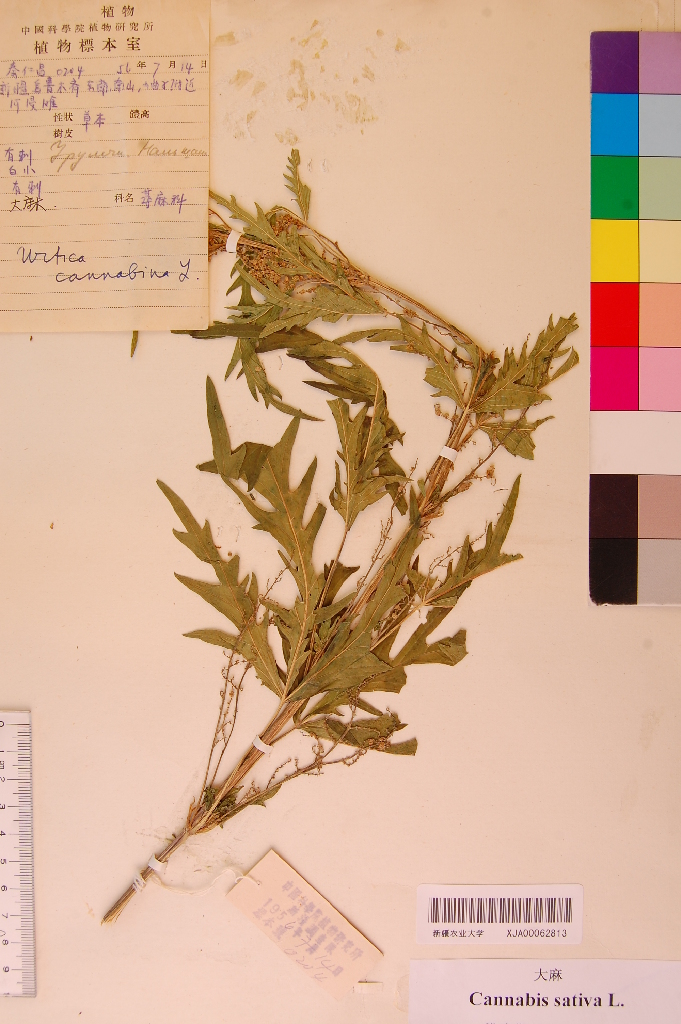
A U. cannabina from Xinjiang has been filed under cannabis before. Xinjiang Agricultural University sheet XJA00062813, collected by Ching Ren-chang (秦仁昌, no. 0204) on 14 July 1956, carries its original Institute of Botany label reading "Urtica cannabina L." and now carries a printed slip reading Cannabis sativa L., the name it is filed under.
The characters that would settle the identification (whether the bristles are stinging hairs, the number of tepals and stamens, and the fruit) need examination of the sheet itself, under a lens. No such examination is recorded. The article and the infobox describe the plant as U. cannabina on the strength of this comparison and mark the identification as original research. The holder's Cannabis is reported as the holder's catalogue name. An examination of the sheet that finds cannabis characters (cystolith hairs on the upper leaf surface, five tepals and five stamens, or a fruit enclosed in a bract) would reopen the identification.
Sources:
- Flora of China, vol. 5: Cannabis and Cannabis sativa (p. 75); Urtica (p. 78); Urtica cannabina (p. 80).
- Flora of China, vols 20–21: Artemisia and Ambrosia.
- Flora of Pakistan: Datisca cannabina.
- Flora of the USSR (Флора СССР), vol. 5, ed. V. L. Komarov (Moscow and Leningrad, 1936), p. 383 (Cannabis) and pp. 385–388 (Urtica).
- Kew sheet K001871180, A. P. Sukhorukov 117: GBIF occurrence 4535504965.
- Xinjiang Agricultural University XJA00062813: sheet image, National Specimen Information Infrastructure.