
RSC-IND-KER-0120150001
More actions
| Kerala Reproduction 2015 | |
|---|---|
| RSC-IND-KER-0120150001 | |

| |
| Second-generation Kerala outdoors in Hawaii (RSC listing caption, 2019) | |
| At a Glance | |
| Classification | Landrace |
| Accession Type | Reproduction |
| Pollination Type | Open pollination |
| Chemotype | THC-dominant |
| Primary Purpose | Recreation |
| Plant Height | 2–5 m |
| Photoperiod | Short-day |
| Aroma | Mint, pepper, mango-carrot |
| Effects | Intense, energising, positive |
| Terpenes | Linalool, alpha-pinene and humulene, with smaller amounts of myrcene and beta-pinene (one tested plant) |
| Botanical Characteristics | |
| Growth Pattern | Christmas tree, Creeper |
| Flower Structure | Loose |
| Processing | |
| Method | Ganja |
| Notes | Seedless or lightly seeded buds |
| Location | |
| Country | India |
| Province/State | Kerala |
| District | Idukki District |
| Coordinates | 9.82, 77.00 |
| Traditional Names | |
| Local Name | Neelachadayan |
| Translation | Blue dreadlocks |
| Collection | |
| Method | Seeds |
| Sourcing Type | Multi-generation reproduction |
| Autochthonous | No |
| Date | 2015 |
| Collector | Angus |
| Conservation | |
| Introgression | Minimal |
| Cultivation | |
| Status | Unknown |
| System Type | Unknown |
| Cycle 1 Planting | June–July |
| Cycle 1 Harvest | December–Early February |
| Preservation | |
| Seed Storage | The Real Seed Company |
Kerala Reproduction 2015 is a landrace cannabis accession from Idukki District, Kerala, India, listed as Kerala in the seed catalogue of The Real Seed Company (RSC).[1] RSC calls it the Idukki cannabis landrace, a classic South Indian landrace grown for ganja.[1]
Geography
RSC describes Idukki, where the accession was collected, as an equatorial highland district and Kerala's most renowned historic centre of ganja cultivation. It gives a latitude of about 9° N.[1] An RSC blog post of August 2023 says the district is renowned for its "red-dirt" terroir.[2]
History
RSC reports that the landrace is also known as Neelachadayan, meaning "blue dreadlocks" or, some say, "blue poison", after the powerful high and blue colas of outstanding plants in the population.[1][2] According to RSC, Keralan landraces are renowned for their intensely positive and stimulating Sativa-type high and contributed to modern hybrids such as Haze and White Widow.[1]
RSC's 2023 post states that indigenous tribal communities in Kerala traditionally offer ganja to the deity Munishvaran as a sacrament, and that recent crackdowns by the state government have effectively destroyed this custom. The post adds that the COVID-19 pandemic stopped RSC's plans to obtain seed from the winter 2019–20 harvest through veteran ganja farmers in Idukki. It describes the Keralan landrace, with RSC's Thai, Lao and Burmese ganja landraces, as critically endangered or close to extinct, mostly because of hybridisation with seed introduced by Westerners and rich cosmopolitan Asians.[2]
Collection Details
The listing gives the sourcing as The Real Seed Company, Idukki District, Kerala (2015).[1] In 2019 the listing described the accession as personally collected at source in Idukki District.[3] RSC states that the seeds on sale come from a 2022 maintenance grow of the 2015 accession and are the third generation from it, reproduced ex situ through open pollination.[1] The Kwik Seeds listing of the same line, on the shop RSC calls its other site,[4] gives the same sourcing and calls the seed the second generation, as RSC did until January 2023.[5][6]
Cultivation Details
RSC gives the purpose as ganja, which it glosses as seedless or lightly seeded buds, and the regional growing period as about five months from seed to harvest. It lists greenhouse or outdoor growing.[1] According to RSC, cannabis in Kerala is typically planted in June and July and harvested from December to early February, and farmers have traditionally favoured a later harvest. Kwik Seeds gives December to early February as the regional harvest.[1][5]
RSC reports that the 2015 accession has produced exceptionally early-maturing variants that can be ready by early November; its 2019 versions gave late October to early November.[1][3] RSC sees no sign of hybrid contamination in the morphology or aroma of these plants and attributes the fast finish to decades of pressure from eradication programmes, which it says led farmers to keep seed from early plants.[1] RSC quotes a grower working outdoors in Australia who found the plants exceptional, covered in resin well before flowering and with intense sweet and spicy aromas.[1]
Botanical Characteristics
RSC describes a true tropical Sativa-type domesticate 2 to 4 metres tall, with bamboo-like leaflets, and reports that creeper and Christmas-tree architecture can occur. Kwik Seeds gives the same height, and versions of the RSC listing from August 2020 to January 2023 gave 2 to 5 metres.[1][5][7][6] According to RSC, the buds are loose and resinous, with minty, peppery and fruity aromas, and give a smooth, sweet smoke.[1] Versions of the listing from August 2020 to February 2025 classified the line as Cannabis sativa subsp. indica var. indica.[7][8]
The grower of the customer plant shown in RSC's 2023 post describes "very narrow leaves" and a "very strong mint garden spice aroma".[2]
Chemistry
RSC reports a recent test of one plant from the accession that gave 17.63 per cent THC (or 14.86 per cent, depending on how the result is interpreted), with modest quantities of THCV and no CBD. It considers mid- to high-teens THC not unusual for the variety.[1] Its 2019 versions added that the terpenoids of the tested plant were dominated by linalool, alpha-pinene and humulene, with smaller amounts of myrcene and beta-pinene.[3]
Effects
RSC describes an intense, energising high and says the Idukki landrace is characterised above all by the energising positivity of its high.[1]
Smoke Reports
Gallery
-
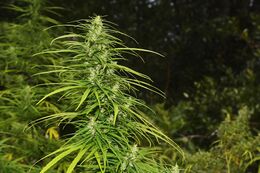 Another second-generation Kerala plant outdoors in Hawaii (RSC listing caption, 2019)
 -
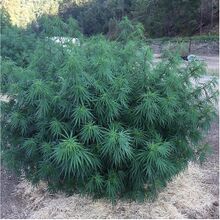 Second-generation Kerala outdoors in Oregon (RSC listing caption, 2019)
 -
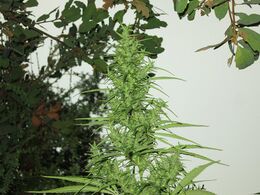 Early Idukki variant in the Pacific Northwest, United States, cut on 6 November (RSC listing caption, 2019)
 -
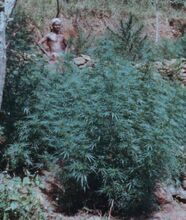 Kerala landrace in Idukki, 1983 (RSC listing caption, 2019)
 -
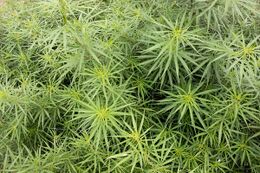 Kerala foliage (RSC listing)
 -
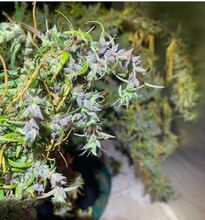 Kerala grown indoors from maintenance-grow seed of the 2015 accession, about 15 weeks (customer photo, RSC blog post, August 2023)


See Also
References
- ↑ 1.00 1.01 1.02 1.03 1.04 1.05 1.06 1.07 1.08 1.09 1.10 1.11 1.12 1.13 1.14 1.15 "Kerala". The Real Seed Company. Retrieved 17 September 2026.
- ↑ 2.0 2.1 2.2 2.3 "Idukki 'Blue Dreadlocks' Landrace Ganja – Kerala". The Real Seed Company. 30 August 2023. Retrieved 17 September 2026.
- ↑ 3.0 3.1 3.2 "Kerala". The Real Seed Company. Archived from the original on 19 August 2019. Retrieved 17 September 2026.
- ↑ "Hemp & Multipurpose". The Real Seed Company. Retrieved 17 September 2026.
- ↑ 5.0 5.1 5.2 "Kerala". Kwik Seeds. Retrieved 17 September 2026.
- ↑ 6.0 6.1 "Kerala". The Real Seed Company. Archived from the original on 30 January 2023. Retrieved 17 September 2026.
- ↑ 7.0 7.1 "Kerala". The Real Seed Company. Archived from the original on 5 August 2020. Retrieved 17 September 2026.
- ↑ "Kerala". The Real Seed Company. Archived from the original on 8 February 2025. Retrieved 17 September 2026.