
RSC-AFG-BAL-0520070001-R1
More actions
| 2007 RSC Mazar-i-Sharif Reproduction | |
|---|---|
| RSC-AFG-BAL-0520070001-R1 | |

| |
| The Mazar-i-Sharif landrace outdoors in Spain, with pink to red stigmas (RSC listing, 2019) | |
| At a Glance | |
| Classification | Landrace |
| Accession Type | Reproduction |
| Hierarchy | |
| Growing Region | Northern Afghanistan |
| Growing Area | Balkh |
| Location | |
| Country | Afghanistan |
| Province/State | Balkh Province |
| Collection | |
| Method | Seeds |
| Sourcing Type | Multi-generation reproduction |
| Autochthonous | No |
| Date | May 2007 |
| Collector | Angus |
| Conservation | |
| Main lot | The Real Seed Company Seed lot: Urgent grow-out history grow-out history: grown out; isolation not recorded |
| Preservation | |
| Seed Storage | The Real Seed Company |
| Genebanks and Sequence Data | |
Genebank accessions | |
| Genetic Relationships | |
Reproduction of | |
2007 RSC Mazar-i-Sharif Reproduction is seed grown outside Afghanistan from Mazar-i-Sharif General Population 2007, seed that The Real Seed Company (RSC) bought in Peshawar in 2007 as a landrace from Balkh, in northern Afghanistan. It is the seed RSC sells under the listing Mazar-i-Sharif.[1]
Production
The listing states that the seeds are "the fourth generation of the original accession to have been produced outside Afghanistan through open pollination".[1] Versions of the listing archived from August 2019 to 19 January 2021 called them the third generation,[2] and "fourth generation" first appears in the version of 25 January 2021.[3] The Kwik Seeds listing of the line, on the shop RSC calls its other site,[4] still says the third generation.[5]
In August 2023 Angus gave a packet of the seed to the U.S. National Plant Germplasm System, which holds it as accession G 33740 at its Plant Genetic Resources Unit in Geneva, New York.[6][7] The donor's note says that the line has been kept indoors by a hobbyist in the West since the seed was brought back from Asia in 2007, and that the packet is about three generations removed from the original batch. Each generation was open-pollinated, with all healthy males allowed to pollinate all females, and seed was taken from the most resinous females. The note reports a bottleneck around 2013, when one crop was lost.[6]
Botanical Characteristics
The donor's note reports that plants of the line grown in North America and Europe were typically well over 2 metres tall, with red stems, pink-red stigmas and large leaves whose leaflets were broad on most plants, and that they matured late, from late October.[6] RSC's listing of 2019 showed the line outdoors in Spain, with pink to red stigmas, and outdoors in Oregon in 2017.[2]
Source accession
The seed was bought in Peshawar in May 2007 from an Afghan merchant who said it came from Balkh.[6] The account of the purchase, and the geography, history and description RSC gives for the line, are on the page of the collection, Mazar-i-Sharif General Population 2007.
Gallery
-
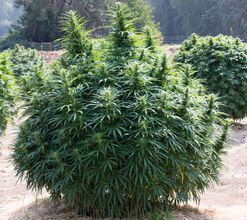 The Mazar-i-Sharif strain outdoors in Oregon in 2017 (RSC listing, 2019)

Smoke Reports
See Also
References
- ↑ 1.0 1.1 "Mazar-i-Sharif". The Real Seed Company. Retrieved 27 October 2026.
- ↑ 2.0 2.1 "Mazar-i-Sharif". The Real Seed Company. Archived from the original on 22 October 2019. Retrieved 27 October 2026.
- ↑ "Mazar-i-Sharif". The Real Seed Company. Archived from the original on 25 January 2021. Retrieved 27 October 2026.
- ↑ "Hemp & Multipurpose". The Real Seed Company. Retrieved 27 October 2026.
- ↑ "Mazar-i-Sharif". Kwik Seeds. Retrieved 26 October 2026.
- ↑ 6.0 6.1 6.2 6.3 "G 33740, Cannabis sativa L., Mazar-i-Sharif". GRIN-Global. USDA Agricultural Research Service, National Plant Germplasm System. Retrieved 27 October 2026.
- ↑ "Northeast Regional Plant Introduction Station (NE9)". GRIN-Global. USDA Agricultural Research Service, National Plant Germplasm System. Retrieved 27 October 2026.