Kham
More actions
| Kham | |
|---|---|
| ActiveGrown here in 2000 or later | |
| Location | |
| Coordinates | 30.05, 101.96 |
| Country | China |
| Provinces/States | Sichuan,Tibet |
| Area | 165,000 km² |
| Growing history | |
| Dated accessions | 1928–1934 |
| Conservation | |
| Populations | none documented yet |
Kham is a cannabis growing region of China, drawn on the Garzê Tibetan Autonomous Prefecture (甘孜, Gānzī) in Sichuan and the prefecture-level city of Chamdo (昌都, Chāngdū) in Tibet, with three counties of Ngawa (Jinchuan, Xiaojin and Barkam). It is the "Eastern Tibet" of the British consul Eric Teichman and of the plant collector Frank Kingdon-Ward, whose journey of 1913 led to "the belt of deep gorges which stripe the country called Kam".[1][2]: 1 Describing the Tibetans of A-tun-tsi (Deqin), Pang-tsi-la and Batang, Kingdon Ward called them people of "the province of Kham".[3]: 55 Kham reaches into north-western Yunnan, where the growing area Dêqên lies under the Yunnan growing region. Travellers between 1889 and 1913 saw hemp in the valleys of the Dadu and the Yalong and on a tributary of the Salween.[4]: 304[5]: 363[2]: 147 A crop-resources survey of 1982 collected cannabis, including cultivated cannabis, in the counties of Chamdo.[6] Police in Daocheng, Zogang and Markam cleared wild plants in 2024.[7][8][9] The region's growing area is Gyalrong.
Geography
The region is drawn on Garzê Tibetan Autonomous Prefecture in western Sichuan and Chamdo in eastern Tibet, with the Jinchuan, Xiaojin and Barkam counties of Ngawa Prefecture, and stops at the Yunnan border. Its line follows the ridges round the valleys that hold land below 4,000 m. The high grassland plateau of the north and west, around Shiqu and Dêngqên, and the high ground of the Shaluli Mountains and the other ranges between the Yalong, Jinsha, Mekong and Salween are left out at its edge, which leaves about 165,000 km².
Hemp in the valleys, 1889–1913
Leaving Ta-chien-lu (now Kangding) for Ya-chou in July 1889, William Woodville Rockhill noticed "a good deal of hemp" near Hua-lin-p'ing, a village in a side valley of the Dadu below Lu-ting (Luding), where the fields were planted with maize and sorghum, with beans between the rows.[4]: 298, 304 The British consul-general Alexander Hosie spent the night of 16 August 1904 at Hua-lin-p'ing on his way to Ta-chien-lu. In the cultivated country round it he noticed maize, beans, tobacco, hemp, potatoes, buckwheat and broad beans.[10]: 21–22
West of Ta-chien-lu the road crosses the Yalong at Ho-k'ou (Nya-ch'uk'a), the "Middle ferry". Coming down towards the river from the Laniba pass in late September 1892, Rockhill saw "patches of hemp" and a few small fields of barley and wheat round the Chinese inn at Ma-kai-chung and lower down the valley.[5]: 363 Hosie, travelling west at the end of August 1904, noticed a patch of buckwheat and another of hemp in the narrow gorge that leads down to Ho-k'ou.[10]: 33
Kingdon Ward reached the Wi valley on his journey of 1913; he took the name Wi-chu to be the local pronunciation of the Yü-chu. Round the large houses of its prosperous people lay irrigated fields "in which crops of hemp and turnips were still standing".[2]: 1, 144–147
The survey of 1982
From 25 May to 23 October 1982 the survey team for the crop-variety resources of Tibet examined the fibre crops (麻类, málèi) of nine counties, 28 districts and 67 communes of Chamdo Prefecture, among them Markam, Zogang, Baxoi, Zayü, Bomi, Chaya, Chamdo and Jomda. Among the material it collected was cannabis, including cultivated cannabis.[6]
Herbarium sheets from Kangding
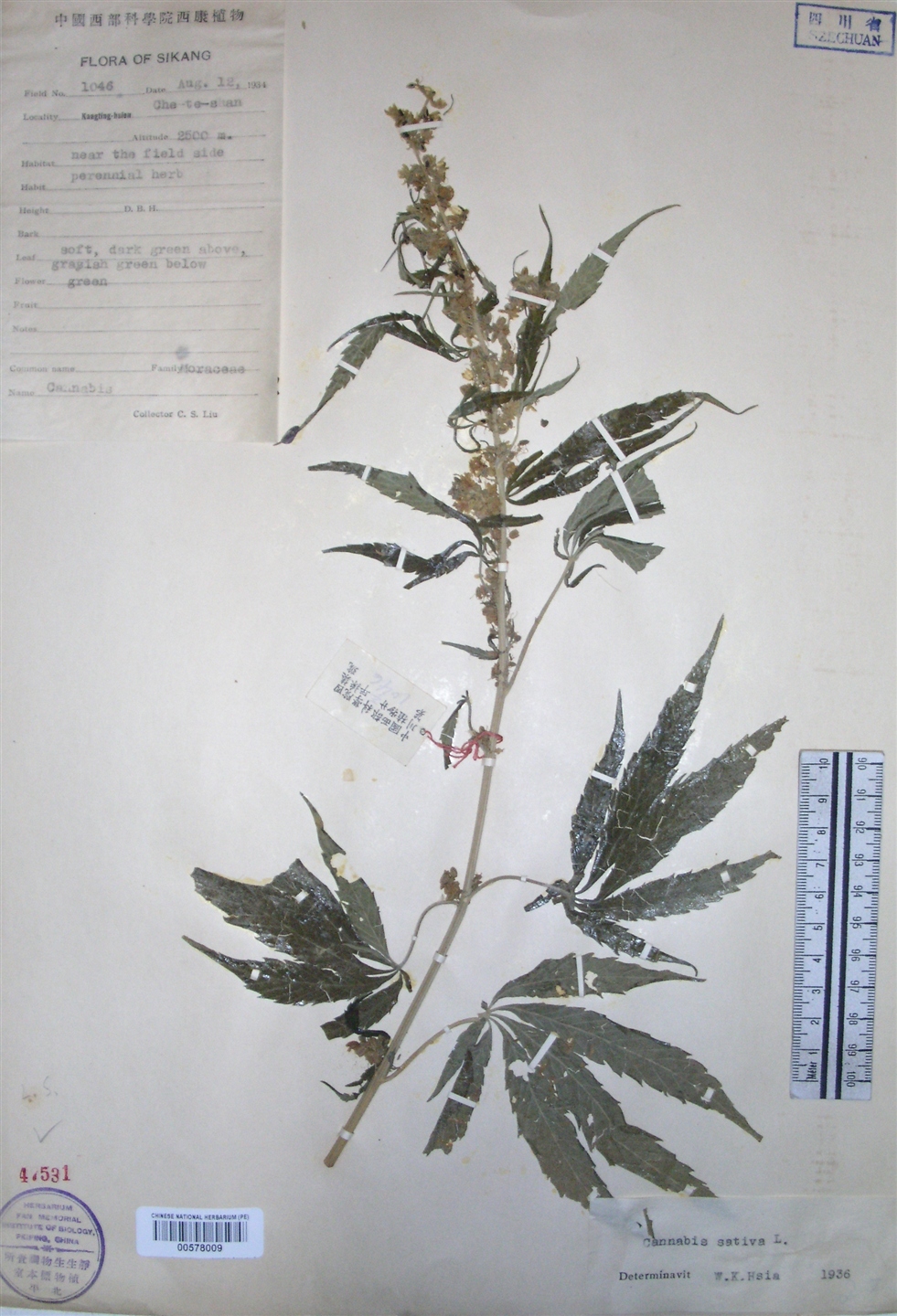
Collectors gathered the plant round Ta-chien-lu. The field label of Jean-André Soulié's number 844 names the place, Tatsienlou, with the year 1893 (Soulié 844 (1893)).[11] R. Cunningham's number 145 is labelled "Neighbourhood of Tatsien-lu" and dated 1923 (Cunningham 145 (1923)).[12] W. P. Fang collected the plant on a grassy slope at about 2,600–2,750 m (8,500–9,000 feet on the label) on 22 September 1928 (Fang 3525 (1928)).[13] C. S. Liu collected it at Che-te-shan, at 2,500 m, "near the field side" on 12 August 1934 (Liu 1046 (1934)).[14]
Wild plants cleared by the police
On 6 May 2024 the Xialinka township police station of Zogang found a large number of wild cannabis seedlings on waste ground in Xiba village and cleared more than 2,000 of them.[8] In July 2024 the Jiga police station of Daocheng County found more than 200 plants at the edge of a field, between 20 cm and 1 m tall. They were spreading naturally with no sign of having been planted; the station destroyed them.[7] On 4 September 2024 the Suoduoxi township police of Markam found wild plants on an embankment. They grew irregularly with no trace of planting; the police cleared more than 230 of them.[9]
Gyalrong
In the valleys of the Ta-chin and Hsiao-chin rivers, the country of the Gyalrong Tibetans, Hosie in 1904 and the plant collector Ernest Henry Wilson in 1908 called the hemp they saw Cannabis.[10]: 59[15]: 185 A seed lot collected at Xiaojin in 2020, now in the National Gene Bank of Traditional Chinese Medicine, is one of the twenty hemp landraces studied by Li and colleagues.[16]
Growing Areas
Accessions
| Accession ID | Name | Collected | Locality | Area |
|---|---|---|---|---|
| Fang 3525 (1928) | Fang 3525 herbarium specimen, Kangting hsien (1928) | Kangtin hsien (Tatsienlu) | ||
| Liu 1046 (1934) | Liu 1046 herbarium specimens, Kangting, Sikang (1934) | Kangting (康定), Che-te-shan |
Recent news
No news items are recorded for this growing region yet.
See also
References
- ↑ Teichman, Eric (1922). Travels of a Consular Officer in Eastern Tibet, together with a History of the Relations between China, Tibet and India. Cambridge: Cambridge University Press.
- ↑ 2.0 2.1 2.2 Kingdon Ward, F. (1923). The Mystery Rivers of Tibet. London: Seeley, Service & Co.
- ↑ Kingdon Ward, F. (1913). The Land of the Blue Poppy: Travels of a Naturalist in Eastern Tibet. Cambridge: Cambridge University Press.
- ↑ 4.0 4.1 Rockhill, William Woodville (1891). The Land of the Lamas: Notes of a Journey through China, Mongolia and Tibet. New York: The Century Co.
- ↑ 5.0 5.1 Rockhill, William Woodville (1894). Diary of a Journey through Mongolia and Tibet in 1891 and 1892. Washington: Smithsonian Institution.
- ↑ 6.0 6.1 Hu, Yiyang (1984). 西藏昌都地区麻类资源考察 [A survey of the fibre-crop resources of Chamdo Prefecture, Tibet] (abstract). 中国种业 [China Seed Industry] (in 中文) (2). Retrieved 22 October 2026.
- ↑ 7.0 7.1 一株不留!铲除野生大麻,清除源头“毒”害 [Not one plant left: wild cannabis eradicated, a source of drug harm removed]. 腾讯新闻 (in 中文). 甘孜日报社康巴传媒中心. 12 July 2024. Retrieved 22 October 2026.
- ↑ 8.0 8.1 左贡县公安局下林卡乡派出所铲除野生大麻 消除源头“毒”害 [Xialinka township police station of the Zogang County public security bureau eradicates wild cannabis]. 西藏长安网 (in 中文). 中共西藏自治区党委政法委员会. 10 May 2024. Retrieved 22 October 2026.
- ↑ 9.0 9.1 "芒康公安铲除230余株野生大麻" [Markam public security eradicates more than 230 wild cannabis plants] (in 中文). 昌都市公安局. 5 September 2024. Retrieved 3 October 2026.
- ↑ 10.0 10.1 10.2 Hosie, Alexander (1905). Report by Mr. A. Hosie, His Majesty's Consul-General at Chengtu, on a Journey to the Eastern Frontier of Thibet (Report). London: His Majesty's Stationery Office. Cd. 2586.
- ↑ "Digitised sheet P06781393: Cannabis sativa L." Herbier national, images. Muséum national d'Histoire naturelle. Retrieved 12 October 2026.
- ↑ "Digitised sheet E01459312, IIIF manifest". RBGE IIIF image service. Royal Botanic Garden Edinburgh. Retrieved 9 October 2026.
- ↑ "Digitised sheet E01459319, IIIF manifest". RBGE IIIF image service. Royal Botanic Garden Edinburgh. Retrieved 9 October 2026.
- ↑ "Digitised sheet PE 00578009: Cannabis sativa". Chinese Virtual Herbarium image service. Institute of Botany, Chinese Academy of Sciences. Retrieved 13 October 2026.
- ↑ Wilson, Ernest Henry (1913). A Naturalist in Western China, with Vasculum, Camera, and Gun. Vol. I. London: Methuen.
- ↑ Li, Jun; Wang, Sijia; Wan, Huihua; He, Ruikun; Li, Zhen; An, Ruofan; Yue, Zhongbao; Mi, Yaolei; Chen, Weiqiang; Cao, Xue; Wang, Sifan; Xu, Zhichao; Zhu, Lingjuan; Ma, Wei; Chen, Shilin; Sun, Wei; Yang, Wei (2026). "Metabolomic diversity and spatial localization of bioactive compounds in hemp achenes from diverse landraces". Journal of Pharmaceutical Analysis. 16 (9) 101545. doi:10.1016/j.jpha.2025.101545. PMC 13571719.