Yu 1220 (1932)
More actions
| Yu 1220 herbarium specimens, Sichang, Szechwan (1932) | |
|---|---|
| Yu 1220 (1932) | |
| At a Glance | |
| Classification | Other |
| Location | |
| Country | China |
| Province/State | Sichuan |
| Locality | 西昌 (Sichang) |
| Coordinates | 27.86, 102.13 |
| Collection | |
| Method | Herbarium specimen |
| Sourcing Type | Historical |
| Date | 1932 |
| Collector | T. T. Yu |
| Specimen | |
| Repository | Institute of Botany, Chinese Academy of Sciences |
| Catalogue Number | PE 00578008 |
| Collector Number | Yu 1220 |
| Scientific Name | Cannabis sativa L. |
| Occurrence Record | View occurrence record |
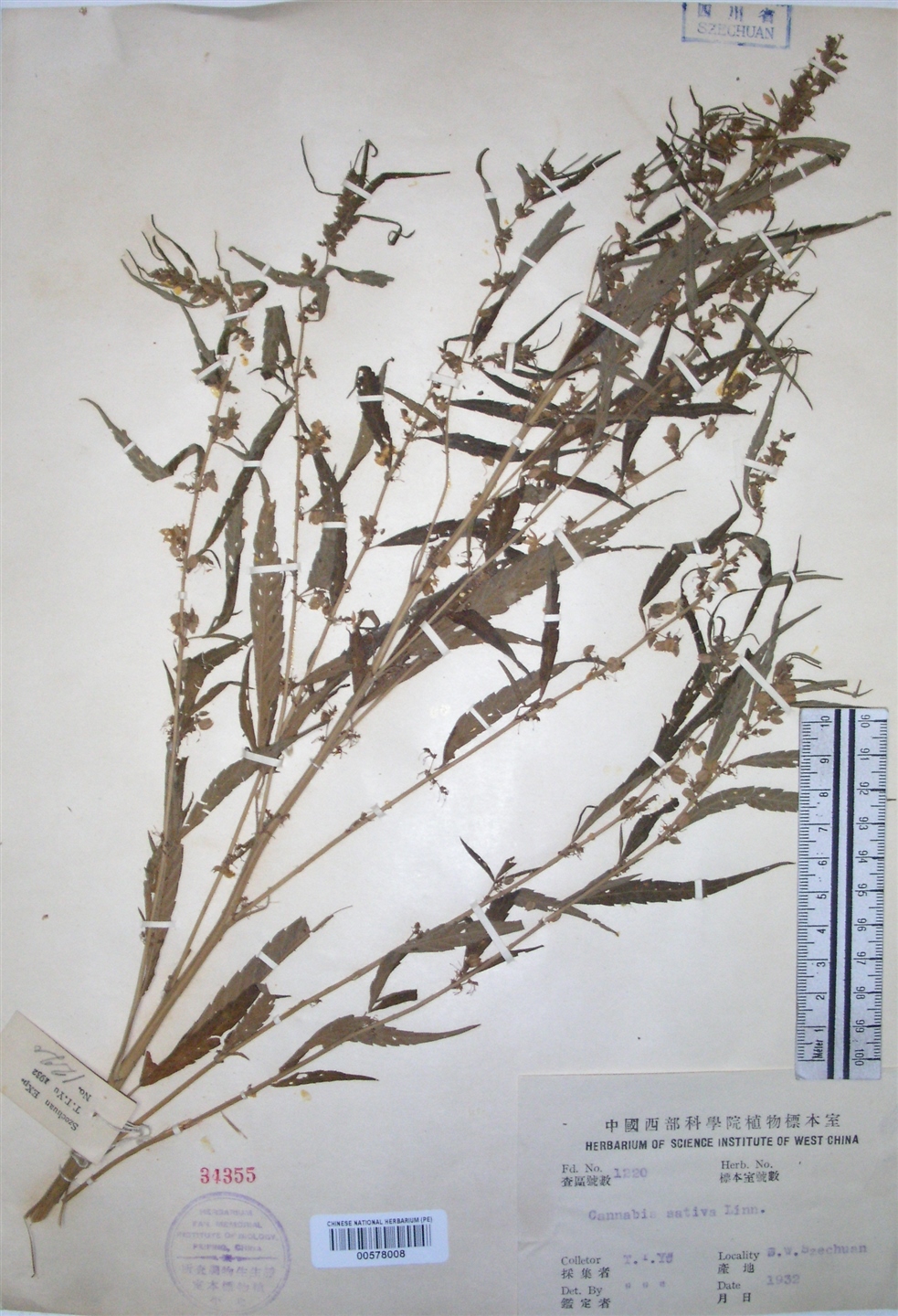
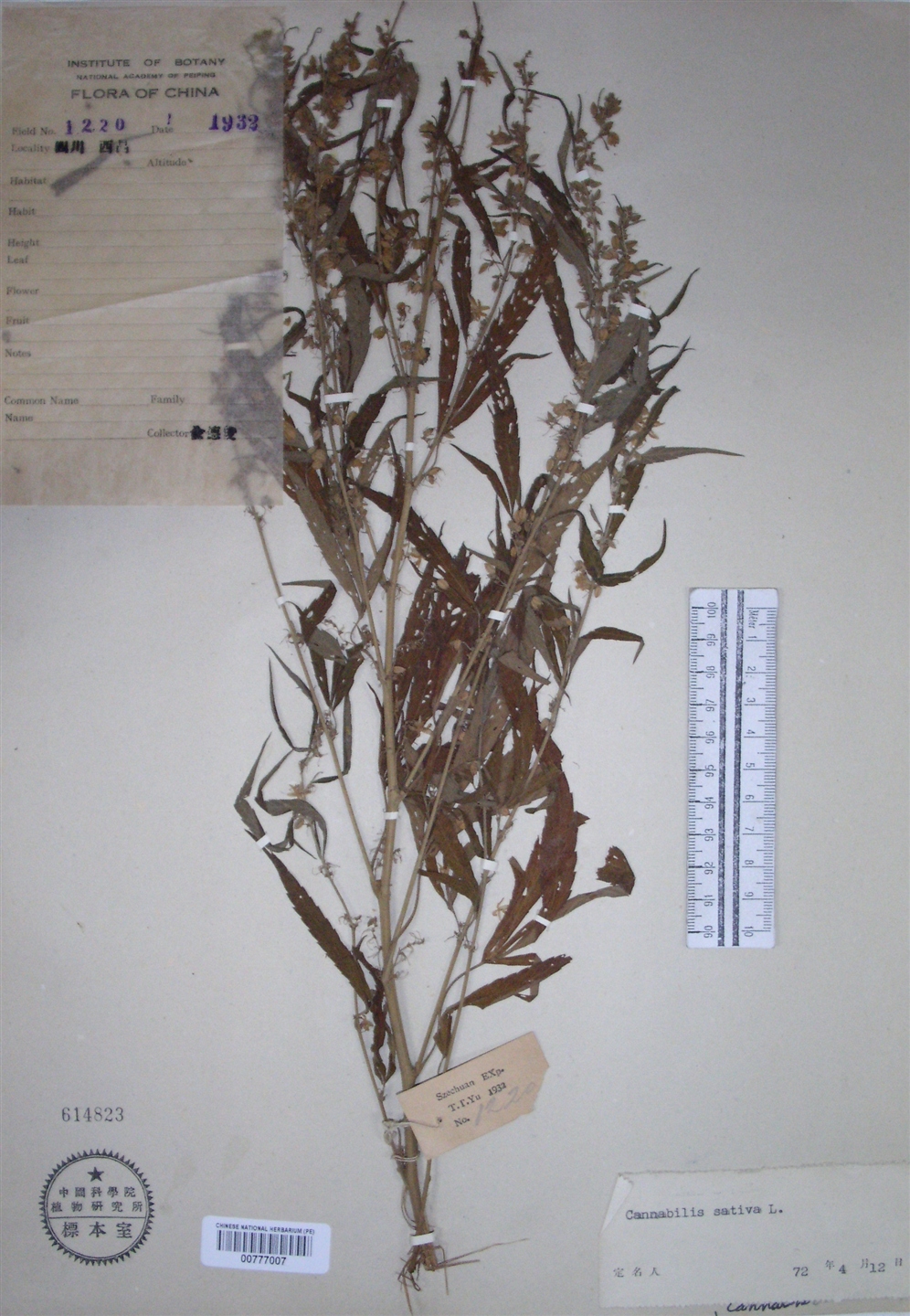
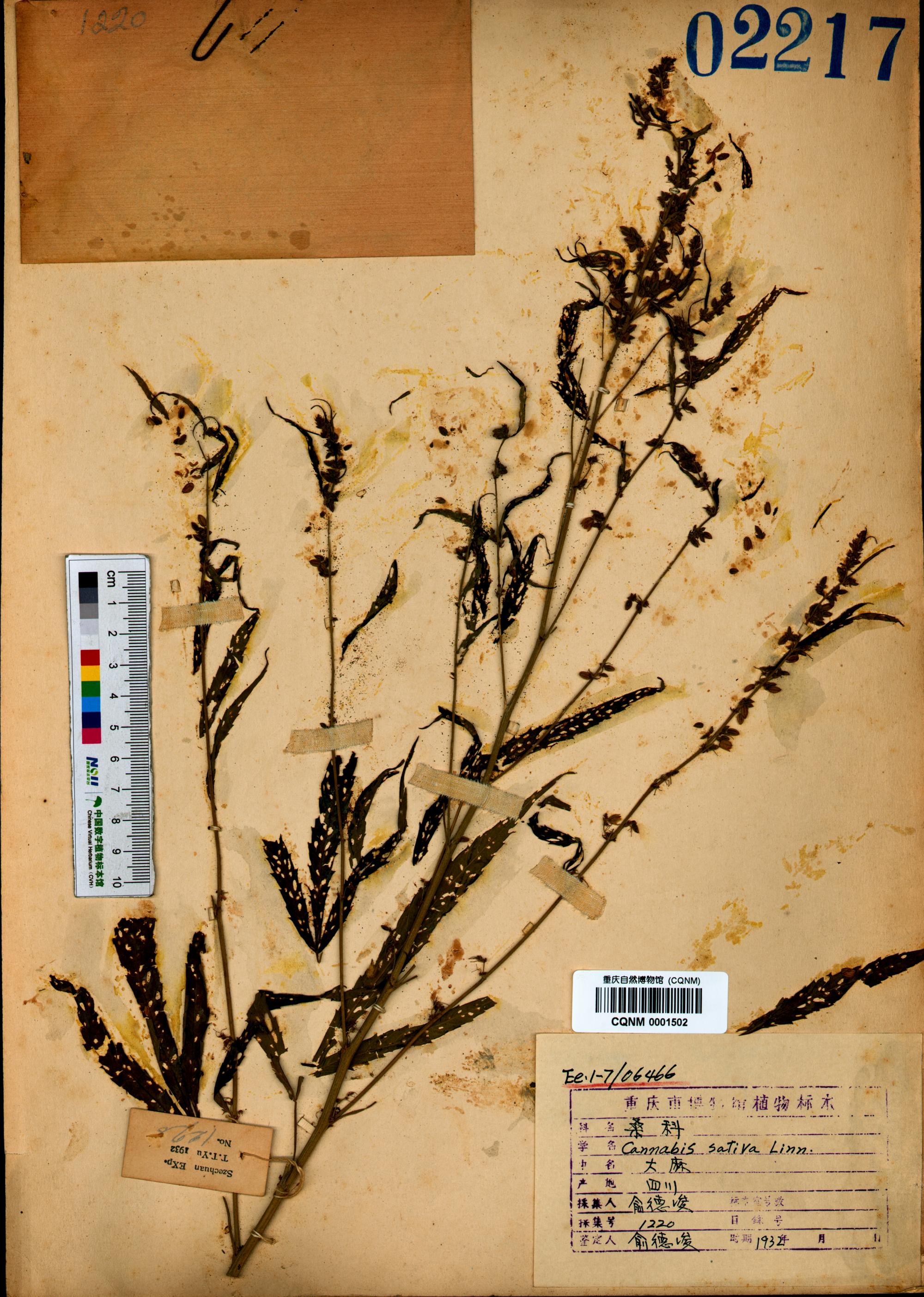
Yu 1220 is a herbarium accession of Cannabis sativa collected at Sichang (西昌, Xichang), in south-western Sichuan, China, in 1932 by T. T. Yu on the Szechuan Expedition. The Institute of Botany, Chinese Academy of Sciences in Beijing holds two sheets, PE 00578008[1] and PE 00777007[2], and the Chongqing Natural History Museum a third as CQNM 0001502.[3]
Collection and locality
PE 00578008 carries a typed form of the herbarium of the Science Institute of West China (中國西部科學院植物標本室): Fd. No. 1220, the collector T.T.Yu, the locality S.W. Szechuan and the date 1932. PE 00777007 carries a Flora of China form of the Institute of Botany, National Academy of Peiping, completed with stamps: the number 1220, the year 1932, the locality 四川 西昌 (Szechwan, Sichang) and the collector 俞德浚 (Yü Te-tsun). Both sheets carry the same printed tag, Szechuan Exp., T.T.Yu 1932 and No. 1220.[4][5] The catalogue gives the number, the year and Sichuan, with the collector as T. T. Yu for one sheet and 俞德俊 for the other.[1][2] CQNM 0001502 carries the same tag and a later form of the Chongqing Municipal Museum (重庆市博物馆), written in simplified characters, which gives the number 1220, the year 1932, the province 四川 (Szechwan) and 俞德浚 as collector and as determiner.[6] The catalogue gives that sheet's collector as 俞德俊.[3]
Specimen and identification
Both sheets carry tall, much-branched stems with narrow leaflets and flowers at the nodes.[4][5] The West China form names the plant Cannabis sativa Linn., with the determiner's line left blank; a later slip on PE 00777007 reads Cannabilis sativa L.[4][5] The Chongqing sheet carries several tall, much-branched stems with narrow, serrate leaflets and dense leafy flowering tops.[6] The Chinese Virtual Herbarium publishes its sheet images under a non-commercial, no-derivatives licence (CC BY-NC-ND 4.0); they are read and cited here, not reproduced.
- ↑ 1.0 1.1 "Specimen PE 00578008: Cannabis sativa". Chinese Virtual Herbarium. Institute of Botany, Chinese Academy of Sciences. Retrieved 13 October 2026.
- ↑ 2.0 2.1 "Specimen PE 00777007: Cannabis sativa". Chinese Virtual Herbarium. Institute of Botany, Chinese Academy of Sciences. Retrieved 13 October 2026.
- ↑ 3.0 3.1 "Specimen CQNM 0001502: Cannabis sativa". Chinese Virtual Herbarium. Institute of Botany, Chinese Academy of Sciences. Retrieved 15 October 2026.
- ↑ 4.0 4.1 4.2 "Digitised sheet PE 00578008: Cannabis sativa". Chinese Virtual Herbarium image service. Institute of Botany, Chinese Academy of Sciences. Retrieved 13 October 2026.
- ↑ 5.0 5.1 5.2 "Digitised sheet PE 00777007: Cannabis sativa". Chinese Virtual Herbarium image service. Institute of Botany, Chinese Academy of Sciences. Retrieved 13 October 2026.
- ↑ 6.0 6.1 "Digitised sheet CQNM 0001502: Cannabis sativa". Chinese Virtual Herbarium image service. Institute of Botany, Chinese Academy of Sciences. Retrieved 15 October 2026.