Tsiang 9255 (1930)
More actions
| Tsiang 9255 herbarium specimen, Pumei, Tsehheng (1930) | |
|---|---|
| Tsiang 9255 (1930) | |
| At a Glance | |
| Classification | Landrace |
| Location | |
| Country | China |
| Province/State | Guizhou |
| Locality | Pumei, Tsehheng |
| Coordinates | 25.25, 105.66 |
| Collection | |
| Method | Herbarium specimen |
| Sourcing Type | Historical |
| Date | 6 November 1930 |
| Collector | Y. Tsiang |
| Specimen | |
| Repository | Institute of Botany, Chinese Academy of Sciences |
| Catalogue Number | PE 00578057 |
| Collector Number | Tsiang 9255 |
| Scientific Name | Cannabis sativa L. |
| Identified By | H. Handel-Mazzetti |
| Occurrence Record | View occurrence record |
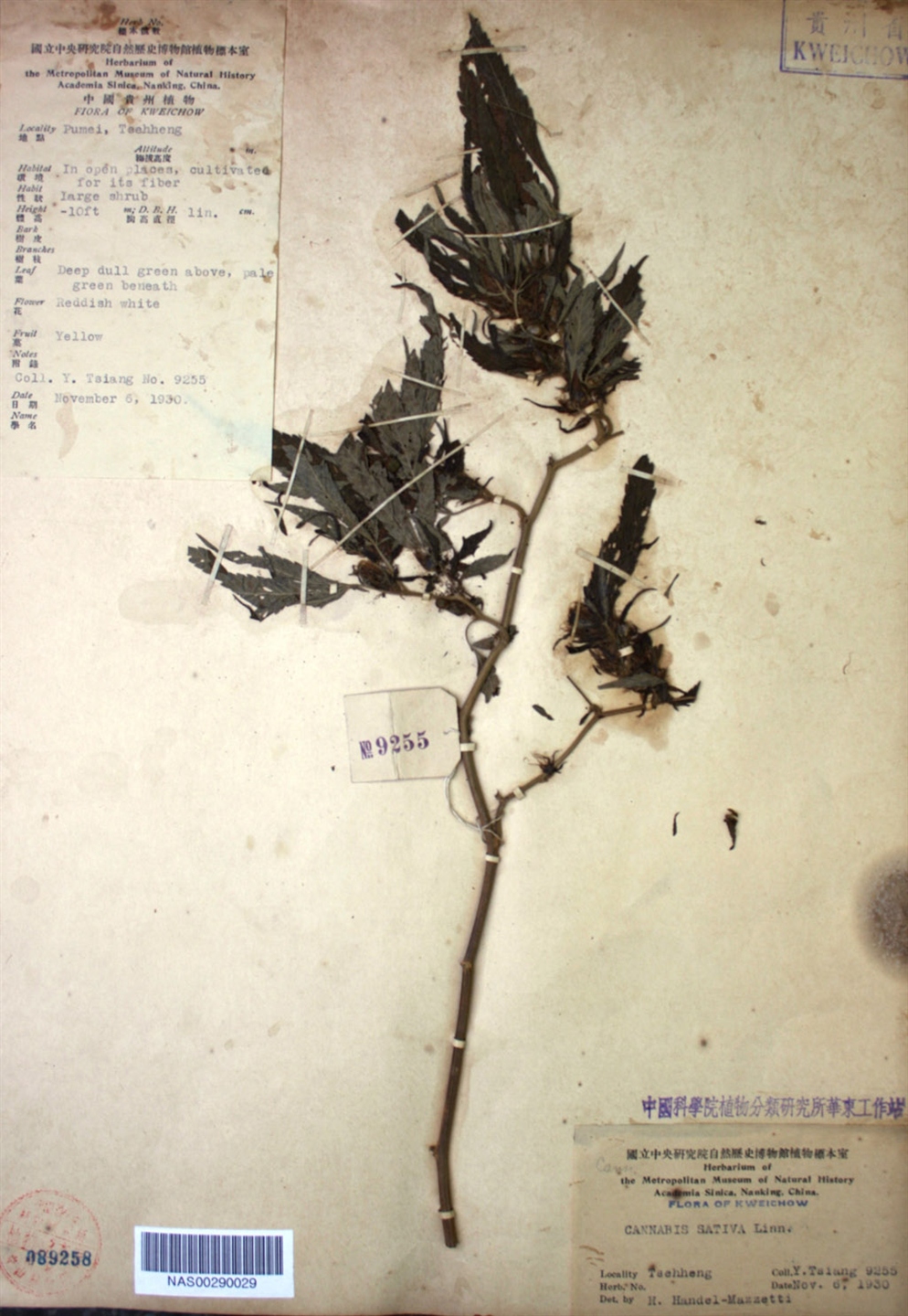
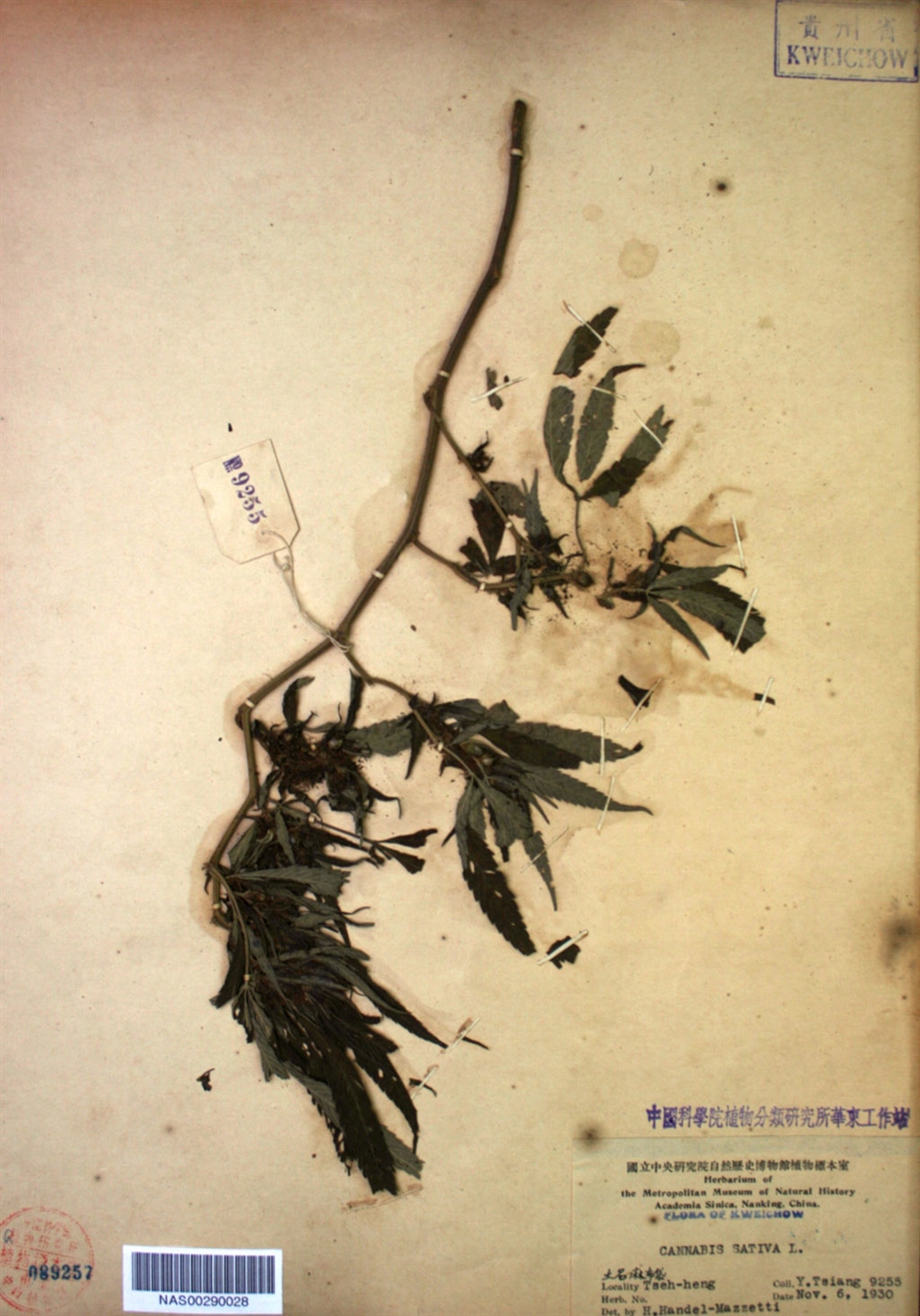
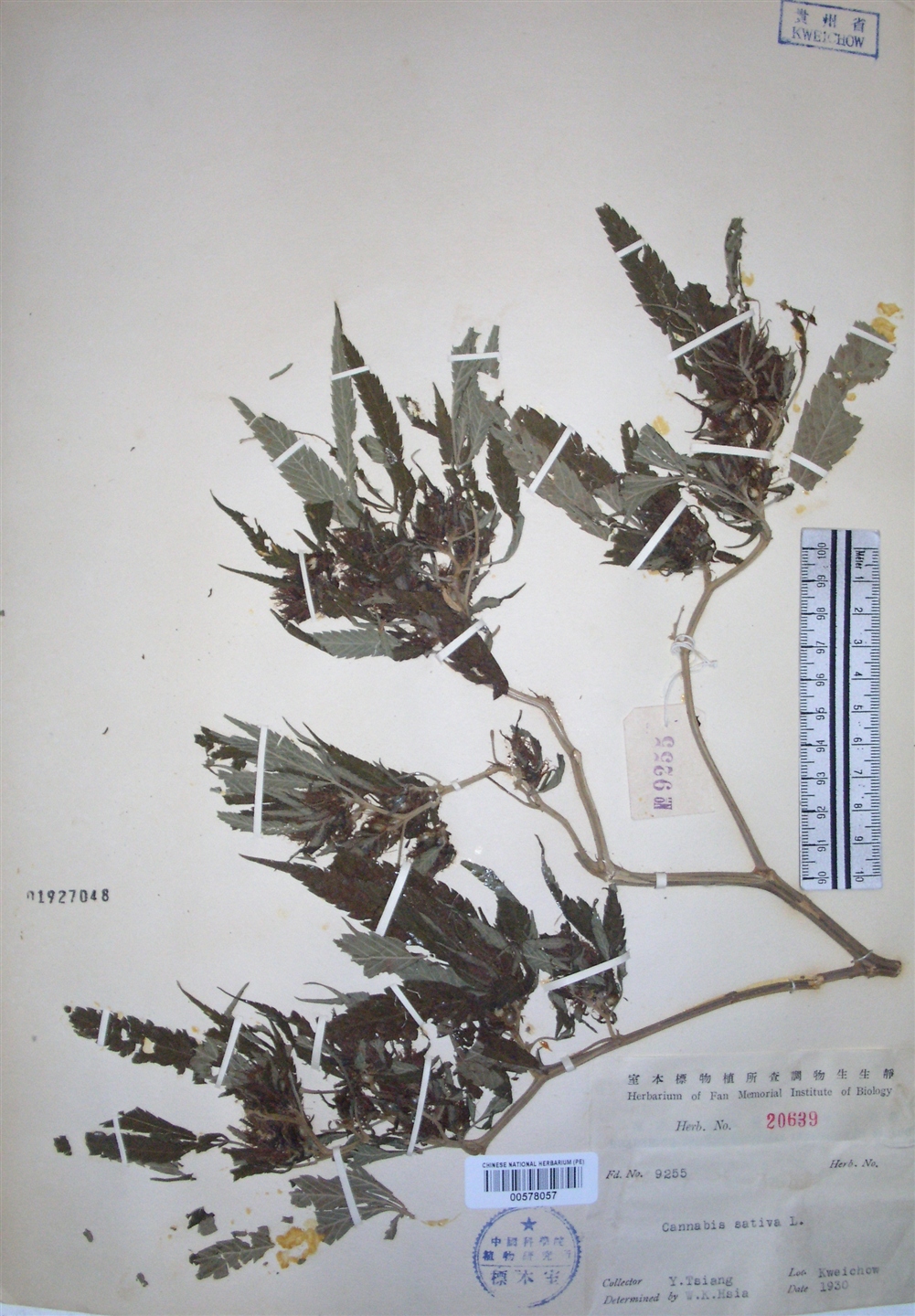
Tsiang 9255 is a herbarium accession of Cannabis sativa collected from hemp cultivated for its fibre at Pumei, in Tsehheng (Ceheng), Guizhou (then Kweichow), China, on 6 November 1930 by Y. Tsiang. The Institute of Botany, Chinese Academy of Sciences in Beijing holds a sheet as PE 00578057[1], and the Institute of Botany, Jiangsu Province and Chinese Academy of Sciences in Nanjing two more, NAS00290028[2] and NAS00290029[3].
Collection and locality
The field label on NAS00290029 is a typed form of the herbarium of the Metropolitan Museum of Natural History, Academia Sinica, Nanking, headed Flora of Kweichow. It gives the locality Pumei, Tsehheng, the habitat In open places, cultivated for its fiber and Coll. Y. Tsiang No. 9255, dated November 6, 1930.[4] The same museum's determination labels on both Nanjing sheets give the locality Tsehheng and the number and date; on NAS00290028 a line in ink above the locality reads 土名 (local name) followed by 麻 (ma, hemp) and a character that was not read.[5] The Beijing sheet's label, of the Fan Memorial Institute of Biology, gives the number, the collector and Kweichow.[6] The catalogue gives the collector, number, year and Guizhou.[1]
Specimen and identification
The field label describes a large shrub to 10 feet high, its stem an inch thick, with leaves deep dull green above and pale green beneath, reddish white flowers and yellow fruit.[4] The three sheets carry large branched tops with narrow serrate leaflets, the Beijing sheet dense female flower clusters.[6][5][4] The Nanjing labels name the plant Cannabis sativa Linn., determined by H. Handel-Mazzetti; the Beijing label Cannabis sativa L.[6][5][4] The Chinese Virtual Herbarium publishes its sheet images under a non-commercial, no-derivatives licence (CC BY-NC-ND 4.0); they are read and cited here, not reproduced.
- ↑ 1.0 1.1 "Specimen PE 00578057: Cannabis sativa". Chinese Virtual Herbarium. Institute of Botany, Chinese Academy of Sciences. Retrieved 13 October 2026.
- ↑ "Specimen NAS00290028: Cannabis sativa". Chinese Virtual Herbarium. Institute of Botany, Chinese Academy of Sciences. Retrieved 13 October 2026.
- ↑ "Specimen NAS00290029: Cannabis sativa". Chinese Virtual Herbarium. Institute of Botany, Chinese Academy of Sciences. Retrieved 13 October 2026.
- ↑ 4.0 4.1 4.2 4.3 "Digitised sheet NAS00290029: Cannabis sativa". Chinese Virtual Herbarium image service. Institute of Botany, Chinese Academy of Sciences. Retrieved 13 October 2026.
- ↑ 5.0 5.1 5.2 "Digitised sheet NAS00290028: Cannabis sativa". Chinese Virtual Herbarium image service. Institute of Botany, Chinese Academy of Sciences. Retrieved 13 October 2026.
- ↑ 6.0 6.1 6.2 "Digitised sheet PE 00578057: Cannabis sativa". Chinese Virtual Herbarium image service. Institute of Botany, Chinese Academy of Sciences. Retrieved 13 October 2026.