
Steinheil s.n., Bône (1834)
More actions
| Steinheil herbarium specimen, Annaba (1834) | |
|---|---|
| Steinheil s.n., Bône (1834) | |

| |
| Steinheil s.n., held by the Muséum national d'Histoire naturelle as P06886057 (CC BY 4.0) | |
| At a Glance | |
| Classification | Unknown |
| Location | |
| Country | Algeria |
| Province/State | Annaba Province |
| Locality | Annaba |
| Coordinates | 36.90, 7.75 |
| Point type | Settlement point |
| Uncertainty | about 5 km |
| Collection | |
| Method | Herbarium specimen |
| Sourcing Type | Historical |
| Date | 1834 |
| Collector | A. de Steinheil |
| Specimen | |
| Repository | Muséum national d’Histoire naturelle |
| Catalogue Number | P06886057 |
| Collector Number | Steinheil, A. de s.n. |
| Scientific Name | Cannabis sativa L. |
| Occurrence Record | View occurrence record |
Steinheil s.n., Bône is a herbarium accession of Cannabis sativa credited to Adolphe Steinheil and dated 1834. Its locality is given as Bone, the French colonial name for present-day Annaba in north-eastern Algeria. The Muséum national d’Histoire naturelle in Paris holds the sheet as catalogue P06886057.[1] GBIF publishes it as occurrence 731718635.[2]
Collection and locality
The sheet's label, printed Herb. Mus. Paris., is written in one hand: Bone. at the lower left and M. Ad. Steinheil 1834. at the lower right.[3] The place name carries no circumflex. The label gives no habitat, altitude, collection number or month. The catalogue transcribes the same place and year.[1][2] The date is held as a span from 1 January to 31 December 1834, the form this catalogue uses where only a year is known.[2]
Bône was the French name for the port, which France took in 1832 and which is now called Annaba.[4] Annaba lies in Annaba Province.[5]
Adolphe Steinheil lived from 1810 to 1839, so a gathering of 1834 falls inside his working life.[6]
Specimen and identification
The sheet holds a single leafy stem bearing fruit. A second printed label, HERB. MUS. PARIS. with ALGÉRIE printed at its foot, names the plant Cannabis sativa L. in manuscript.[3] The catalogue records the preparation as a herbarium sheet and the name as Cannabis sativa L., with no infraspecific rank and no determiner named.[1][2] A leaf sample was taken from the sheet in March 2021 for C. J. Grassa at Harvard University, under request 156515.[2]
Three images of the sheet are published with the occurrence: the whole sheet under a Creative Commons Attribution licence and two close photographs of its fruits with a one-millimetre scale bar, credited to Corinne Sarthou and Germinal Rouhan, under an Attribution-NonCommercial-NoDerivatives licence.[2]
-
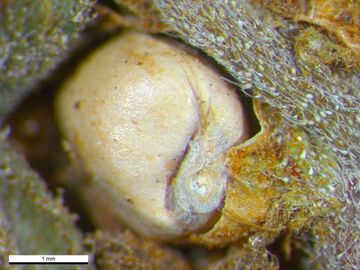 A fruit on the sheet, photographed at high magnification (CC BY-NC-ND 4.0)
-
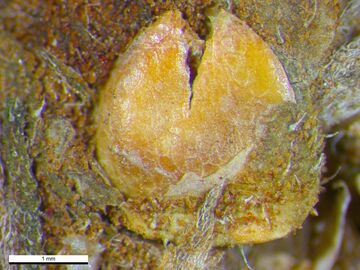 A second fruit, split open (CC BY-NC-ND 4.0)


- ↑ 1.0 1.1 1.2 "Specimen P06886057: Cannabis sativa L." MNHN collections. Muséum national d’Histoire naturelle. Retrieved 18 September 2026.
- ↑ 2.0 2.1 2.2 2.3 2.4 2.5 "Occurrence 731718635: Cannabis sativa L." GBIF. Global Biodiversity Information Facility. Retrieved 18 September 2026.
- ↑ 3.0 3.1 "Digitised sheet P06886057: Cannabis sativa L." Herbier national, images. Muséum national d'Histoire naturelle. Retrieved 4 October 2026.
- ↑ "Annaba". Encyclopædia Britannica. Retrieved 18 September 2026.
- ↑ "Annaba, Algeria". Nominatim. OpenStreetMap Foundation. Retrieved 18 September 2026.
- ↑ "Steinheil, Adolph(e) (1810-1839)". International Plant Names Index. Royal Botanic Gardens, Kew, Harvard University Herbaria and Australian National Botanic Gardens. Retrieved 18 September 2026.