
RSC-LBN-UNK-0120080001
More actions
| Lebanese Reproduction 2008 | |
|---|---|
| RSC-LBN-UNK-0120080001 | |

| |
| Fourth-generation Lebanese outdoors in Oregon in mid-September (RSC listing caption, 2019) | |
| At a Glance | |
| Classification | Landrace |
| Accession Type | Reproduction |
| Selection Type | Multiple plants |
| Pollination Type | Open pollination |
| Primary Purpose | Recreation |
| Plant Height | 0.5–1.5 m |
| Photoperiod | Semi-autoflowering |
| Aroma | Cedar, pine, fruit, mango, candy, hashish |
| Botanical Characteristics | |
| Growth Pattern | Columnar, Bushy |
| Processing | |
| Method | Dry-sift |
| Notes | Sieved hashish |
| Location | |
| Country | Lebanon |
| Coordinates | 34.00, 36.14 |
| Collection | |
| Method | Seeds |
| Sourcing Type | Multi-generation reproduction |
| Autochthonous | No |
| Date | 2008 |
| Collector | Angus |
| Conservation | |
| Priority | Medium |
| Introgression | Minimal |
| Cultivation | |
| Status | Unknown |
| System Type | Unknown |
| Cycle 1 Harvest | August–September |
| Preservation | |
| Seed Storage | The Real Seed Company |
Lebanese Reproduction 2008 is a landrace cannabis accession from the Bekaa Valley, Lebanon, listed as Lebanese in the seed catalogue of The Real Seed Company (RSC).[1] RSC describes it as a Lebanese cannabis landrace collected at source in the valley from the 2008 harvest, and grown for sieved hashish.[1]
Geography
RSC gives the sourcing as the Bekaa Valley and a latitude of about 34° N, and states that the line originates in one of the most renowned mountain regions above the valley, where it says the finest Lebanese hashish has been produced.[1] It files the line under its Near East category, which it describes as a distinct zone for drug-type landraces, whose plants are close to the classic Indica but much earlier maturing, with the harvest often beginning as early as mid-August.[2]
History
According to RSC, Lebanon has a long tradition of producing hashish and the region's best landraces are renowned for their quality and breeding potential.[1] In a note carried since August 2020, RSC writes that the Bekaa Valley has been a major centre of commercial hashish production for export since the early 20th century; that the crops of that era were probably introduced by the Levantine smuggling networks that controlled Mediterranean smuggling to Egypt, then among the world's largest markets for hashish; that the plants were likely to have been similar to those cultivated in Greece, the major regional producer until the 1930s; that Afghan seeds are said to have been introduced to the Bekaa in 1974; and that hemp was briefly cultivated in the valley during the 1990s in crop substitution programmes, which RSC suggests may explain the high CBD levels of some plants in the population.[1][3]
In a blog post of March 2023 RSC describes the morphology of Near Eastern landraces such as this one as typical of the C. sativa subsp. indica landraces of the region, with semi-dwarf architecture but markedly narrower leaflets at maturity than the classic Indica, and without the skunky notes of most Central Asian landraces.[4] In an interview of July 2019, RSC's Angus says the line was one he found in the Bekaa Valley.[5]
Collection Details
The listing gives the sourcing as The Real Seed Company, Bekaa Valley, Lebanon, 2008 harvest, and states that the line was personally collected at source with the assistance of a local old-timer hashish aficionado from the valley.[1][6] Versions of the listing from August 2019 to April 2023, and the Kwik Seeds listing of the same line on the shop RSC calls its other site,[7] add that the seeds were produced with first-generation and third-generation seeds from the original 2008 accession by open pollination, involving numerous males and females with minimal selection, and that plants with negative traits were removed while biodiversity was maintained so far as possible.[6][8][9] Neither listing names a village or a farmer.
Cultivation Details
RSC gives the purpose as hashish, which it glosses as sieved resin, and the harvest as August through September. It lists outdoor, greenhouse or indoor growing.[1][9] RSC describes the line as very early maturing, with harvest as early as August, and uses the term "semi-auto" for a landrace that flowers during the summer while days are long, which it considers good for northern latitudes.[1] Kwik Seeds files the line under its Auto & Semi-Auto category, which names Lebanese among the landraces showing that trait.[10] An RSC blog post of August 2025 describes Lebanese among the semi-autoflowering varieties of its Near East collection.[11] A post of September 2023 gives the harvest in regions such as the Bekaa Valley as beginning as early as mid-August, and considers Near Eastern landraces good candidates for breeding high-density outdoor crops for dry northern latitudes.[12]
Botanical Characteristics
RSC gives a height of 0.5 to 1.5 metres and describes compact, early maturing and resinous plants, with deep-red or purple colouration during senescence. It reports two main architectures: columnar plants that grow to one central stem with minimal branching, which it considers suited to breeding industrial crops, and heavily branched plants that are often near-spherical, about 90 by 90 centimetres.[1][9] Versions of the listing from August 2020 to April 2023 classified the line as C. sativa subsp. indica var. afghanica × C. sativa subsp. indica var. indica.[3][8]
Chemistry
RSC reports that CBD can be exhibited in exceptionally high double-digit quantities in some plants, and that the population can be expected to segregate into type 1, type 2 and type 3 chemotypes.[1] In a blog post of July 2019 it reports a Lebanese plant whose sieved resin tested at 19 per cent CBD and 13.75 per cent THC, with some CBDV, and adds that tested bud of some plants has shown double-digit CBD.[13] RSC files the line under its CBD category, which it describes as covering high-CBD cannabis landraces.[14]
Aroma
RSC lists cedar, pine, fruit, mango, candy and hashish, and describes sweetness with heavy aromas of fruit such as mango and cherry.[1][9]
Smoke Reports
Gallery
-
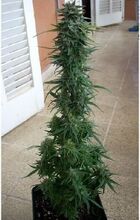 Columnar Lebanese plant outdoors in Spain (RSC listing caption, 2019)
 -
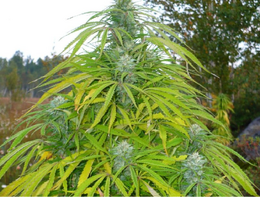 Branched Lebanese plant outdoors in North America in mid-September (RSC listing caption, 2019)
 -
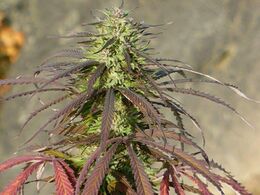 Lebanese flower top outdoors in North America in mid-September (RSC listing caption, 2019)
 -
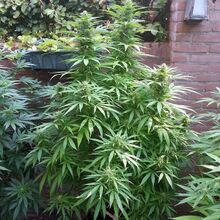 A Lebanese plant whose sieved resin tested at 19 per cent CBD and 13.75 per cent THC (RSC blog post, July 2019)
 -
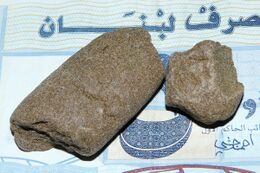 Lebanese hashish from the 2008 harvest, Bekaa Valley (RSC listing caption, 2019)
 -
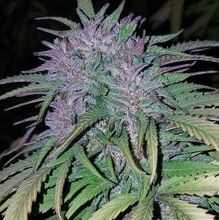 Lebanese flower top with purple colouration (RSC listing)
 -
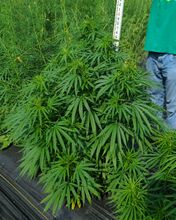 Lebanese plants beside a measuring pole (RSC listing)


See Also
References
- ↑ 1.00 1.01 1.02 1.03 1.04 1.05 1.06 1.07 1.08 1.09 1.10 "Lebanese". The Real Seed Company. Retrieved 17 September 2026.
- ↑ "Near East". The Real Seed Company. Retrieved 17 September 2026.
- ↑ 3.0 3.1 "Lebanese". The Real Seed Company. Archived from the original on 5 August 2020. Retrieved 17 September 2026.
- ↑ "10 Quick Questions with The Real Seed Company". The Real Seed Company. 22 July 2019. Retrieved 17 September 2026.
- ↑ 6.0 6.1 "Lebanese". The Real Seed Company. Archived from the original on 19 August 2019. Retrieved 17 September 2026.
- ↑ "Hemp & Multipurpose". The Real Seed Company. Retrieved 17 September 2026.
- ↑ 8.0 8.1 "Lebanese". The Real Seed Company. Archived from the original on 4 April 2023. Retrieved 17 September 2026.
- ↑ 9.0 9.1 9.2 9.3 "Lebanese". Kwik Seeds. Retrieved 17 September 2026.
- ↑ "Auto & Semi-Auto". Kwik Seeds. Retrieved 17 September 2026.
- ↑ "Auto and Semi-Auto Traits in Landrace and Feral Cannabis". The Real Seed Company. 15 August 2025. Retrieved 17 September 2026.
- ↑ "Landraces for Breeding Advanced Semi-Dwarf Cannabis Cultivars". The Real Seed Company. 20 September 2023. Retrieved 17 September 2026.
- ↑ "CBD in Cannabis landraces". The Real Seed Company. 22 July 2019. Retrieved 17 September 2026.
- ↑ "CBD". The Real Seed Company. Retrieved 17 September 2026.