Francis Buchanan-Hamilton
More actions
| Francis Buchanan-Hamilton | |
|---|---|
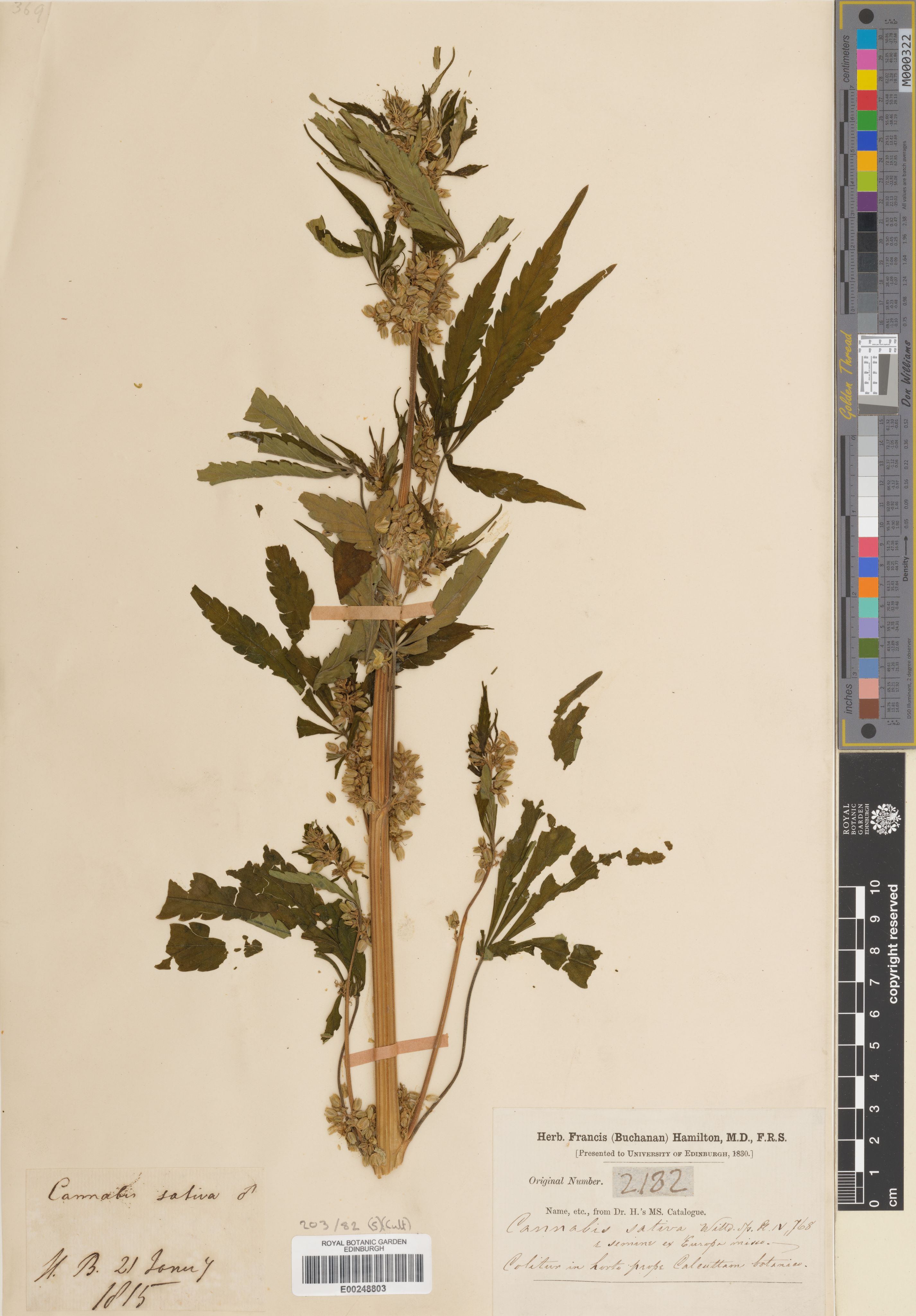
 Buchanan-Hamilton 2182, a male cannabis plant grown in the Calcutta botanic garden in 1815, from the herbarium he left to the University of Edinburgh. It is held by the Royal Botanic Garden Edinburgh (CC BY-SA 2.5)
| |
| Born | 15 February 1762 Branziet, parish of Callander, Perthshire, Scotland |
| Died | 15 June 1829 Leny, near Callander, Perthshire |
| Nationality | British |
| Occupation | Surgeon, surveyor and naturalist |
| Institutions | East India Company; Calcutta Botanic Garden |
| Known for | Surveys of Mysore (1800–1801), Nepal (1802–1803) and Bengal and Bihar (1807–1814) |
| Collector name on accessions | F. Buchanan-Hamilton |
| Botanical author abbreviation | Buch.-Ham. |
Francis Buchanan-Hamilton (15 February 1762 – 15 June 1829), born Francis Buchanan and known from 1818 as Francis Hamilton, was a Scottish surgeon in the East India Company's Bengal service. For the Company he reported on Mysore in 1800 and 1801 and on Nepal in 1802 and 1803. From 1807 to 1814 he made a statistical survey of Bengal and Bihar.[1][2] His reports describe how ganja was grown, prepared and sold in the districts he visited. His account of Nepal describes charas and the wild hemp in the country's wheat fields.[3]: 865–866[4] In 1814 and 1815 he had charge of the Company's botanic garden at Calcutta.[1] Cannabis from his herbarium is held at the Royal Botanic Garden Edinburgh and at Kew, where a sheet came through Nathaniel Wallich's distribution of the Company's herbarium.[5][6]
His botanical author abbreviation is Buch.-Ham.[7]
Perthshire, Glasgow and Edinburgh
Buchanan was born at Branziet, in the parish of Callander in Perthshire, on 15 February 1762. He was the third son of Thomas Buchanan of Spittal and Elizabeth Hamilton, heiress of Bardowie.[1] He took the degree of MA at the University of Glasgow in 1779 and then studied medicine at Edinburgh. There James Edward Smith, later the founder of the Linnean Society, was his fellow student and friend.[8]: vi He graduated MD at Edinburgh in 1783.[1]
The Dictionary of National Biography says that he then served as surgeon of a man-of-war and gave the post up through ill health.[1] David Prain, who wrote his life in 1905, had the naval records for 1783 to 1794 searched, and they showed no naval service. Prain concluded that Buchanan made two and possibly three voyages to India and the East on East Indiamen, first as surgeon's mate and then as surgeon. One of Buchanan's own papers places him in the Arabian Sea in July 1785, on a ship bound for Bombay. In 1788 he became one of the first associates of the Linnean Society.[8]: vi–viii
Ava, Chittagong and the Bengal delta, 1794–1799
Buchanan joined the Company's Bengal medical service as an assistant surgeon on 26 September 1794.[8]: viii In 1795 he went with Michael Symes's embassy to the court of Ava. He collected plants in Ava, in Pegu and on the Andaman Islands.[1] The Court of Directors gave the specimens and drawings from this journey to Joseph Banks.[8]: xl
After the embassy returned he was stationed at Lakkipur (Lakshmipur), near the mouth of the Brahmaputra. There he wrote the account of the river's fishes that was published in 1822.[1] In 1798 William Roxburgh secured him a commission from the Board of Trade to report on Chittagong. In a letter to Roxburgh, Buchanan called it a botanical excursion of nearly three months.[8]: xi
Mysore and Nepal, 1800–1803

In 1800 the governor-general, Lord Wellesley, sent Buchanan to report on Mysore, Canara and Malabar. His instructions covered agriculture, arts and commerce, religion and customs, natural and civil history and antiquities.[1] He was back at Madras, the survey finished, on 6 July 1801.[8]: xiii The Court of Directors had his journal published in London in 1807, in three quarto volumes.[1]
In 1802 he went to Nepal with the Company's mission under Captain Knox.[8]: xv He spent fourteen months near Kathmandu, gathering a large herbarium and having drawings and descriptions made. A Brahmin from Calcutta, Babu Ramajai Bhattacharji, collected information for him.[8]: xvi The mission left Kathmandu in March 1803.[8]: xvii Buchanan gave his Nepal herbarium, with its drawings and descriptions, to Smith. A set of duplicates went to Aylmer Bourke Lambert, and David Don used it with Wallich's later Nepal collections for his flora of Nepal.[8]: xxxi, xli
In the cold season of 1803–04 Wellesley made him surgeon to the governor-general and put him in charge of the menagerie at Barrackpore. He spent the next two years drawing and describing its animals.[8]: xvii When Wellesley sailed for England he went with him.[1]
The survey of Bengal and Bihar, 1807–1814
While he was in England the Court of Directors named him Roxburgh's successor at the Calcutta garden and chose him to survey the Bengal presidency.[8]: xviii[1] He was promoted to surgeon on 20 June 1807. His orders were to begin in Rangpur and to work westward, district by district, across the Gangetic plain north of the Ganges. He was to write a full topographical account of each district and was forbidden to leave the Company's territory.[8]: xix He began instead with Dinajpur, late in 1807. Rangpur followed in 1808 and 1809, when the district took in part of lower Assam. Purnea, Bhagalpur, Gaya with Patna and Shahabad came next. He ended with Gorakhpur in 1813 and 1814.[8]: xx The survey was never finished.[1][8]: xx
His artists drew only plants that had not already been drawn for Roxburgh. One of them was probably Haludar, who had worked for him in Mysore and Nepal. They made 138 botanical drawings in all. The largest groups were drawn at Goalpara in Assam in 1808 and at Nathpur, near the Nepal frontier, in 1810.[2]
In November 1814 the government put him in charge of the Calcutta garden. In February 1815 he handed it to Wallich and sailed for England.[8]: xxii–xxiii The governor-general, Lord Hastings, ordered the survey's drawings to be kept in Calcutta. Buchanan had meant to take them home with his specimens, which he could not describe properly without them.[2] His reports reached East India House in 1816.[1] An account of Dinajpur was printed at Calcutta in 1833.[1][8]: xxxix In 1838 Montgomery Martin edited the survey in three volumes covering Bihar with Patna, Shahabad, Dinajpur, Bhagalpur, Purnea, Gorakhpur, Rangpur and Assam.[1][9]
Writing on cannabis
In his Account of the Kingdom of Nepal (1819) Buchanan found most of the wheat fields of Nepal choked with hemp, Cannabis sativa, which he called a troublesome and useless weed there.[10] The plant was not cultivated in Nepal, although it was much used for intoxication. Dried leaves came from the Tariyani, but the extract, charas, was used more, and the best charas came from Tibet. He wrote that charas was properly made by cutting into the stem and collecting the juice, in the way opium is taken from the poppy, and that a coarser kind was pressed from the plant. He did not accept William Kirkpatrick's account that the resin was rubbed from the leaves until it stuck to the fingers. A dose was 10 to 12 grains, made into a pill and smoked.[4] A shopkeeper who followed the mission's camp died from smoking too much.[11]
In Dinajpur he found ganja grown almost only in the division he spelt Jogodol, on about 300 bigahs of rich clay land near the farmers' houses. People there called the plant gangja when young and siddhi once its flowers had opened. It also grew wild in much of the district. The dried leaves of wild siddhi were pounded in a mortar with water and the infusion drunk.[3]: 865 For ganja the seed was sown in a small bed at the end of June. The seedlings were planted out in August, three or four feet apart, and were manured and weeded. In February, before the flowers opened, the buds and young leaves were pinched off and dried on the ground for 10 or 12 days. Ganja was smoked like tobacco, about 12 grains at a time.[3]: 866
He wrote that the people of Purnea held ganja to be "more conducive to health and strength" than other intoxicants. Because ganja was easy to smuggle, he suggested banning its cultivation except on the Company's account. Charas was prohibited there.[9]: 114–115 At Gondwara in the same district about 25 bigahs were under the crop, and he suspected that much more was grown privately.[9]: 247 At Patna licensed dealers sold ganja for smoking, and one of them, with a capital of 30,000 rupees, imported nearly all of it. The rich ate majun, tablets made from hemp leaves, clarified butter and sugar.[12]: 338, 372 In Gorakhpur most users took the wild plant. He wrote that Brahmans there could use hemp without losing caste, but that only men who had left the world for a religious life used it much.[3]: 424, 473 The Shahabad tables count 5,507 men who smoked ganja and 8,790 who took siddhi or bhang. Charas users were few.[12]: Appendix, 47
Cannabis specimens

In India Buchanan formed no herbarium of his own and gave his collections away.[8]: xxxvii After he retired he wrote out two copies of the catalogue of his Bengal survey specimens. He sent one set of specimens and one copy to East India House, and Wallich distributed that set with the rest of the Company's herbarium some seven or eight years later. He left his own set and catalogue to the University of Edinburgh.[2]
The Edinburgh sheet Buchanan-Hamilton 2182 (1815) is catalogued as E00248803. Its printed label reads Herb. Francis (Buchanan) Hamilton, M.D., F.R.S. and records the gift to the university in 1830. It gives the number 2182 and takes the name from his manuscript catalogue, which says the plant was raised in the botanic garden near Calcutta from seed sent from Europe. A slip marks it male and dates it 21 January 1815.[5]
Entry 4665 of Wallich's list, Cannabis sativa, has a lot A listed as H Ham.- Sudallapur & HBC.[6] Kew's sheet of the lot carries two specimens, catalogued K001039631 and K001039632.[13][14] The slip of one reads Cannabis sativa ♂, Botanical garden 21 Jany 1815, the date of the Edinburgh sheet. The slip of the other reads Cannabis sativa spontanea, Sadullahpur 5 Jany 1809.[13][14]
Accessions collected by Buchanan-Hamilton:
| Collected | Locality | Repository | Catalogue number | |
|---|---|---|---|---|
| Buchanan-Hamilton 2182 (1815) | Acharya Jagadish Chandra Bose Indian Botanic Garden | Royal Botanic Garden Edinburgh | E00248803 | |
| Wallich 4665A (1809) | Sadullahpur | Royal Botanic Gardens, Kew | K001039632 |
Leny and the later works, 1815–1829
Buchanan reached England about August 1815.[8]: xxvi He settled at Leny, near Callander.[2] In 1818, on the death of his eldest brother, he succeeded to his mother's estate and took her name, Hamilton.[1][2] The Account of the Kingdom of Nepal appeared in 1819 under the name Francis Hamilton.[10] His account of the fishes of the Ganges followed in 1822.[1] In a letter of 1821 to Wallich he said that he meant to publish commentaries on Rheede's Hortus Malabaricus and on the Amboina flora of Rumphius.[8]: xxxi
In 1821 Wellesley, newly made Lord Lieutenant of Ireland, invited him to join his staff. He declined. Soon afterwards he married a lady named Brooke. They had a daughter, Katherine, who died unmarried in 1839, and a son, John, who succeeded to the family estates.[8]: xxxi
He was a fellow of the Royal Society and a member of the Royal Asiatic Society. In 1826 he was made a deputy lieutenant of Perthshire.[1] He also claimed to be chief of the Buchanans. The Dictionary of National Biography dates the success of the claim to 1826, Prain to 1828.[1][8]: xxxii He died at Leny on 15 June 1829.[8]: xxxvi[1]
See also
References
- ↑ 1.00 1.01 1.02 1.03 1.04 1.05 1.06 1.07 1.08 1.09 1.10 1.11 1.12 1.13 1.14 1.15 1.16 1.17 1.18 1.19 Arbuthnot, Alexander John (1886). "Buchanan, Francis Hamilton". Dictionary of National Biography. Vol. 7. London: Smith, Elder & Co. p. 186 – via Wikisource.
- ↑ 2.0 2.1 2.2 2.3 2.4 2.5 Noltie, Henry (29 November 2018). "Francis Buchanan's Bengal Survey botanical drawings and specimens reunited after 203 years". Botanics Stories. Royal Botanic Garden Edinburgh. Retrieved 8 October 2026.
- ↑ 3.0 3.1 3.2 3.3 Martin, Montgomery, ed. (1838). The History, Antiquities, Topography, and Statistics of Eastern India (PDF). Vol. 2: Bhagulpoor, Goruckpoor, and Dinajepoor. London: W. H. Allen and Co. – via Wikimedia Commons.
- ↑ 4.0 4.1 Hamilton, Francis (1819). An Account of the Kingdom of Nepal, and of the Territories Annexed to This Dominion by the House of Gorkha. Edinburgh: Archibald Constable and Company. p. 231 – via Internet Archive.
- ↑ 5.0 5.1 "Digitised sheet E00248803: Cannabis sativa". IIIF image service. Royal Botanic Garden Edinburgh. Retrieved 8 October 2026.
- ↑ 6.0 6.1 "4665: Cannabis sativa L." Wallich Catalogue Online. Royal Botanic Garden Edinburgh. Retrieved 8 October 2026.
- ↑ "Buchanan-Hamilton, Francis (1762–1829)". International Plant Names Index. Royal Botanic Gardens, Kew; Harvard University Herbaria; Australian National Herbarium. Author ID 1242-1. Retrieved 8 October 2026.
- ↑ 8.00 8.01 8.02 8.03 8.04 8.05 8.06 8.07 8.08 8.09 8.10 8.11 8.12 8.13 8.14 8.15 8.16 8.17 8.18 8.19 8.20 8.21 8.22 Prain, D. (1905). "A sketch of the life of Francis Hamilton (once Buchanan), sometime superintendent of the Honourable Company's Botanic Garden, Calcutta" (PDF). Annals of the Royal Botanic Garden, Calcutta. 10: i–lxxv – via Wikimedia Commons.
- ↑ 9.0 9.1 9.2 Martin, Montgomery, ed. (1838). The History, Antiquities, Topography, and Statistics of Eastern India (PDF). Vol. 3: Puraniya, Ronggopoor, and Assam. London: W. H. Allen and Co. – via Wikimedia Commons.
- ↑ 10.0 10.1 Hamilton, Francis (1819). An Account of the Kingdom of Nepal, and of the Territories Annexed to This Dominion by the House of Gorkha. Edinburgh: Archibald Constable and Company. p. 226 – via Internet Archive.
- ↑ Hamilton, Francis (1819). An Account of the Kingdom of Nepal, and of the Territories Annexed to This Dominion by the House of Gorkha. Edinburgh: Archibald Constable and Company. p. 232 – via Internet Archive.
- ↑ 12.0 12.1 Martin, Montgomery, ed. (1838). The History, Antiquities, Topography, and Statistics of Eastern India (PDF). Vol. 1: Behar (Patna City) and Shahabad. London: W. H. Allen and Co. – via Wikimedia Commons.
- ↑ 13.0 13.1 "Occurrence 1051241889: Cannabis sativa L., K001039631". GBIF. Global Biodiversity Information Facility. Retrieved 8 October 2026.
- ↑ 14.0 14.1 "Occurrence 1051241909: Cannabis sativa L., K001039632". GBIF. Global Biodiversity Information Facility. Retrieved 8 October 2026.