Tu 731 (1935)
More actions
| Tu 731 herbarium specimens, Szechwan (1935) | |
|---|---|
| Tu 731 (1935) | |
| At a Glance | |
| Classification | Other |
| Location | |
| Country | China |
| Province/State | Sichuan |
| Elevation | 1700 m |
| Collection | |
| Method | Herbarium specimen |
| Sourcing Type | Historical |
| Date | 1935 |
| Collector | T. H. Tu |
| Specimen | |
| Repository | Institute of Botany, Chinese Academy of Sciences |
| Catalogue Number | PE 00578031 |
| Collector Number | Tu 731 |
| Scientific Name | Cannabis sativa L. |
| Identified By | K. C. Kuan |
| Occurrence Record | View occurrence record |
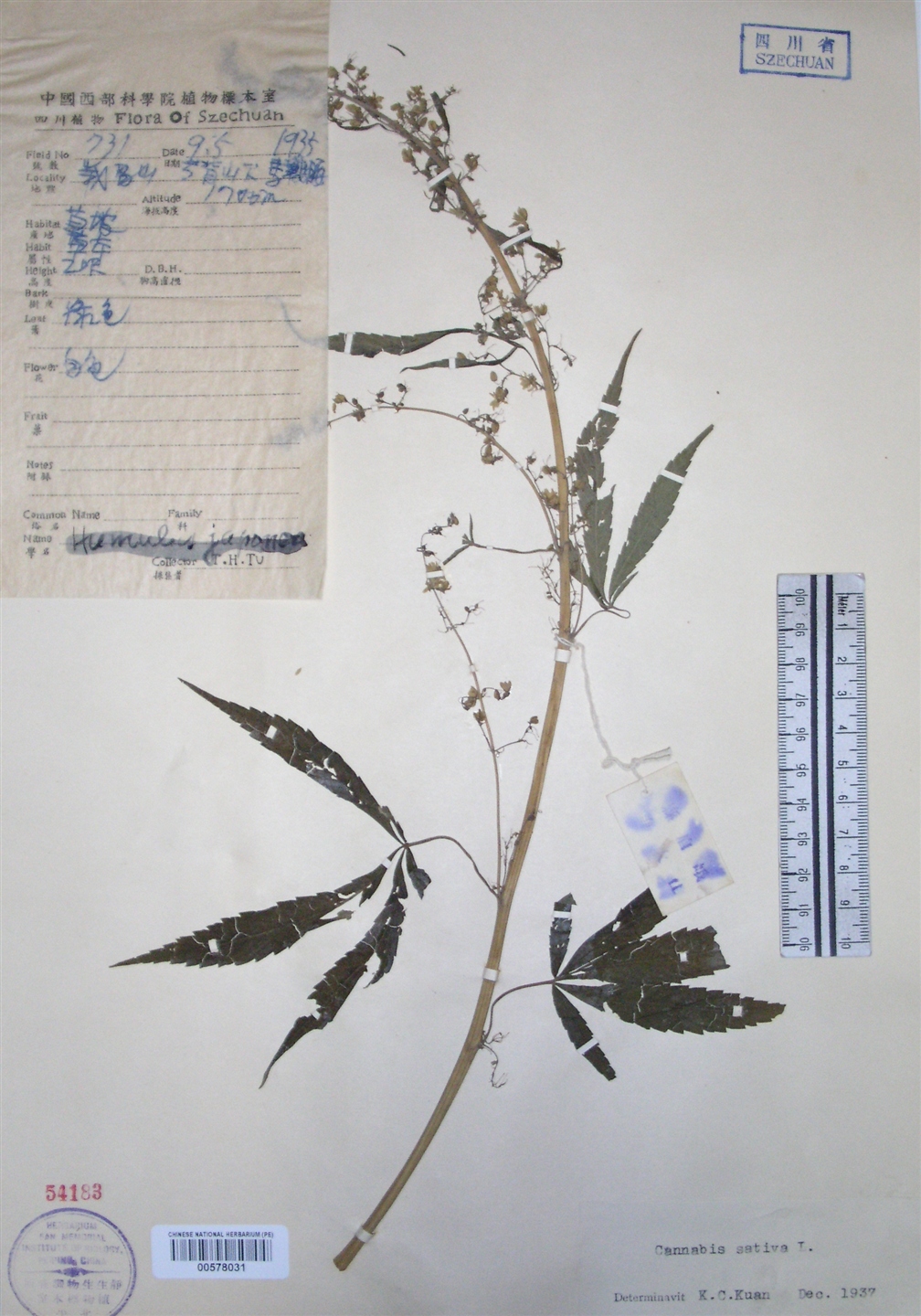
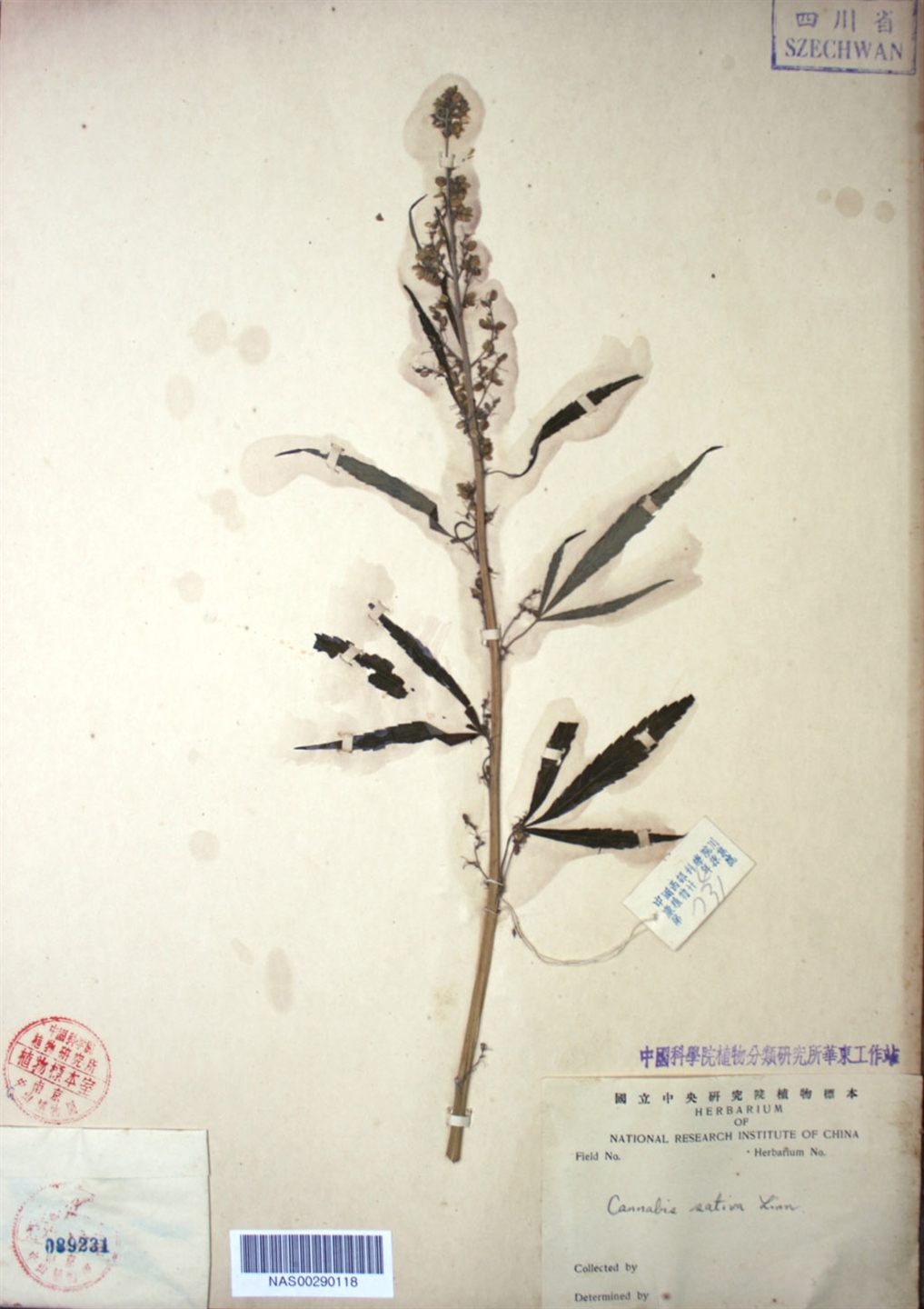
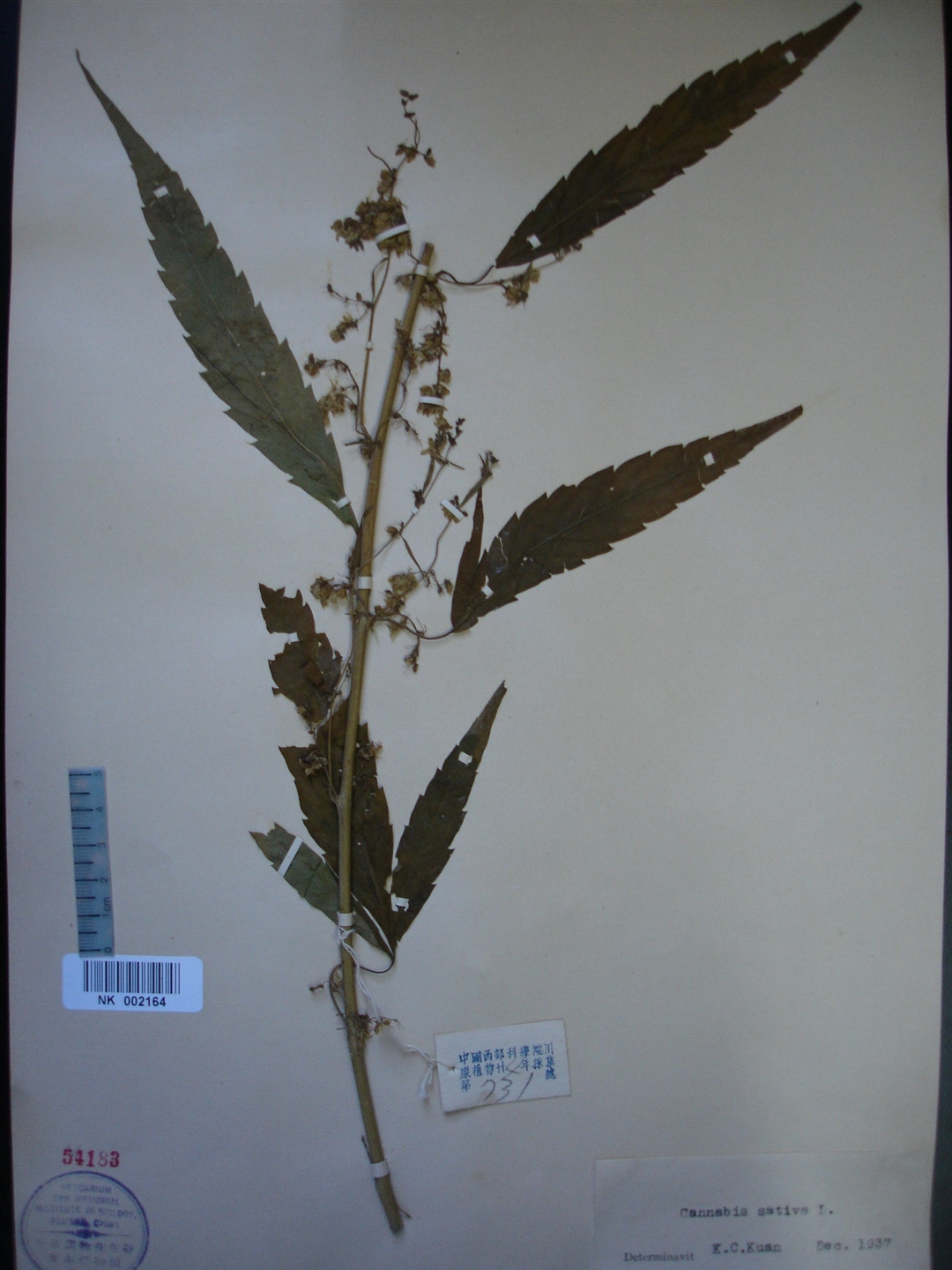
Tu 731 is a herbarium accession of Cannabis sativa collected in Sichuan, China, at 1,700 m in 1935 by T. H. Tu for the West China Academy of Science. The Institute of Botany, Chinese Academy of Sciences in Beijing holds a sheet as PE 00578031[1], the Institute of Botany, Jiangsu Province and Chinese Academy of Sciences in Nanjing a duplicate as NAS00290118[2], and Nankai University in Tianjin a third as NK 002164.[3]
Collection and locality
PE 00578031 carries a form of the herbarium of the West China Academy of Science (中國西部科學院植物標本室), headed 四川植物 Flora of Szechuan and filled in by hand in blue ink. It gives the number 731, the date 9.5 1935, a locality in cursive characters that are overwritten and blotted, the altitude 1700m., a habitat read as 草坡 (grassy slope) with doubt, green leaves and white flowers, the name Humulus japonica and the stamped collector T.H.Tu.[4] NAS00290118 carries an Academia Sinica label with nothing written on it but the name Cannabis sativa Linn., and the Academy's tag, 中國西部科學院川康植物廿[四]年採集 第731號 (West China Academy of Science, Szechwan and Sikang plants, collected in year 2[4] of the Republic, no. 731), the year's second character pencilled over.[5] The catalogue gives the number, the year and Sichuan, with the collector as 杜大华 for the Beijing sheet and as the tag's heading, 中国西部科学院川康植物, for the Nanjing sheet.[1][2] The Tianjin sheet carries no form. It carries the Academy's tag, as the Nanjing sheet does, with the year's figure pencilled over and the number in pencil, read as 731 and as 231; K. C. Kuan's slip of December 1937, as on the Beijing sheet; and the purple stamp of the Fan Memorial Institute's herbarium with the red number 54183, which PE 00578031 also carries.[6] The catalogue gives the collector as T. H. Tu, the number 731, the year and Sichuan.[3]
Specimen and identification
The Beijing and Nanjing sheets carry male plants: long stems with palmate leaves of five to seven narrow, serrate leaflets and open flowering panicles, with no twining stem and no hop leaf. The Tianjin sheet carries a long stem with large, coarsely serrate leaflets and an open male panicle.[6] The field form named the plant Humulus japonica, a hop; a slip on the Beijing sheet names it Cannabis sativa L., determined by K. C. Kuan in December 1937, and the Nanjing label gives Cannabis sativa Linn.[4][5] The Chinese Virtual Herbarium publishes its sheet images under a non-commercial, no-derivatives licence (CC BY-NC-ND 4.0); they are read and cited here, not reproduced.
- ↑ 1.0 1.1 "Specimen PE 00578031: Cannabis sativa". Chinese Virtual Herbarium. Institute of Botany, Chinese Academy of Sciences. Retrieved 13 October 2026.
- ↑ 2.0 2.1 "Specimen NAS00290118: Cannabis sativa". Chinese Virtual Herbarium. Institute of Botany, Chinese Academy of Sciences. Retrieved 13 October 2026.
- ↑ 3.0 3.1 "Specimen NK 002164: Cannabis sativa". Chinese Virtual Herbarium. Institute of Botany, Chinese Academy of Sciences. Retrieved 15 October 2026.
- ↑ 4.0 4.1 "Digitised sheet PE 00578031: Cannabis sativa". Chinese Virtual Herbarium image service. Institute of Botany, Chinese Academy of Sciences. Retrieved 13 October 2026.
- ↑ 5.0 5.1 "Digitised sheet NAS00290118: Cannabis sativa". Chinese Virtual Herbarium image service. Institute of Botany, Chinese Academy of Sciences. Retrieved 13 October 2026.
- ↑ 6.0 6.1 "Digitised sheet NK 002164: Cannabis sativa". Chinese Virtual Herbarium image service. Institute of Botany, Chinese Academy of Sciences. Retrieved 15 October 2026.