Junpei Sato
More actions
| Junpei Sato | |
|---|---|
| Born | 14 April 1896 Kanaashi, Minamiakita District, Akita Prefecture, Japan |
| Died | 6 February 1970 |
| Nationality | Japanese |
| Occupation | Botanist, teacher and plant collector in Manchuria |
| Institutions | Port Arthur botanical garden; Liaoyang County guidance farm |
| Known for | Plant collections from Manchuria; 漢薬の原植物 (1959), on the plant sources of Chinese drugs |
| Collector name on accessions | J. Sato |
Junpei Sato (佐藤潤平; 14 April 1896 – 6 February 1970) was a Japanese botanist and plant collector who lived in Manchuria from 1921 to 1953. He went to Port Arthur (Lüshun) in the Kwantung Leased Territory as a schoolteacher in 1921. He was director of the Port Arthur botanical garden from 1928 to 1938 and then managed a county farm near Liaoyang until 1945. After the war he taught botany and medicinal plants at colleges in Shenyang. He returned to Japan in 1953 and in 1962 took a doctorate in pharmacy at Kyoto University for his study of the plants from which Chinese drugs are made.[1]: 194–198
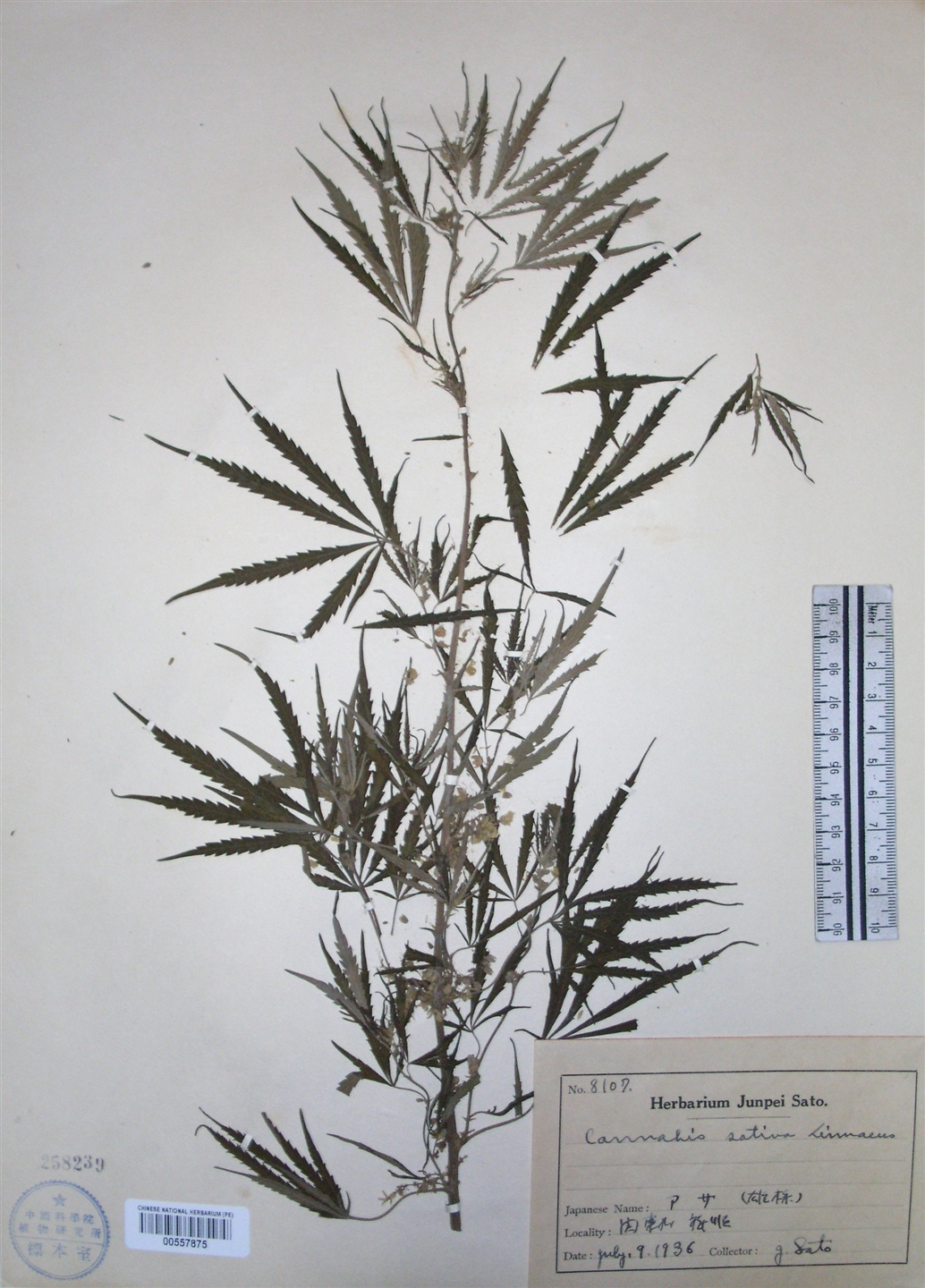
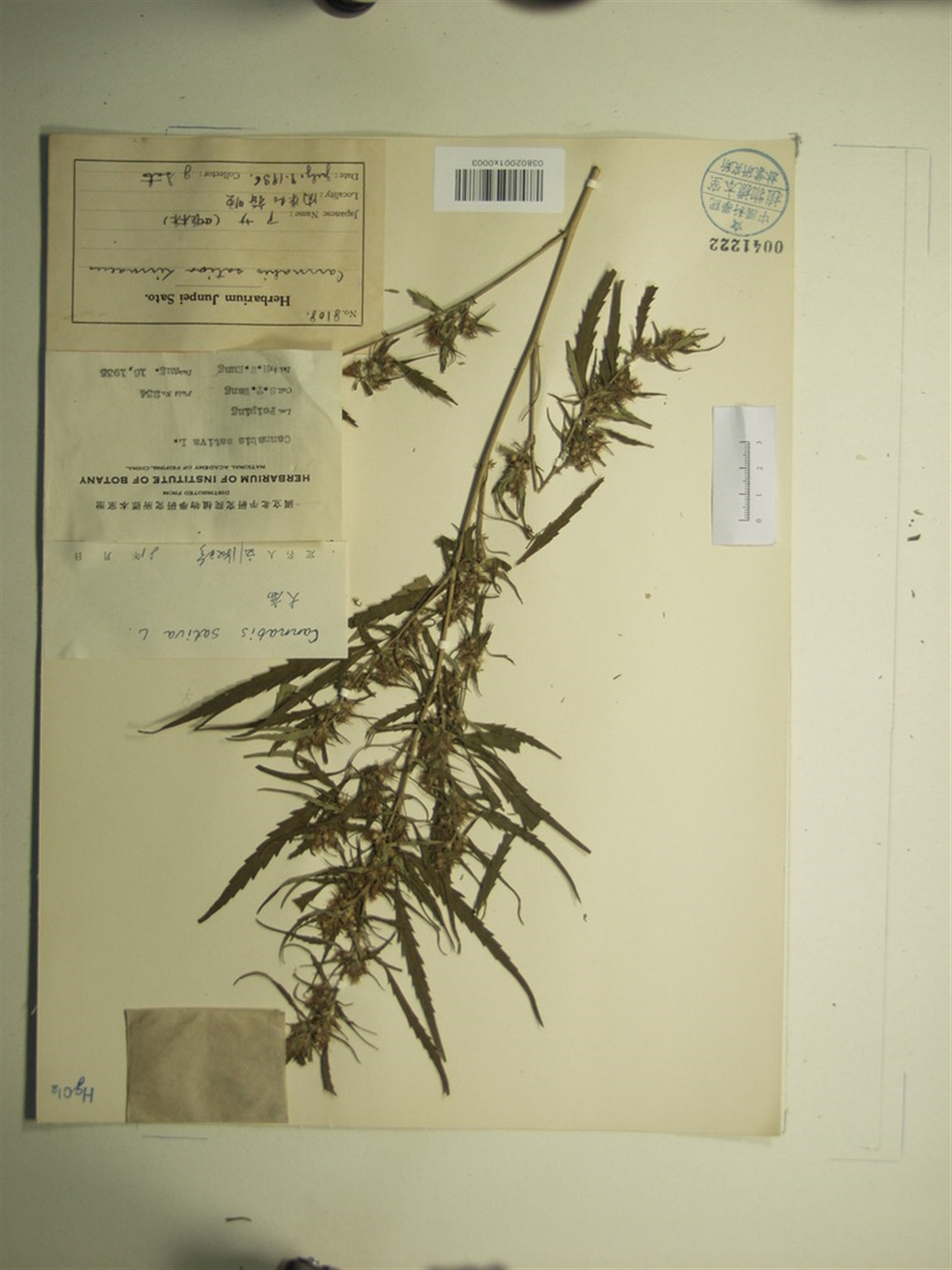
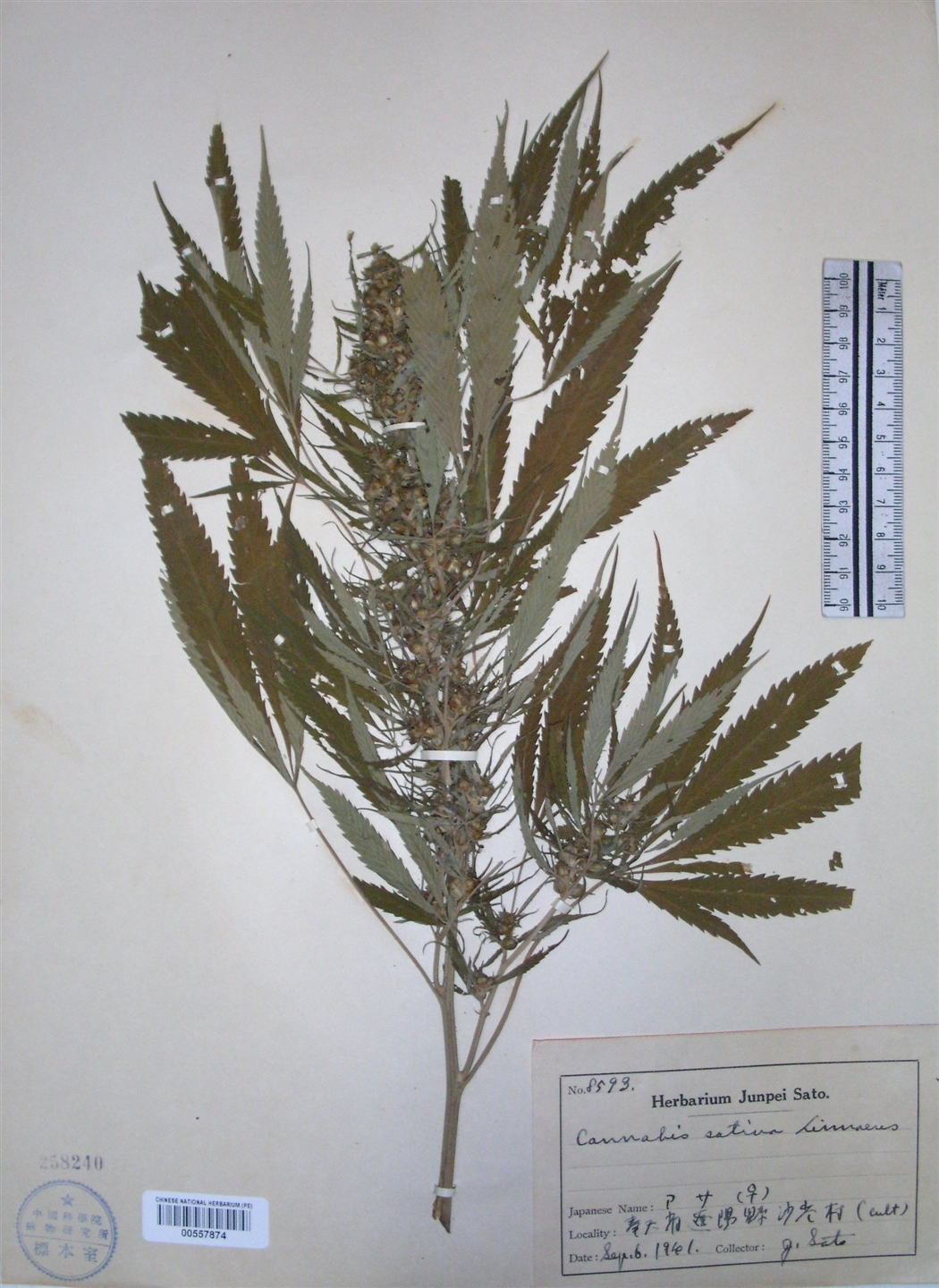
Three herbarium sheets of Cannabis sativa carry the printed slip of his private herbarium, Herbarium Junpei Sato. Two hold a male and a female plant gathered at Lüshun on 9 July 1936. The third holds a cultivated female plant gathered in Liaoyang County on 6 September 1941. The collector line on each slip reads J. Sato.[2][3][4] The same form of his name heads Tagawa's 1955 list of the Manchurian ferns he collected.[5]: 52
Early life and teaching in Akita
Sato was born on 14 April 1896 at Kanaashi in Minamiakita District, Akita Prefecture, now part of the city of Akita. He was the only son of a farming family. He wanted to go to an agricultural school but trained as a teacher at his parents' wish. While working as a substitute teacher at his old primary school he found a plant encyclopaedia and taught himself to name plants from it. He entered Akita Normal School in April 1913. In his first summer there he made specimens of about 200 species and named about 125 of them. He graduated on 23 March 1917 at the bottom of his class, with a certificate of special ability in plants and horticulture.[1]: 194
He taught at primary schools in Minamiakita District from April 1917. In 1918 a manuscript flora of Akita, about 850 sheets long, won him first prize at the prefecture's education exhibition. A 430-page book on the useful plants of the Tōhoku region followed in 1919; he later said that he had made it with paste and scissors. In April 1920 he began teaching natural history at Ōdate Middle School, where his interest turned to medicinal plants. On visits to Tokyo he heard Shirai Mitsutarō and Makino Tomitarō. He resolved to go to China to study the plants from which Chinese drugs are made.[1]: 194
Port Arthur, 1921–1938
A senior graduate of his normal school who was working in Manchuria found him a post. On 23 December 1921 he became a teacher at the Port Arthur Girls' High School, under the Kwantung government. He collected plants whenever he had free time, with no reference books, no teacher and little money. In the summer of 1924 the natural history teachers of Manchuria brought the botanist Yabe Yoshitada from the South Manchuria Railway to give a course. Yabe took notice of Sato. With the help of the railway's education section, he was appointed in August 1924 a lecturer at the railway's teacher-training college. The post came with a free pass on every line of the railway, which he used for collecting journeys. In 1925 he took a commission at the Kwantung government museum.[1]: 194
The South Manchurian Education Society granted him 500 yen a year for research on the plants of Manchuria and Mongolia. In the summer of 1925 he collected along the Andong–Mukden railway. In the summer of 1926 he travelled to the Greater Khingan range by way of Hailar and then to the sand country around Tongliao, where he gathered ephedra. His book on the wild flowers of Manchuria and Mongolia, written to bring them into gardens, appeared in August 1927.[1]: 195
On 31 March 1928 he left the school and became director of the Port Arthur botanical garden. The Kwantung government gave him the post and a salary so that he could study the plants of Manchuria and Mongolia. A scholarship fund of the South Manchuria Railway supported his research from December 1927 until 1945. From July 1928 he contributed to a photographic series on the plants of Manchuria and Mongolia, 20 plates a month for three years. He also wrote accounts of his collecting journeys for its newsletter. The botanist Siro Kitamura, then a student at Kyoto University, met him at his laboratory in Port Arthur in July 1930. Kitamura found a large botanical library there and was asked to identify Sato's specimens of the daisy family.[1]: 195
His books from the Port Arthur years include a 1931 work on the trees and shrubs for planting in Manchuria, two lists of tree and useful plant names (1932) and a report on the flora of East Ujimqin with 244 seed plants (1934). He also held commissions from the railway's research department (1929), the Kwantung government's civil engineering office (1930), the Kwantung Army (1932) and the capital construction bureau of Manchukuo.[1]: 195–196
Liaoyang, 1938–1945
On 31 March 1938 Sato became manager of the Liaoyang County guidance farm, a new farm about 6 km from Liaoyang. His specimens and books filled two railway wagons when he moved from Port Arthur. The manuscript of an illustrated flora of Manchuria and Mongolia with 200 photographs was lost in the move. Kitamura stayed with him from 8 to 24 September 1939. The farm had a herbarium in varnished wooden cabinets, which Kitamura put at about 50,000 specimens, nearly all from Manchuria. Sato gave the duplicates of the daisy and bellflower families to Kyoto University, where they arrived at the end of 1939.[1]: 196
At the farm he worked to improve local farming. The finance section of Fengtien province funded a project of his for collecting, growing and studying medicinal plants at 20,000 yen a year. In July 1940 the North China Transportation Company commissioned him to survey the plants of Mengjiang and plan tree planting there. His books from these years include a guide to the medicinal and food plants of Manchuria and Mongolia (1940), an illustrated flora of the water plants of Manchuria (1942) and an illustrated account of the trees of Manchuria and Mongolia (1942).[1]: 196–197
In his own count he gathered about 300,000 plant specimens, 30,000 books and 7,000 photographs during 31 years in Manchuria. He said that the figures for the specimens and the books were not exact.[1]: 197
After the war
Sato was at Liaoyang when the war ended on 15 August 1945. Looting began near the farm within days. Local farmers and the farm's Chinese staff moved its collections by cart to the strongroom of a cotton company on 24 August. His household goods were stolen, with the manuscript and photographic film of a flora of Mengjiang. In April 1946 he was retained in service at the county's agriculture and forestry farm.[1]: 196–197
From 1 January 1947 he was a professor at the Northeastern University in Mukden (Shenyang), lecturing on forest trees, plant taxonomy and medicinal plants. He moved to the Shenyang Medical College in September 1947 and to the pharmacy school of the China Medical University on 1 November 1949. In September 1950 he joined the committee compiling the pharmacopoeia of the People's Republic of China. From October 1951 he also lectured on ornamental trees at the new Shenyang Agricultural College. He returned to Japan on 14 October 1953 on the last repatriation ship and left much of his material in Manchuria.[1]: 197–198
In Japan he worked for the Tokyo regional forestry office of the Ministry of Agriculture and Forestry from 9 February 1955 to May 1967 and then for the Sanpo pharmaceutical company. His book 漢薬の原植物 (on the plant sources of Chinese drugs, 476 pages) was published by the Japan Society for the Promotion of Science on 31 March 1959. He submitted it to Kyoto University and became a doctor of pharmacy on 1 February 1962. After his return he gathered about 50,000 specimens of Japanese plants and more than 10,000 photographs. He died on 6 February 1970.[1]: 194, 198
Plant collecting
Kitamura published Sato's Manchurian specimens of the daisy family in 1935. Many of Kitamura's later studies of that family in Manchuria and Mongolia drew on Sato's specimens.[1]: 198 Sato also gave about 80 sheets of Manchurian ferns, of 43 species, to the herbarium of the Faculty of Science at Kyoto University. The pteridologist M. Tagawa listed them in 1955. Their localities run from the Kwantung territory to the Greater Khingan, Mudanjiang, Heihe and Mengjiang. Two of them are numbered gatherings from hills at Lüshun (nos. 3741 and 3742).[5]: 52
Cannabis
Three sheets of Cannabis sativa carry Sato's slip, printed Herbarium Junpei Sato. and completed by hand with the number, the name, the Japanese name, the locality, the date and the collector. Each slip names the plant アサ (asa, hemp):[2][3][4]
- No. 8107, a male plant (雄株) from 関東州 旅順 (Lüshun, Kwantung), 9 July 1936. The Institute of Botany, Chinese Academy of Sciences in Beijing holds the sheet as PE 00557875: Sato 8107 (1936).[2]
- No. 8108, a female plant (雌株) from the same place on the same day. The Institute of Applied Ecology, Chinese Academy of Sciences in Shenyang holds the sheet as IFP 03802001x0003: Sato 8108 (1936).[3]
- No. 8593, a female plant marked (cult) from a village in 奉天省 遼陽縣 (Liaoyang County, Fengtien), 6 September 1941. The Institute of Botany in Beijing holds the sheet as PE 00557874: Sato 8593 (1941).[4]
The two 1936 gatherings date from his years as director of the Port Arthur botanical garden. The 1941 gathering dates from his years at the Liaoyang County farm.[1]: 195–196
Accessions collected by Sato:
| Collected | Locality | Repository | Catalogue number | |
|---|---|---|---|---|
| Sato 8107 (1936) | 関東州 旅順 (Lüshun, Kwantung) | Institute of Botany, Chinese Academy of Sciences | PE 00557875 | |
| Sato 8108 (1936) | 関東州 旅順 (Lüshun, Kwantung) | Institute of Applied Ecology, Chinese Academy of Sciences | IFP 03802001x0003 | |
| Sato 8593 (1941) | Institute of Botany, Chinese Academy of Sciences | PE 00557874 |
Works
- 満蒙の野外花卉 (wild flowers of Manchuria and Mongolia). 1927.[1]: 195
- 満州造園樹木 (trees and shrubs for planting in Manchuria). South Manchuria Railway, 1931.[1]: 195
- 東烏珠穆沁植物調査報告 (report on the flora of East Ujimqin). Kwantung government, 1934.[1]: 196
- 満州樹木名彙 (names of the trees of Manchuria). South Manchuria Railway, 1937.[1]: 196
- 満蒙通俗薬用食用植物 (medicinal and food plants of Manchuria and Mongolia). Sanseidō, 1940.[1]: 197
- 満州水草図譜 (illustrated flora of the water plants of Manchuria). Sanseidō, 1942.[1]: 197
- 満蒙樹木図説 (illustrated account of the trees of Manchuria and Mongolia). Seibundō Shinkōsha, 1942.[1]: 197
- 漢薬の原植物 (the plant sources of Chinese drugs). Japan Society for the Promotion of Science, 1959.[1]: 198
See also
References
- ↑ 1.00 1.01 1.02 1.03 1.04 1.05 1.06 1.07 1.08 1.09 1.10 1.11 1.12 1.13 1.14 1.15 1.16 1.17 1.18 1.19 1.20 1.21 1.22 Kitamura, Siro (September 1970). 佐藤潤平氏の伝 [A biography of Junpei Sato]. Acta Phytotaxonomica et Geobotanica (in 日本語). 24 (4–6): 194–198. doi:10.18942/bunruichiri.KJ00002992160.
- ↑ 2.0 2.1 2.2 "Digitised sheet PE 00557875: Cannabis sativa". Chinese Virtual Herbarium image service. Institute of Botany, Chinese Academy of Sciences. Retrieved 13 October 2026.
- ↑ 3.0 3.1 3.2 "Digitised sheet IFP 03802001x0003: Cannabis sativa". Chinese Virtual Herbarium image service. Institute of Botany, Chinese Academy of Sciences. Retrieved 15 October 2026.
- ↑ 4.0 4.1 4.2 "Digitised sheet PE 00557874: Cannabis sativa". Chinese Virtual Herbarium image service. Institute of Botany, Chinese Academy of Sciences. Retrieved 13 October 2026.
- ↑ 5.0 5.1 Tagawa, M. (October 1955). 佐藤潤平氏採集滿洲産羊齒植物 [Manchurian pteridophytes collected by J. Sato]. Acta Phytotaxonomica et Geobotanica (in 日本語). 16 (2): 52–55. doi:10.18942/bunruichiri.KJ00003217459.