Water pipe (Kew EBC 67634)
More actions
| Horn water pipe from Zululand, given to Kew by John Medley Wood | |
|---|---|
| Artefact· KewEBC 67634 | |
| Object | |
| Object Type | Water pipe |
| Use | Smoking |
| Materials | horn |
| Cannabis in the Record | |
| Holder's Wording | "Pipe for smoking 'Insangu' Cannabis sativa L." |
| Attribution | Stated |
| Name Recorded | Insangu |
| Origin | |
| Place (as Recorded) | Zululand |
| Country | South Africa |
| Holding | |
| Held By | Royal Botanic Gardens, Kew |
| Collection | Economic Botany Collection |
| Catalogue Number | EBC 67634 |
| Entry Number | 75.1888 |
| Acquired From | John Medley Wood |
| Date Acquired | 1888 |
| Holder's Record | View the holder's record |
EBC 67634 is an artefact catalogued in the Economic Botany Collection of the Royal Botanic Gardens, Kew: a horn water pipe for smoking cannabis, from Zululand in South Africa.[1] Its label names what was smoked in it as Insangu. It was entered at Kew in 1888 with John Medley Wood recorded as the donor.[2]
Kew's record
The catalogue gives the artefact name, the parts held and the use as Pipe for smoking cannabis. It gives the plant name as 153.04 CANNABACEAE with no genus, the country as South Africa, the geography description as Zululand, the storage as Bottles, boxes etc, the entry book number as 75.1888 and the donor as Medley Wood J. The collector, collector's number, donor number, donor date and collection date fields are all blank. The record page reads No Image.[1]
Kew assigns entry book numbers to each group of specimens at the point of acquisition, in a series that runs each year. Its catalogue numbers were assigned when the collection was databased in the 1980s.[2] Kew also publishes the record to GBIF, where the object is determined to the family Cannabaceae with the locality Zululand.[3]
The label
The notes field transcribes the object's label: Label source: Pipe for smoking 'Insangu' Cannabis sativa L. The horn is particlly filled with water and the smoke inhaled from the large end, Zululand. The spelling particlly is the catalogue's.[1]
The label names the plant smoked in the pipe as Cannabis sativa L. Kew's own determination of the object stops at the family, Cannabaceae, without a genus.[1]
The donor and the entry
The donor field reads Medley Wood J.[1] John Medley Wood was appointed curator of the Durban Botanic Gardens on 1 March 1882 and in the same year established the Natal Herbarium.[4]: 225
A Zulu mat labelled isitebe carries the same entry number and the same donor on both its labels: 75-1888. J. Medley Wood Esq. on the printed one and J. Medley Wood 75.1888 on the handwritten one. It left Kew for the British Museum in 1960 with a large collection of African material and is held there as Af1960,20.111.[5]
The name on the label
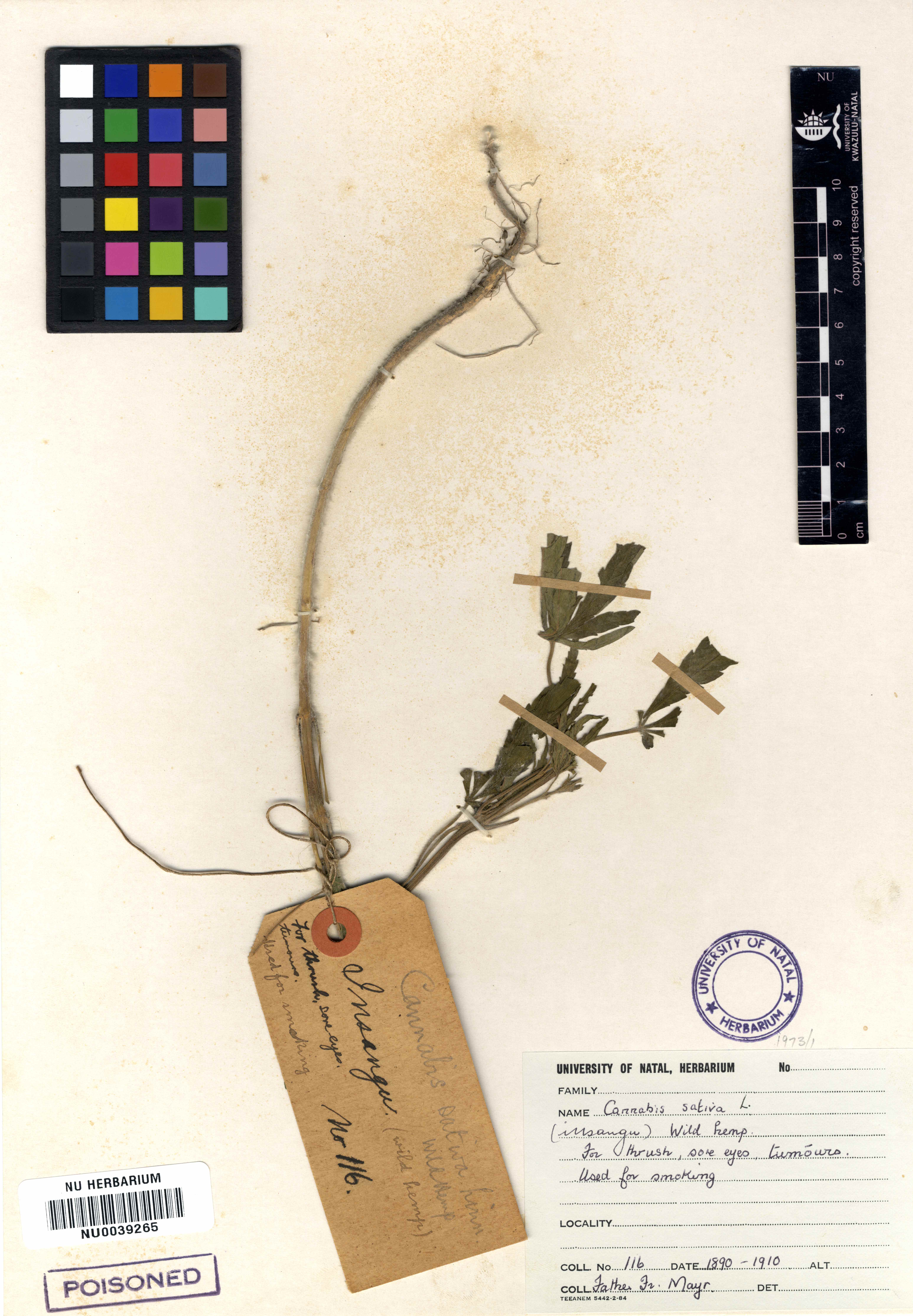
The label gives the plant's name as Insangu. The same name is written on the field tag of the herbarium sheet Mayr 116 (1890 to 1910).[6] It stands in the locality line of the sheet Forbes s.n., Durban (1921).[7] Kew received the sheet Callaway s.n., Natal (1857) from the Reverend Dr Callaway in 1857 under the name Insango.[8]
References
- ↑ 1.0 1.1 1.2 1.3 1.4 "Pipe for smoking cannabis, catalogue number 67634". Economic Botany Collection. Royal Botanic Gardens, Kew. Retrieved 24 September 2026.
- ↑ 2.0 2.1 "How to use the Economic Botany Collection database". Economic Botany Collection. Royal Botanic Gardens, Kew. Retrieved 24 September 2026.
- ↑ "Occurrence 2429015685: Cannabaceae". GBIF. Global Biodiversity Information Facility. Retrieved 24 September 2026.
- ↑ Schrire, B.D. (1983). "Centenary of the Natal Herbarium, Durban, 1882–1982". Bothalia. 14 (2): 223–236. doi:10.4102/abc.v14i2.1167.
- ↑ "Mat, Af1960,20.111". Collection online. British Museum. Retrieved 24 September 2026.
- ↑ "Digitised sheet NU0039265". The Bews Virtual Herbarium. Bews Herbarium, University of KwaZulu-Natal. Retrieved 23 September 2026.
- ↑ "Cannabis sativa L., barcode NBG1533367-0, in the Botanical Database of Southern Africa (BODATSA)". Plants of southern Africa. South African National Biodiversity Institute. Retrieved 23 September 2026.
- ↑ "Occurrence 6194769666: Cannabis sativa L." GBIF. Global Biodiversity Information Facility. Retrieved 23 September 2026.