Xining
More actions
| Xining | |
|---|---|
| 西宁 (Xīníng); Sining; Huangshui valley; 湟中 (Huángzhōng) | |
| ActiveGrown here in 2000 or later | |
| Geography | |
| Country | China |
| Province/State | Qinghai |
| Prefecture-level cities | Xining, Haidong |
| Coordinates | 36.62, 101.78 |
| Landscape | |
| Area | 24,100 km² |
| Terrain | Valleys of the Huangshui and its tributaries round Xining, and the Yellow River valley at Guide, in north-eastern Qinghai; approximately the cities of Xining and Haidong with Guide County; ground above 4,000 m and bare ground are left out |
| Growing history | |
| Dated accessions | 1908–1923 |
| Documentation | |
| Appellations | 0 |
| Accessions | 2 |
| Conservation | |
| Populations | none documented yet |
Xining is a cannabis growing area of north-eastern Qinghai, China, in the valley of the Huangshui round the city of Xining (西宁, Sining) and in the valley of the Yellow River at Guide. W. W. Rockhill wrote in 1891 that the Tibetans of the Kansu border, under the Amban at Hsi-ning, called their country Amdo.[1]: 72–73 A herbarium sheet collected at Xining on the mission of Paul Pelliot in July 1908 is labelled Chanvre cultivé (cultivated hemp),[2] and in 1892 Rockhill was told at Guide that hemp was among the principal crops.[3]: 90 A genomic study published in 2026 sampled feral populations at Huangzhong and at Guide.[4]: Table S1
Hemp in the valleys
The field label of the Pelliot sheet, of 13 July 1908, gives Chanvre cultivé on its locality line; the museum label places it at Si-Ning-Fou, at 2,400 m (Pelliot 440 (1908)).[2]
Rockhill spent the end of February 1892 at Kuei-te, now Guide, on the Yellow River. He wrote in his diary that "Wheat, millet, hemp, broad beans and peas are the principal crops", with fruit trees and a little poor cotton, but added that he had this from an informant and had seen almost none of it for himself.[3]: 90
Xuan Chen and colleagues included a Qinghai landrace, C466, recorded at 36.50° N, in a whole-genome study of wild and cultivated Chinese cannabis published in 2022.[5]
Feral populations
Baishi Wang and colleagues resequenced 271 cannabis accessions from 29 sites in 12 provinces of China, collected under the authority of the narcotics bureau of the Ministry of Public Security.[4] Two of their populations come from this area, both classed as feral. Ten plants came from Huangzhong (湟中), which the table places in Xining, at 2,225 m and 36.50° N. Six came from Guide, which the table prints as "Guide County, Xining City", at 2,759 m and 36.04° N.[4]: Table S1
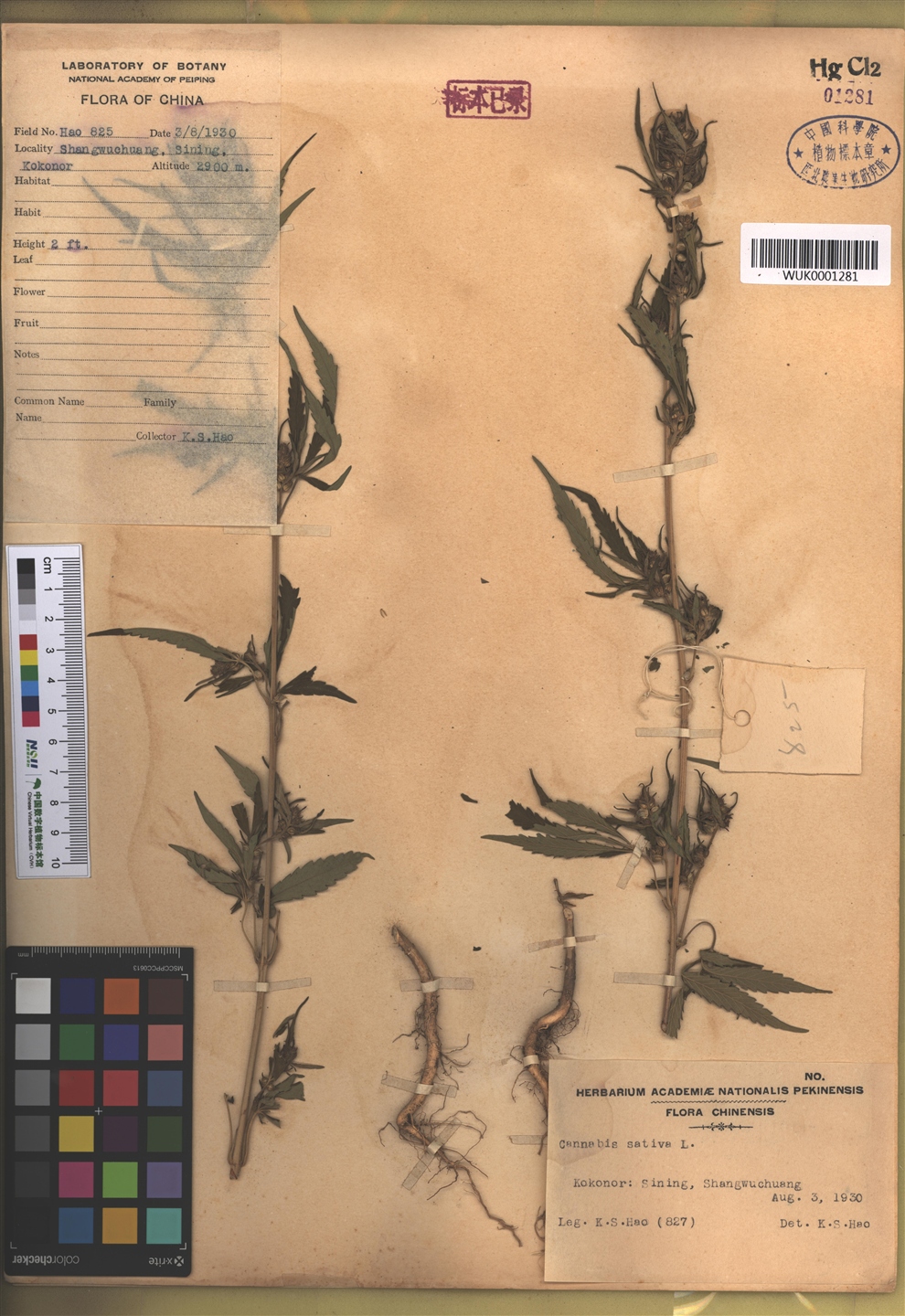
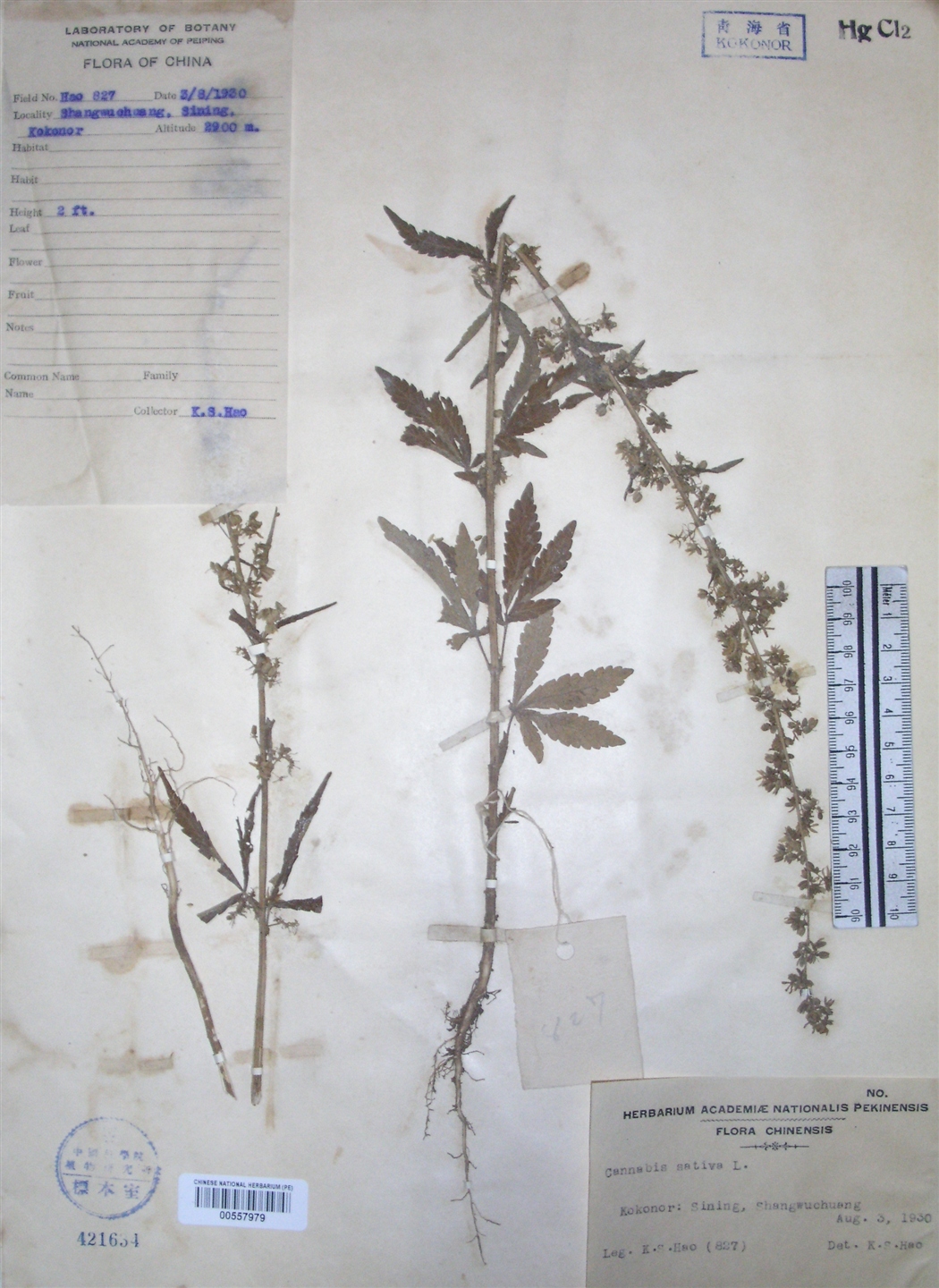
Earlier collectors found the plant away from fields. R. C. Ching gathered it in moist grassland at Chian Shing Cheon, south of Sining, at 3,200 to 3,300 m on 2 August 1923 (Ching 681 (1923)),[6] and K. S. Hao collected two gatherings at Shangwuchuang, Sining, at 2,900 m on 3 August 1930 (Hao 825 (1930), Hao 827 (1930)).[7][8]
Appellations
No appellation pages exist for this growing area yet.
Accessions
| Accession ID | Name | Locality | Elevation | Collected |
|---|---|---|---|---|
| Ching 681 (1923) | Ching 681 herbarium specimen, south of Sining (1923) | Chian Shing Cheon, south of Sining (Xining) | 3,250 m | |
| Pelliot 440 (1908) | Pelliot 440 herbarium specimen, Si-Ning-Fou (1908) | Si-Ning-Fou (Xining) | 2,400 m |
Recent news
No news items are recorded for this growing area yet.
See also
References
- ↑ Rockhill, William Woodville (1891). The Land of the Lamas: Notes of a Journey through China, Mongolia and Tibet. New York: The Century Co.
- ↑ 2.0 2.1 "Digitised sheet P06884311: Cannabis sativa L." Herbier national, images. Muséum national d'Histoire naturelle. Retrieved 12 October 2026.
- ↑ 3.0 3.1 Rockhill, William Woodville (1894). Diary of a Journey through Mongolia and Tibet in 1891 and 1892. Washington: Smithsonian Institution.
- ↑ 4.0 4.1 4.2 Wang, Baishi; Gao, Shan; Wang, Xue; Yun, Quanzheng; Nie, Hao; Li, Ning; Li, Yonggang; Feng, Deri; Li, Linsen; Li, Tianye; Lu, Xu; Liu, Jingjing; Wei, Xuge; Mu, Yanhong; Wu, Qiqi; Hu, Jinyuan; Liu, Fangru; Feng, Rui; Yin, Jianyu; Zhang, Qikun; Zhang, Ying; Ren, Fu (7 September 2026). "Genomic variation in 271 diverse accessions of Cannabis sativa L. in China". BMC Plant Biology. doi:10.1186/s12870-026-09909-5.
- ↑ Chen, Xuan; Guo, Hong-Yan; Zhang, Qing-Ying; Wang, Lu; Guo, Rong; Zhan, Yi-Xun; Lv, Pin; Xu, Yan-Ping; Guo, Meng-Bi; Zhang, Yuan; Zhang, Kun; Liu, Yan-Hu; Yang, Ming (2022). "Whole-genome resequencing of wild and cultivated cannabis reveals the genetic structure and adaptive selection of important traits". BMC Plant Biology. 22 (1) 371. doi:10.1186/s12870-022-03744-0.
- ↑ "Digitised sheet E01459296, IIIF manifest". RBGE IIIF image service. Royal Botanic Garden Edinburgh. Retrieved 9 October 2026.
- ↑ "Digitised sheet WUK0001281: Cannabis sativa". Chinese Virtual Herbarium image service. Institute of Botany, Chinese Academy of Sciences. Retrieved 14 October 2026.
- ↑ "Digitised sheet PE 00557979: Cannabis sativa". Chinese Virtual Herbarium image service. Institute of Botany, Chinese Academy of Sciences. Retrieved 13 October 2026.