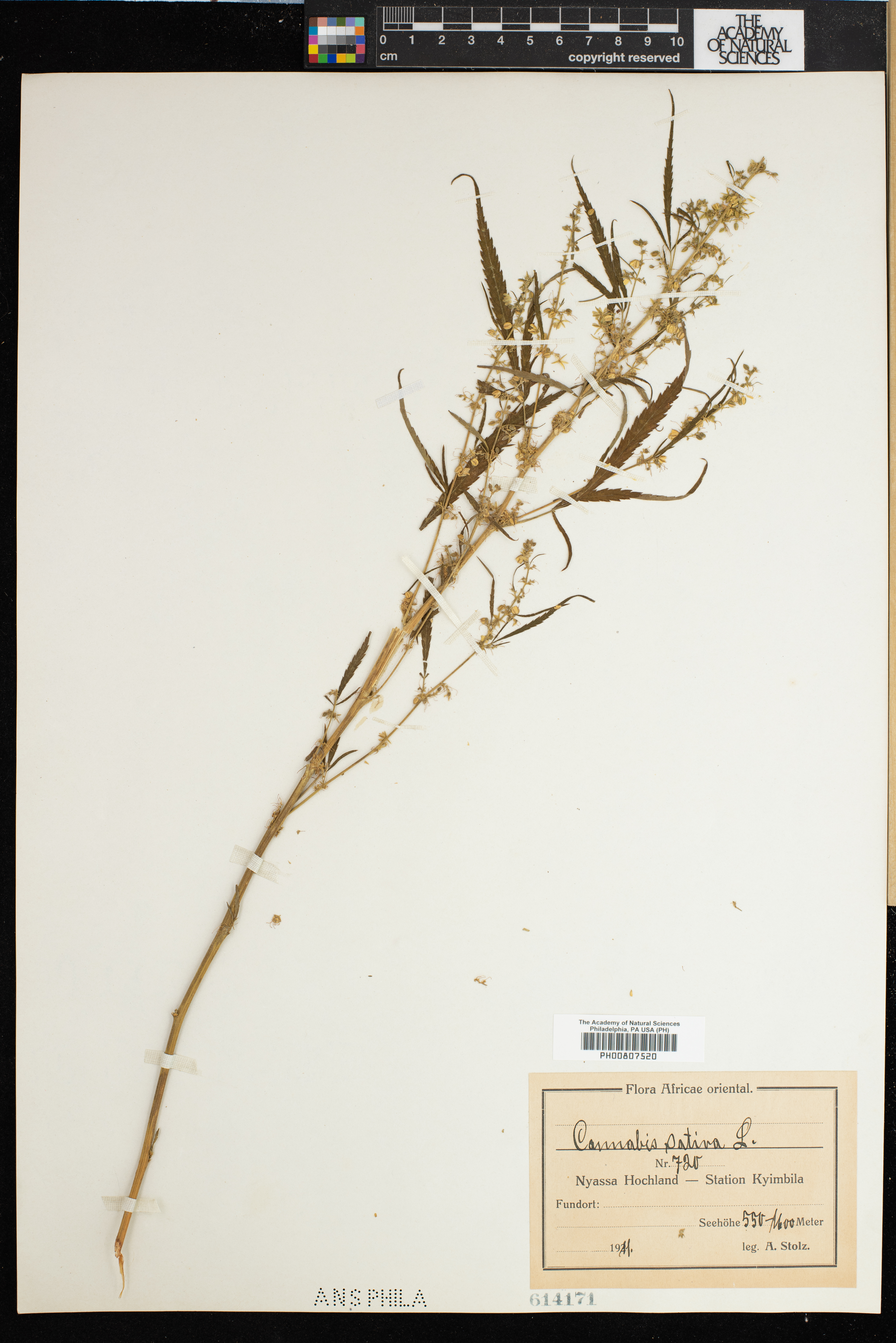
Stolz 720 (1911)
More actions
| Stolz 720 herbarium specimens, Kyimbila, Mbeya Region (1911) | |
|---|---|
| Stolz 720 (1911) | |

| |
| Stolz 720, Kyimbila, 1911: Naturalis Biodiversity Center L.1592675 (CC0) | |
| At a Glance | |
| Classification | Other |
| Location | |
| Country | Tanzania |
| Province/State | Mbeya Region |
| District | Rungwe District |
| Locality | Station Kyimbila |
| Coordinates | -9.28, 33.65 |
| Collection | |
| Method | Herbarium specimen |
| Sourcing Type | Historical |
| Date | 1911 |
| Collector | A. Stolz |
| Specimen | |
| Repository | Naturalis Biodiversity Center |
| Catalogue Number | L.1592675; U.1198646; PH00807520; MO 104521724; P06780063; P06829892 |
| Collector Number | 720 |
| Scientific Name | Cannabis sativa L. |
| Occurrence Record | View occurrence record |
Stolz 720 is a herbarium accession of Cannabis sativa gathered by A. Stolz in 1911 from Kyimbila station, in the Nyasa highlands, in what is now Mbeya Region, Tanzania. Six sheets of the gathering are known: two at the Naturalis Biodiversity Center (L.1592675 and U.1198646), and one each at the Academy of Natural Sciences in Philadelphia, the Missouri Botanical Garden and, as two sheets, the Muséum national d’Histoire naturelle in Paris.[1][2][3][4][5][6]
Collection and locality
The three labels read for this page are copies of one printed form, headed Flora Africae oriental. It is printed with the words Nyassa Hochland — Station Kyimbila (Nyasa highlands, Kyimbila station) and leg. A. Stolz., and filled in by hand with the name Cannabis sativa L., the number 720 and the altitude 550–1600 metres. The line for the place of gathering, Fundort:, is left blank on all three, and the printed year is corrected by hand.[7][8][9] Every holder catalogues the gathering under 1911.[10][2][3][4][5]
The Utrecht sheet carries the stamp of the Botanisch Museum, Utrecht, dated 21 February 1923.[8] The Paris catalogue files its two sheets under Malawi; the label's Kyimbila is in Tanzania.[5][6]
Specimen and identification
The Leiden sheet holds several tall stems with slender male flowering branches; the Utrecht sheet one long, sparsely leafy stem; the Philadelphia sheet a single branched stem with male flowers.[7][8][9] The labels name the plant Cannabis sativa L., and every holder files it under that name.[10][4] The Paris catalogue records that leaf tissue was taken from both its sheets in March 2021 for C. J. Grassa of Harvard University.[5][6]
Sheets

- ↑ "Specimen L.1592675". Naturalis Bioportal. Naturalis Biodiversity Center. Retrieved 15 October 2026.
- ↑ 2.0 2.1 "Occurrence 2517135510: Cannabis sativa L." GBIF. Global Biodiversity Information Facility. Retrieved 15 October 2026.
- ↑ 3.0 3.1 "Occurrence 4929900787: Cannabis sativa L." GBIF. Global Biodiversity Information Facility. Retrieved 15 October 2026.
- ↑ 4.0 4.1 4.2 "Occurrence 5831991346: Cannabis sativa L." GBIF. Global Biodiversity Information Facility. Retrieved 15 October 2026.
- ↑ 5.0 5.1 5.2 5.3 "Occurrence 731718373: Cannabis sativa L." GBIF. Global Biodiversity Information Facility. Retrieved 15 October 2026.
- ↑ 6.0 6.1 6.2 "Occurrence 731719274: Cannabis sativa L." GBIF. Global Biodiversity Information Facility. Retrieved 15 October 2026.
- ↑ 7.0 7.1 "Digitised sheet L.1592675: Cannabis". Naturalis media library. Naturalis Biodiversity Center. Retrieved 15 October 2026.
- ↑ 8.0 8.1 8.2 "Digitised sheet U.1198646: Cannabis". Naturalis media library. Naturalis Biodiversity Center. Retrieved 15 October 2026.
- ↑ 9.0 9.1 "Digitised sheet PH00807520: Cannabis sativa L." ANSP botany images. Academy of Natural Sciences of Drexel University. Retrieved 15 October 2026.
- ↑ 10.0 10.1 "Occurrence 2513889182: Cannabis sativa L." GBIF. Global Biodiversity Information Facility. Retrieved 15 October 2026.