Robert Wight
More actions
| Robert Wight | |
|---|---|
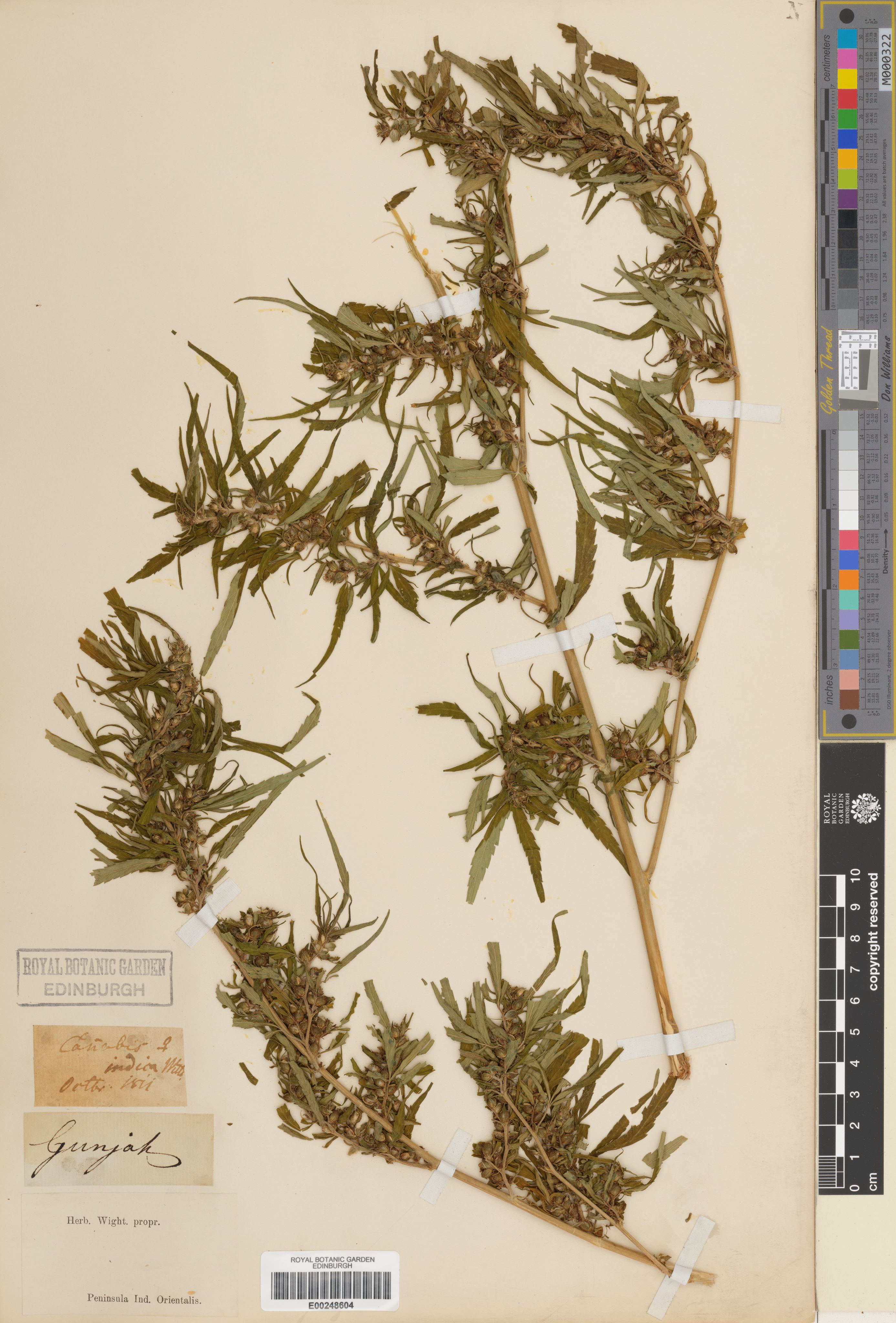
 Wight's cannabis sheet E00248604, labelled Gunjah, at the Royal Botanic Garden Edinburgh (CC BY-SA 2.5)
| |
| Born | 6 July 1796 Milton, Duncra Hill, East Lothian, Scotland |
| Died | 26 May 1872 Grazeley, near Reading, England |
| Nationality | British |
| Occupation | Surgeon and botanist |
| Institutions | East India Company |
| Known for | Plant collections from South India, 1820s–1853; Icones Plantarum Indiae Orientalis |
| Collector name on accessions | Robert Wight |
| Botanical author abbreviation | Wight |
Robert Wight (6 July 1796 – 26 May 1872) was a Scottish surgeon and botanist in the East India Company's service in the Madras Presidency. From 1819 to 1853 he collected and described the plants of South India, much of the time through Indian collectors and artists he employed.[1] The Dictionary of National Biography credits him with describing nearly 3,000 species of Indian plants.[2] His herbarium is the source of a cannabis sheet at the Royal Botanic Garden Edinburgh labelled Gunjah, and of a second at the Naturalis Biodiversity Center that Kew distributed in 1866–68. A lot of Cannabis sativa in Nathaniel Wallich's list of the Company's herbarium came from it too.[3][4][5]
His standard label name is R. Wight. His botanical author abbreviation is Wight.[6][7]
Edinburgh and the passage to Madras
Wight was born at Milton, Duncra Hill, in East Lothian on 6 July 1796. He was the twelfth of fourteen children of an Edinburgh Writer to the Signet.[1] At the High School of Edinburgh his schoolfellows included Robert Christison and George Walker-Arnott, who later became his collaborator. He took the surgeons' diploma in 1816 and a medical degree at the university in 1818. He then made several voyages as a ship's surgeon, one of them to America.[1][2]
The Company appointed him an assistant surgeon on 25 May 1819 and posted him to the 42nd Native Infantry at Madras.[2] The regiment was then in the Northern Division. Cleghorn writes that Wight knew little more botany than his medical degree had required. For three years he made slow progress, because the regiment was often on the march and he had no books. He then acquired Willdenow's Species Plantarum, Persoon's Synopsis and an early edition of Linnaeus's Genera Plantarum.[1]
Collectors, the Naturalist's post and Negapatam
Almost from his arrival Wight paid Indians to collect plants for him and took great pains over preparing the specimens.[1] A collection he sent in 1823 to Robert Graham in Edinburgh was lost at sea. In 1826 a large herbarium gathered at Samulcotta (Samalkot), Rajahmundry, Madras and Vellore reached William Jackson Hooker at Glasgow.[1][2]
About 1826 he succeeded Dr Shuter as Naturalist at Madras. From 1826 to 1828 he had charge of the botanical establishment there. He sent trained collectors into the districts and employed draughtsmen to draw the specimens.[1] He made a long tour of the southern provinces. Cleghorn quotes his journal of the hills in 1826: on 11 December, climbing a peak in the Pulney Hills, he gathered 70 to 80 species in one day and left many more untouched for want of room.[1] He had planned a two-year tour of the richest districts of the south, including the Malabar coast. He meant to take Rheede's Hortus Malabaricus and Buchanan's Travels in Mysore and match their plants in the field. The government abolished his office in 1828 before he could set out, and he went back to regimental duty.[1]
In 1828 he became garrison surgeon at Negapatam. In two and a half years there he explored the province of Tanjore and made a large collection.[1] He prepared duplicates for other botanists, often at his own cost. His herbarium filled six large cases weighing two tons. He took it to the Company's museum in London and himself distributed the duplicates in 1832 and 1833, with Wallich's collection. A lithographed catalogue of 2,400 species followed in 1833.[1] Many of the specimens were described in the Prodromus he wrote with Walker-Arnott.[1]
Furlough and the Prodromus

In 1831 Wight was given sick leave to Britain after jungle fever. He kept his plant collectors and a draughtsman at work in India and spent most of the three years in Edinburgh.[1] With Walker-Arnott he wrote the Prodromus Florae Peninsulae Indiae Orientalis (1834). Only the first volume appeared, with about 1,400 species, because Wight returned to India in 1834. J. D. Hooker and Thomas Thomson judged it the most able and valuable contribution to Indian botany that had yet appeared.[1][2] In the same year he published Contributions to the Botany of India. Its South Indian Compositae were worked up by A. P. de Candolle and its Cyperaceae by Nees von Esenbeck.[1] While staying with Hooker at Glasgow he practised lithography. According to Cleghorn, he was believed to have taken a complete outfit, stones and all, back to Madras.[1]
Cotton, Coimbatore and the illustrated works

On his return Wight was posted to the 33rd Native Infantry at Bellary. He marched with it 700 miles to Palamcotta, near Cape Comorin.[1] He planned a series of plates for Whitelaw Ainslie's Materia Medica but never finished it. As a first step he published papers on medicinal plants in the Madras Journal of Science.[2][1] In 1836 he caught fever in the hills about Courtallum. He spent a few weeks in Ceylon and botanised there with Colonel Walker.[1]
A government minute of 17 November 1835 chose him for a new post. He left military duty for the revenue department, to report on the cultivation of cotton, tobacco, senna and other Indian products. From 1842 to 1850 he superintended the experimental cotton farm at Coimbatore.[1][2] In his spare hours he visited the hill ranges of the south, above all the Neilgherry plateau.[1]
In 1838 he began two illustrated works in parallel. The Illustrations of Indian Botany had coloured plates and memoirs on the natural orders. It ended in 1850 with the second volume and the 182nd plate. The Icones Plantarum Indiae Orientalis ran to six volumes and 2,101 uncoloured plates by 1853.[1][2] The Madras government took 50 copies of each. Cleghorn writes that neither could otherwise have been finished. Wight paid for the rest himself and lost money.[1] His Spicilegium Neilgherrense reissued a selection of the plates in colour. He hoped its sales would help to pay for the larger works.[1] Most of the drawings were by two Telugu-speaking artists, Rungiah until about 1845 and Govindoo from then until 1853.[8] Wight named the genus Govindooia after Govindoo. At one time about 20 men coloured plates in a large room of his house.[1]
William Griffith died in 1845, and Wight was one of his executors. He urged that Griffith's papers be printed in India before they were sent to Europe, and that a full set of his specimens be kept at the Calcutta garden. Writing on the matter, he called Griffith the greatest botanist ever to set foot in India.[1]
Cannabis specimens

Wight's specimens are spread through many herbaria. Harvard's index lists more than 30 that hold his material, from Kew and Edinburgh to Leiden, Paris and Calcutta.[6] Edinburgh has about 23,000 specimens collected in South India between 1820 and 1853 by Wight and his collectors. The garden's Wight database calls his localities very imprecise, probably because his collectors gathered much of the material without him.[8]
The Edinburgh sheet Wight s.n. (1821) is catalogued as E00248604. Its printed labels read Herb. Wight. propr. and Peninsula Ind. Orientalis. A separate label gives the name Gunjah. A handwritten slip names the plant Cannabis ♀ indica and gives a date in October.[3] Edinburgh's catalogue entry, published through GBIF, gives the year as 1811, eight years before Wight reached India. The year has also been read as 1821.[9]
The Naturalis Biodiversity Center at Leiden holds a second sheet, L.1592642. Its printed label reads Peninsula Indiae Orientalis and Herb. Wight, with the number 2679 written in ink. Its last line reads Distributed at the Royal Gardens, Kew. 1866-8. The label gives no collection date.[4][10]
In 1828 Wight sent duplicates of many of his collections to London, which Wallich distributed as part of the East India Company's herbarium.[8] Entry 4665 of Wallich's list, Cannabis sativa, includes lot E, Hb. Wight.[5] Edinburgh's sheet of the lot is Wallich 4665E (by 1832). Kew's sheet K001039636 is catalogued as lot 4665 E, Hb. Wight.[11] Lot D of the same entry, [Cannabis] indica Hb. Madr., uses the label under which Wallich distributed material from the Madras naturalists' collection, which Wight held from 1826 to 1828. The lot names no collector.[5][8]
Accessions collected by Wight:
| Collected | Locality | Repository | Catalogue number | |
|---|---|---|---|---|
| Wight s.n. (1821) | Peninsular India | Royal Botanic Garden Edinburgh | E00248604 |
Grazeley and the Pharmacopoeia of India
Wight left Coimbatore in March 1853 and retired from the service. Before he sailed, the Agri-Horticultural Society of Madras presented him with an address. It praised him for publishing accurate figures and descriptions of 2,000 to 3,000 Indian plants.[1] He did not take up descriptive botany again in England. Cleghorn puts this down to growing deafness, failing health and family cares, and to Walker-Arnott having turned to diatoms.[1]
In 1853 he bought Grazeley Lodge near Reading and farmed its 66 acres. He wrote on cotton farming for the Gardeners' Chronicle in 1861 and 1862.[1][2] At the request of the Secretary of State for India he joined the committee preparing the Pharmacopoeia of India, edited by Edward John Waring. He attended it from June 1865 to April 1868, a journey of 60 miles each time. According to Waring, Wight and Thomas Thomson were mainly responsible for arranging the work in natural order instead of alphabetically.[1]
He married a daughter of L. G. Ford of the Madras Medical Board in 1838. He was made a member of the Leopoldina in 1832, under the name Roxburgh, and a fellow of the Royal Society in 1855.[1] He died at Grazeley on 26 May 1872. His widow, four sons and a daughter survived him.[2][1] Hugh Francis Clarke Cleghorn, who had known him since 1842, read an obituary of him to the Botanical Society of Edinburgh on 11 July 1872.[1]
See also
References
- ↑ 1.00 1.01 1.02 1.03 1.04 1.05 1.06 1.07 1.08 1.09 1.10 1.11 1.12 1.13 1.14 1.15 1.16 1.17 1.18 1.19 1.20 1.21 1.22 1.23 1.24 1.25 1.26 1.27 1.28 1.29 1.30 1.31 1.32 Cleghorn, H. (1873). "Obituary Notice of Dr Robert Wight, F.R.S.". Transactions of the Botanical Society of Edinburgh. 11 (1–4): 363–388. doi:10.1080/03746607309468002.
- ↑ 2.00 2.01 2.02 2.03 2.04 2.05 2.06 2.07 2.08 2.09 Boulger, George Simonds (1900). "Wight, Robert". Dictionary of National Biography. Vol. 61. London: Smith, Elder & Co. pp. 194–195 – via Wikisource.
- ↑ 3.0 3.1 "Digitised sheet E00248604: Cannabis sativa". IIIF image service. Royal Botanic Garden Edinburgh. Retrieved 8 October 2026.
- ↑ 4.0 4.1 "Digitised sheet L.1592642: Cannabis sativa". Naturalis Biodiversity Center. Retrieved 8 October 2026.
- ↑ 5.0 5.1 5.2 "4665: Cannabis sativa L." Wallich Catalogue Online. Royal Botanic Garden Edinburgh. Retrieved 8 October 2026.
- ↑ 6.0 6.1 "Wight, Robert". Index of Botanists. Harvard University Herbaria. Botanist ID 1098. Retrieved 8 October 2026.
- ↑ "Wight, Robert (1796–1872)". International Plant Names Index. Royal Botanic Gardens, Kew; Harvard University Herbaria; Australian National Herbarium. Author ID 11658-1. Retrieved 8 October 2026.
- ↑ 8.0 8.1 8.2 8.3 "Introduction to the data base of botanical drawings for Robert Wight". Royal Botanic Garden Edinburgh. Retrieved 8 October 2026.
- ↑ "Occurrence 575031386: Cannabis sativa L." GBIF. Global Biodiversity Information Facility. Retrieved 8 October 2026.
- ↑ "Occurrence 2513888087: Cannabis sativa L." GBIF. Global Biodiversity Information Facility. Retrieved 8 October 2026.
- ↑ "Occurrence 1051241985: Cannabis sativa L." GBIF. Global Biodiversity Information Facility. Retrieved 8 October 2026.