
RSC-PAK-KHY-0120210001
More actions
| Chitrali General Population 2021 | |
|---|---|
| RSC-PAK-KHY-0120210001 | |

| |
| Chitrali collected by The Real Seed Company, outdoors in Oregon in 2017 (RSC listing caption, 2019) | |
| At a Glance | |
| Classification | Landrace |
| Accession Type | General population |
| Primary Purpose | Recreation |
| Plant Height | 1–4 m |
| Photoperiod | Short-day |
| Aroma | Hash, tangy candy, mandarin, gasoline |
| Effects | Warm, centred, luminous |
| Botanical Characteristics | |
| Leaf Shape | Intermediate |
| Stigma Color | Pink hairs |
| Flower Structure | Dense |
| Processing | |
| Method | Dry-sift |
| Notes | Sieved resin |
| Hierarchy | |
| Gene Pool | South Asia |
| Regional Complex | Hindu Kush-Himalayan |
| Growing Region | Chitral |
| Growing Area | Yarkhun Valley |
| Location | |
| Country | Pakistan |
| Province/State | Khyber Pakhtunkhwa |
| District | Upper Chitral District |
| Coordinates | 36.30, 72.50 |
| Collection | |
| Method | Seeds |
| Sourcing Type | Point of Origin |
| Autochthonous | Yes |
| Date | 2021 |
| Harvest Date | 2021 |
| Collector | Angus |
| Conservation | |
| Priority | High |
| Legal Threats | Active eradication campaigns |
| Introgression | Minimal |
| Cultivation | |
| Status | Unknown |
| System Type | Unknown |
| Cycle 1 Harvest | October–November |
| Preservation | |
| Seed Storage | The Real Seed Company |
Chitrali General Population 2021 is a landrace cannabis accession from the Yarkhun Valley in Upper Chitral District, Pakistan, listed as Chitrali in the seed catalogue of The Real Seed Company (RSC).[1] RSC describes it as a rare Hindu Kush landrace from Upper Chitral that it personally sourced in one of the most renowned charas-producing valleys of the high Hindu Kush.[1]
Geography
According to RSC, the Yarkhun Valley, where the accession was collected, is the source of the Kunar River. RSC gives a latitude of about 35° N.[1]
History
RSC describes Upper Chitral as once one of the largest charas producers in the Hindu Kush, including Afghanistan. According to RSC, this ended with a government crackdown in the 1970s.[1] RSC reports that continued police pressure has since left only minimal large-scale commercial growing in these valleys. It says most cultivation in Upper Chitral is now restricted to garden plots and small fields for personal use.[1]
Collection Details
RSC gives the sourcing as Landrace Genetics, Chitral, Hindu Kush, 2021 harvest.[1] The Kwik Seeds listing of the same line, on the shop RSC calls its other site,[2] gives the same sourcing.[3]
Cultivation Details
RSC gives the purpose as charas (sieved resin) and the harvest as October to early November. It lists outdoor, greenhouse or indoor growing.[1] RSC gives an outdoor height of 1 to 3 metres. Kwik Seeds, and versions of the RSC listing from 2022 to 2024, give 1 to 4 metres.[1][3][4][5] Both descriptions report plants from 1 metre to over 3 metres outdoors.[1][3]
RSC reports that two accessions from Chitral have shown very strong resistance to mould, including when grown in a jungle climate in Hawaii.[1]
Botanical Characteristics
RSC describes a biodiverse population with phenotypes ranging from small, compact, broad-leafleted Indicas to tall Sativas with narrow or broad leaflets.[1] It reports that buds are typically quite dense and resinous and that pink stigmas are common.[1] According to RSC, as in all charas landraces, a high proportion of plants express considerable amounts of CBD.[1] Versions of the listing from 2022 to February 2026 classified the line as C. sativa subsp. indica var. afghanica × C. sativa subsp. indica var. indica.[4][6]
Aroma
RSC lists hash, tangy candy, mandarin and gasoline aromas. It describes the range as extensive, from intense fruit such as mandarin to sour "kushy" scents to gasoline.[1]
Effects
RSC describes Chitrali charas as having a distinctively warm, centred and "luminous" high.[1]
Conservation Status
RSC states that in its pure form this Chitrali domesticate is currently precariously rare.[1]
Notes
RSC reports that some experts believe the Yarkhun Valley to be the origin of Indica-type cannabis. It considers the valley more probably a point of intersection between Central and South Asian formal varieties of cannabis, as outlined in the study A classification of endangered high-THC cannabis.[1]
Smoke Reports
Gallery
-
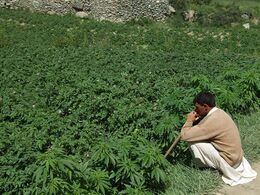 A man beside a cannabis field (RSC listing)
 -
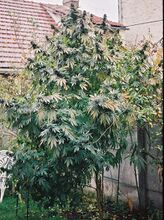 Chitrali outdoors in Europe in 2008, collected by Mriko (RSC listing caption, 2019)
 -
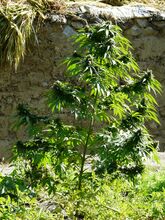 Chitrali plant in front of a stone wall (RSC listing)
 -
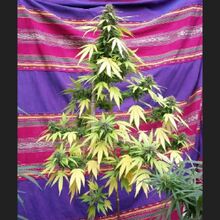 Chitrali plant with yellowing leaves (RSC listing)
 -
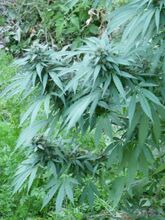 Chitrali plant with forming flowers (RSC listing)
 -
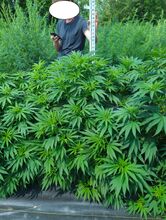 Chitrali plants in a field, beside a measuring pole (RSC listing)
 -
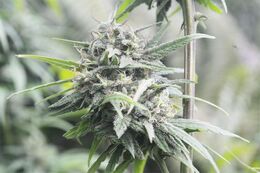 Resinous Chitrali flower (RSC listing)


See Also
References
- ↑ 1.00 1.01 1.02 1.03 1.04 1.05 1.06 1.07 1.08 1.09 1.10 1.11 1.12 1.13 1.14 1.15 1.16 "Chitrali". The Real Seed Company. Retrieved 16 September 2026.
- ↑ "Hemp & Multipurpose". The Real Seed Company. Retrieved 16 September 2026.
- ↑ 3.0 3.1 3.2 "Chitrali". Kwik Seeds. Retrieved 16 September 2026.
- ↑ 4.0 4.1 "Chitrali". The Real Seed Company. Archived from the original on 3 October 2022. Retrieved 16 September 2026.
- ↑ "Chitrali". The Real Seed Company. Archived from the original on 25 May 2024. Retrieved 16 September 2026.
- ↑ "Chitrali". The Real Seed Company. Archived from the original on 9 February 2026. Retrieved 16 September 2026.