Anon. 6033 (1920)
More actions
| Herbarium specimen 6033, Shantung (1920) | |
|---|---|
| Anon. 6033 (1920) | |
| At a Glance | |
| Classification | Other |
| Location | |
| Country | China |
| Province/State | Shandong |
| Collection | |
| Method | Herbarium specimen |
| Sourcing Type | Historical |
| Date | 18 June 1920 |
| Specimen | |
| Repository | Tianjin Natural History Museum |
| Catalogue Number | TIE 00004154 |
| Collector Number | 6033 |
| Scientific Name | Cannabis sativa L. |
| Occurrence Record | View occurrence record |
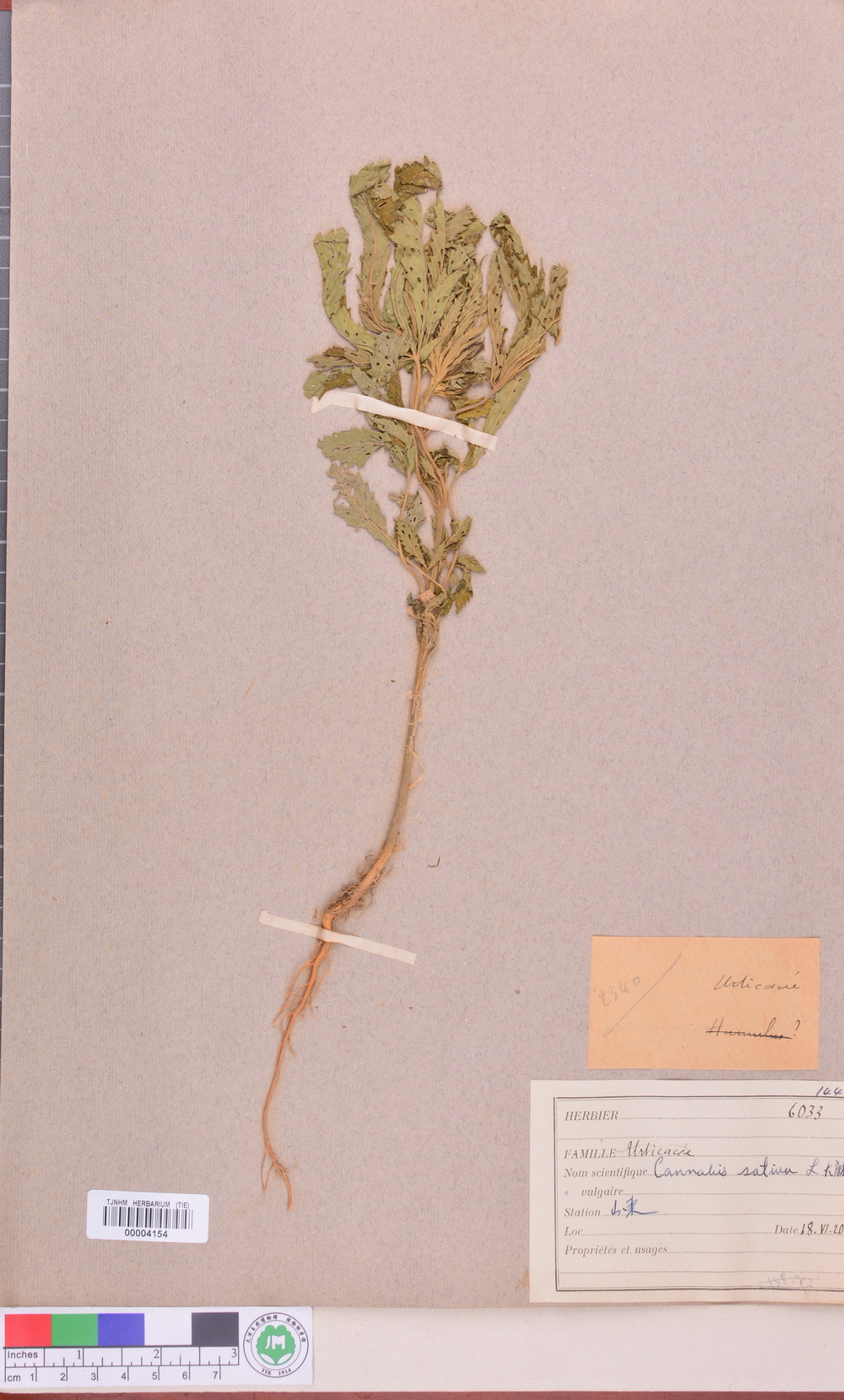
Anon. 6033 is a herbarium accession of Cannabis sativa collected in Shandong (then Shantung), China, on 18 June 1920, with no collector named. The Tianjin Natural History Museum holds the sheet as TIE 00004154[1].
Collection and locality
The sheet carries a printed French form headed Herbier, with lines for the family, the scientific and common names, the station, the locality, the date and the plant's properties and uses, completed by hand: the number 6033, the family Urticacée, the name Cannabis sativa L. and 大麻, the station 山東 (Shantung) and the date 18.VI.20 (18 June 1920), which runs to the edge of the image. A pencilled slip names the family Urticacée and, struck out with a query, Humulus (hop).[2] The catalogue gives the year 1920 and Shandong, with no collector.[1]
Specimen and identification
The sheet carries a young plant with its root and leaves of narrow, serrate leaflets in palmate clusters, many of them holed by insects. The form names it Cannabis sativa L., with no determiner.[2] The Chinese Virtual Herbarium publishes its sheet images under a non-commercial, no-derivatives licence (CC BY-NC-ND 4.0); they are read and cited here, not reproduced.
- ↑ 1.0 1.1 "Specimen TIE 00004154: Cannabis sativa". Chinese Virtual Herbarium. Institute of Botany, Chinese Academy of Sciences. Retrieved 14 October 2026.
- ↑ 2.0 2.1 "Digitised sheet TIE 00004154: Cannabis sativa". Chinese Virtual Herbarium image service. Institute of Botany, Chinese Academy of Sciences. Retrieved 14 October 2026.