
Portal:Botany: Difference between revisions
More actions
Eloise Zomia (talk | contribs) No edit summary |
Eloise Zomia (talk | contribs) No edit summary |
||
| Line 1: | Line 1: | ||
__NOTOC__ | |||
<templatestyles src="Template:LWPortal/styles.css" /> | <templatestyles src="Template:LWPortal/styles.css" /> | ||
<div class="lw-portal"> | <div class="lw-portal"> | ||
Revision as of 17:43, 20 January 2026
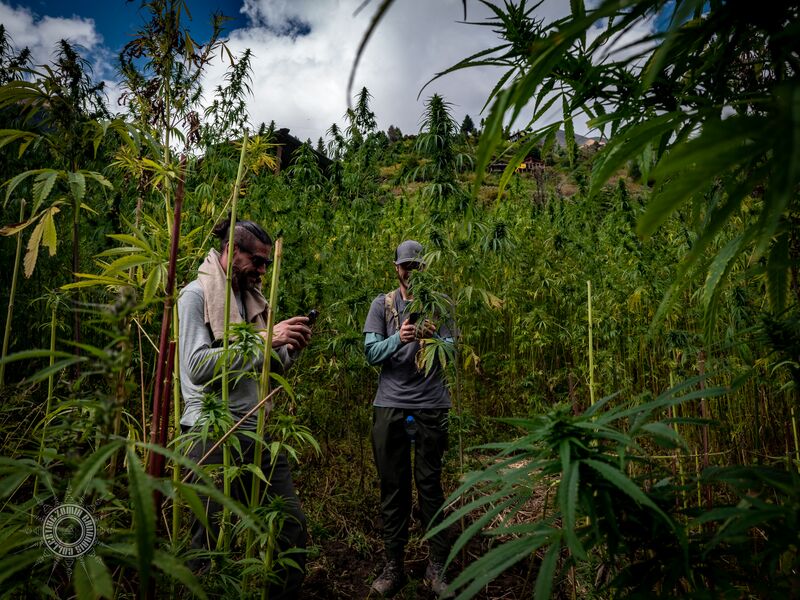
Cannabis botany examines the plant biology of Cannabis sativa L., covering morphology, physiology, reproductive biology, chemical ecology, and environmental adaptation. As one of humanity's oldest cultivated plants, cannabis exhibits remarkable diversity in growth patterns, chemical profiles, and ecological adaptations across traditional growing regions.
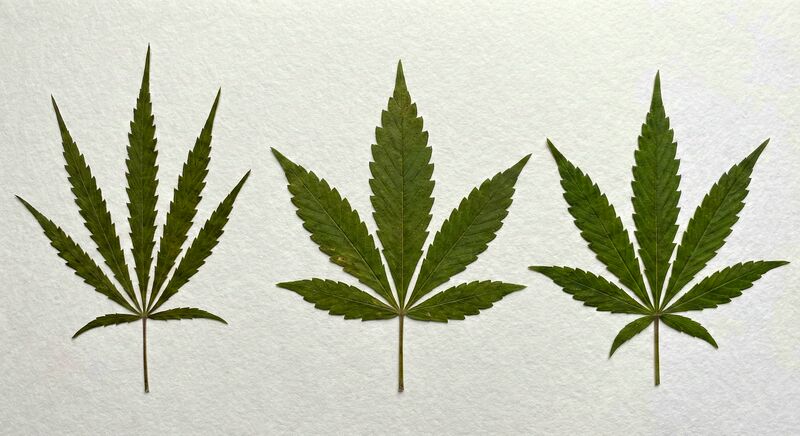
Cannabis is a dioecious annual herb in the family Cannabaceae, characterized by palmate leaves with serrated leaflets, pistillate and staminate flowers on separate plants, and dense resinous trichomes producing cannabinoids and terpenes. The species shows extraordinary morphological variation—from compact highland varieties adapted to short growing seasons to tall tropical cultivars flowering under equatorial photoperiods. Understanding this botanical diversity is essential for conservation, as traditional landrace populations face threats from enforcement, hybridization, and climate change.
Key botanical themes include: photoperiod response and flowering triggers, trichome development and cannabinoid biosynthesis, root architecture and nutrient uptake, pollination ecology and seed development, and phenotypic plasticity across environments. Modern cannabis botany integrates classical morphological description with molecular genetics, phytochemistry, and population biology to document and preserve genetic diversity.
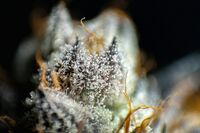
Glandular trichomes are the primary site of cannabinoid and terpene biosynthesis in cannabis. These specialized epidermal structures occur in three main types: bulbous trichomes (10-15 μm), capitate-sessile trichomes (25-30 μm), and capitate-stalked trichomes (50-500 μm). The largest capitate-stalked trichomes feature a multicellular stalk topped by a secretory head composed of disc cells that synthesize and accumulate cannabinoids, terpenes, and flavonoids in a subcuticular storage cavity.
Trichome density varies dramatically between landrace populations, correlating with environmental pressures such as UV radiation, herbivory, and water stress. Highland varieties from regions like the Hindu Kush often display exceptionally dense trichome coverage, while lowland tropical varieties may show sparser but larger trichomes. The chemical profile of trichome secretions also varies regionally—some populations produce predominantly THC, others CBD, while many landrace varieties maintain balanced cannabinoid ratios reflecting their traditional uses. (Full article...)
- ...that cannabis plants can produce over 200 different terpene compounds, creating distinct regional "chemotypes" that traditional farmers recognize by scent?
- ...that some highland landrace varieties complete their entire lifecycle in as little as 75 days, while tropical sativas may require 20+ weeks of flowering?
- ...that cannabis seeds can remain viable in soil seed banks for over a decade, allowing population recovery after disturbance?
- ...that traditional fiber landraces can reach heights exceeding 5 meters with minimal branching, while drug cultivars remain compact and highly branched?
- ...that wild cannabis populations in Central Asia show greater genetic diversity than all cultivated varieties combined?
- ...that the number of leaflet fingers (typically 5-9) varies between regional populations and correlates with latitude?
Morphology & Structure
- Plant architecture · Leaf morphology · Inflorescence structure · Root systems · Stem anatomy · Trichome types · Sexual dimorphism
Reproductive Biology
- Photoperiod response · Flowering triggers · Pollination ecology · Seed development · Dioecious reproduction · Hermaphroditism · Pollen dispersal
Phytochemistry
- Cannabinoid biosynthesis · Terpene production · Flavonoids · Chemotypes · THC vs CBD pathways · Essential oils · Secondary metabolites
Growth & Development
- Germination · Vegetative growth · Floral initiation · Senescence · Life cycle · Phenology · Developmental stages
Environmental Adaptation
- Climate adaptation · Photoperiod sensitivity · Altitude responses · Drought tolerance · Cold hardiness · Soil preferences · Nutrient uptake
Regional Diversity
- Tropical cultivars · Temperate varieties · Highland adaptations · Fiber types · Drug types · Wild populations · Feral cannabis
Research Methods
- Document morphology: Add detailed plant descriptions with measurements
- Upload field photos: Share diagnostic images showing leaves, flowers, stems
- Record phenology: Document flowering times and seasonal patterns
- Describe chemotypes: Add terpene profiles and cannabinoid ratios
- Map distributions: Record geographic ranges of landrace varieties
- Expand stubs: Leaf serration, Pistillate flowers, Pollen viability
- Create missing pages: Trichome density, Photoperiod ecotypes, Seed morphology